
Travel & Leisure Co.: Operational Strength, Capital Management, and the Realities of Travel Sector Volatility
The analysis explores how its business model, competitive position, and capital allocation shape both opportunity and vulnerability in a cyclical industry.
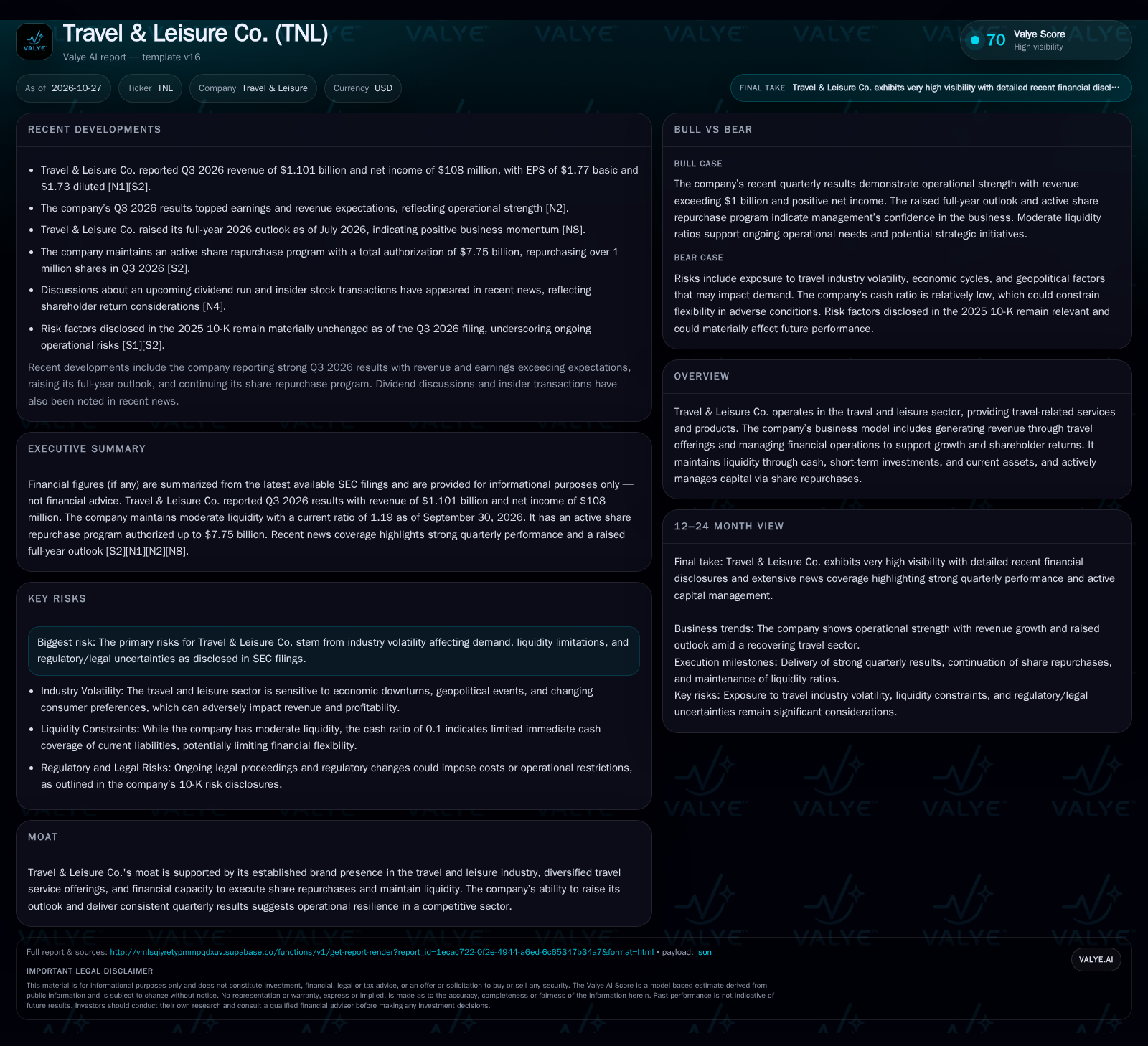
Travel & Leisure Co. delivered robust Q3 2026 results, raising its full-year outlook and continuing aggressive share repurchases.
Travel & Leisure Co. has demonstrated notable operational strength in Q3 2026, with revenue and net income surpassing expectations and prompting a raised outlook for the full year. This performance is paired with an aggressive capital return strategy, including significant share repurchases. The interplay between operational execution, capital management, and sector cyclicality will be decisive in shaping the company’s performance trajectory over the next several quarters.
Recent Results Showcase Growth, But Liquidity and Risk Remain in Focus
Travel & Leisure Co. reported Q3 2026 revenue of $1.101 billion and net income of $108 million, exceeding analyst expectations for the period [S2] [N1] [N2]. The company raised its full-year 2026 outlook in July, citing positive business momentum [N8]. In addition, it continued active share repurchases, with over 1 million shares bought back in Q3 and a total authorization of $7.75 billion [S2].
The company reported cash and liquidity metrics for the period; these figures do not by themselves establish operating runway, investment capacity, financial flexibility, or financing capacity. [S2] Risk factors disclosed in the 2025 10-K remain unchanged, indicating persistent exposure to sector volatility, liquidity constraints, and regulatory/legal risks [S1] [S2].
These facts matter because they frame a business with demonstrated near-term execution and shareholder returns, but with balance sheet limitations that could become more acute if travel demand or macro conditions deteriorate.
Revenue Streams, Cost Structure, and the Role of Capital Allocation
Travel & Leisure Co. generates revenue primarily through travel services and related products. Although the report does not specify the exact mix—such as timeshare sales, vacation club memberships, or travel bookings—the sector typically features a blend of upfront product sales and recurring service fees, with some exposure to cyclical consumer spending and seasonality.
Pricing power in this sector is generally limited by competition and consumer price sensitivity, but can be enhanced by brand strength and differentiated offerings. Volume is driven by both macroeconomic conditions and travel demand trends. Mix may shift seasonally or in response to changes in consumer preferences, such as international vs. domestic travel or premium vs. value offerings.
Operating leverage is a key factor: many costs are semi-fixed, so incremental revenue growth can drive disproportionate improvement in margins during periods of rising demand. Conversely, a downturn can quickly erode profitability if fixed costs remain high. Capital allocation is central to the company’s economics; the large share repurchase authorization suggests a prioritization of shareholder returns, but also requires ongoing cash generation or access to financing.
Capital needs are closely tied to both the maintenance and expansion of the company’s asset base—whether that involves resort properties, technology platforms, or service delivery infrastructure. If the business model relies on advance bookings or membership prepayments, working capital management becomes even more critical during downturns.
Brand, Diversification, and the Challenge of Differentiation in Travel
Travel & Leisure Co. operates in a highly competitive sector, facing rivals across hospitality, vacation ownership, online travel agencies, and alternative accommodations. Its established brand and diversified service portfolio provide some insulation, allowing the company to attract a broad customer base and potentially cross-sell across travel products.
However, barriers to switching are generally low in travel, with consumers able to compare prices and offerings across platforms. Technology-driven entrants and large-scale players can pressure margins and limit pricing power. The company’s ability to differentiate may rest on unique experiences, loyalty programs, or bundled services that encourage repeat business.
Financial firepower, evidenced by the large share repurchase program, can be an advantage in weathering downturns or investing in growth, but only as long as cash flows remain robust. If liquidity tightens, the company may be forced to scale back on shareholder returns, capital expenditures, or marketing—potentially eroding its competitive position.
Leveraging Operational Momentum and Capital Returns for Outperformance
In a favorable scenario, macroeconomic tailwinds and sustained travel demand drive continued revenue growth, allowing Travel & Leisure Co. to leverage its semi-fixed cost base and expand margins. The company’s raised full-year outlook and Q3 outperformance suggest that such momentum is possible if travel trends remain supportive [N2] [N8].
Aggressive share repurchases could amplify earnings per share, and the company’s diversified offerings might help capture incremental market share from weaker competitors. If management can balance capital returns with sufficient reinvestment in technology, customer acquisition, and new services, the business could generate both strong cash flow and durable brand equity.
Evidence that would confirm this scenario includes continued quarterly revenue and earnings beats, further increases in full-year guidance, and stable or improving liquidity metrics even as repurchases persist.
Sustained Performance Amid Cyclical Swings and Disciplined Capital Use
The most plausible path is that Travel & Leisure Co. maintains steady performance, with revenue growth moderating as the post-pandemic travel surge normalizes. Margins remain healthy but do not expand dramatically, reflecting ongoing competitive pressure and the need to invest in customer retention and product innovation.
Share repurchases continue at a measured pace, but are periodically adjusted based on cash flow and liquidity considerations. The company manages to avoid major operational disruptions despite sector volatility, in part due to its brand strength and diversified service base.
Negative signals would include a sudden reduction in repurchase activity, downward revisions to guidance, or evidence of deteriorating liquidity.
Liquidity Constraints and Sector Shocks Could Derail Execution
In an adverse scenario, a macroeconomic downturn or geopolitical shock triggers a sharp decline in travel demand, exposing the company’s fixed cost structure and compressing margins.
In this environment, competitors with stronger balance sheets or lower cost structures could gain share, further pressuring results.
Confirmation of this scenario would include missed revenue/earnings expectations, suspension or reduction of capital return programs, negative revisions to guidance, and any regulatory or legal setbacks that further constrain financial capacity.
Testing the Resilience of Travel & Leisure Co.’s Business Model
Quarterly revenue and net income trends: Sustained outperformance or a reversal would be the clearest signals of operating momentum or vulnerability [S2] [N1] [N2].
Pace and scale of share repurchases: Any slowdown, suspension, or acceleration in buybacks would reveal management’s view on cash flow visibility and market valuation [S2].
Full-year outlook revisions: Upward or downward guidance changes would provide a real-time read on demand and operational confidence [N8].
Risk disclosures: New or updated risk factors in SEC filings could highlight emerging threats or management concerns [S1] [S2].
Competitive positioning updates: Commentary or disclosures regarding customer acquisition, retention, or new product launches would help clarify the company’s ability to defend and grow its market share.
Macro and sector-specific shocks: External events—such as economic slowdowns, travel restrictions, or regulatory changes—would rapidly test the company’s resilience and flexibility.
Monitoring changes in working capital components would provide additional insight into operational efficiency and cash flow quality. For example, trends in accounts receivable and payable turnover could reveal shifts in customer payment behavior or supplier terms, which affect liquidity. Additionally, observing capital expenditure patterns relative to depreciation and amortization would help assess whether the company is maintaining or expanding its asset base. Such metrics, if disclosed, would complement traditional financial ratios and offer a more granular view of the company’s financial health and strategic priorities.
Disclaimer: This is research-only, informational analysis and not investment advice. It may include AI-generated interpretation and general industry context. Always verify important details using primary sources.

Comments