
Mercalot Inc.: Platform Ambitions Meet Acute Liquidity and Execution Pressures in Early-Stage Marketplace Launch
Mercalot Inc. aims to establish a secure, multi-category online marketplace with initial traction in Spain and aspirations for broader European expansion.
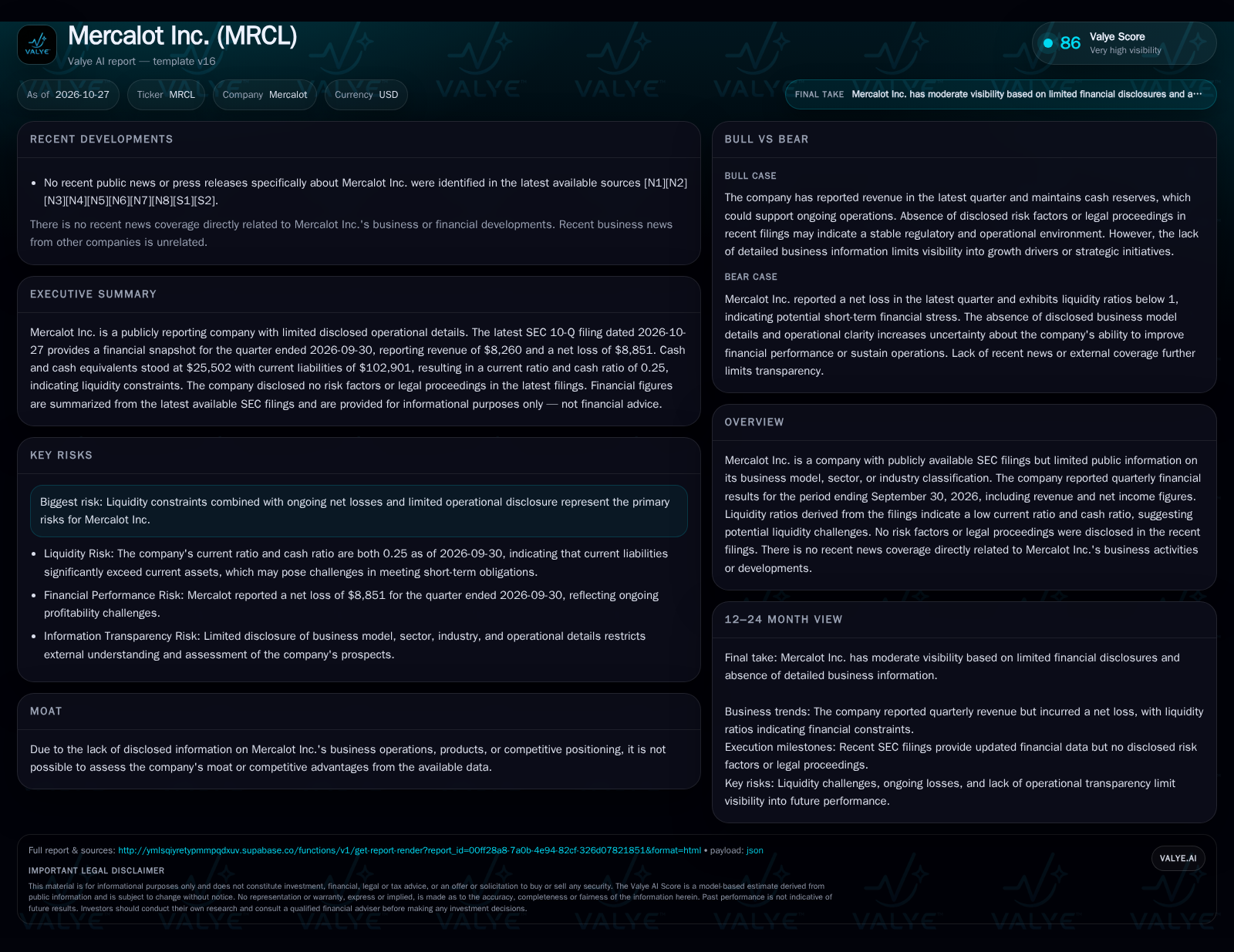
Mercalot Inc. has launched its SafeDeal Connect online marketplace app targeting the Spanish market, but faces acute liquidity pressures, ongoing net losses, and lacks operational scale. The company’s ability to implement its business plan and achieve meaningful platform adoption will likely hinge on raising additional capital and demonstrating user growth and engagement in a highly competitive sector. [S2]
Mercalot Inc. is attempting to carve out a niche in the crowded online marketplace sector through its SafeDeal Connect platform, emphasizing secure and convenient transactions for both goods and services. The company’s future now hinges on its ability to raise capital and demonstrate meaningful user adoption—both of which remain highly uncertain given its current scale and financial structure. [S2]
Mercalot’s Financial Snapshot Highlights Severe Liquidity Strain and Minimal Scale
For the quarter ended September 30, 2026, Mercalot reported revenue of $8,260 and a net loss of $8,851, continuing to operate at a deficit. Cash and cash equivalents were $25,502, while current liabilities stood at $102,901, resulting in a current and cash ratio of 0.25. These metrics underscore a working capital deficit and acute liquidity stress, with management itself citing substantial doubt about the company’s ability to continue as a going concern. Mercalot has no employees beyond its two officers, and there are no disclosed risk factors or ongoing legal proceedings. [S2]
Marketplace Model Ambitions Versus Early-Stage Revenue Realities
Mercalot’s stated business is an online marketplace and classifieds platform—SafeDeal Connect—designed to facilitate secure transactions for goods and services. Marketplace platforms typically generate revenue through transaction fees, listing charges, premium features, or advertising. However, with $8,260 in quarterly revenue and persistent net losses, it is unclear whether Mercalot is charging for listings, taking a commission, or monetizing through ancillary services. The company’s cost structure is likely dominated by platform development, regulatory compliance, and minimal fixed overhead, given its lack of employees.
Operating leverage in digital marketplaces can be substantial if user adoption scales, as incremental users and transactions drive revenue with relatively modest marginal costs. However, without evidence of significant user traction or a differentiated monetization model, Mercalot’s path to break-even remains speculative. Capital needs are acute: management explicitly anticipates the need for additional funding to sustain operations and execute on its growth ambitions. [S2]
In addition to the typical revenue streams of transaction fees and premium listings, the scalability of Mercalot’s platform economics critically depends on the network effect dynamics and the platform’s ability to reduce friction in user transactions. If SafeDeal Connect can successfully lower the cost and perceived risk of transactions through enhanced security features or dispute resolution mechanisms, it may justify premium pricing or higher take rates. However, this assumes sufficient user trust and volume to offset the incremental costs associated with these features. Moreover, the platform’s monetization strategy must balance revenue generation with user retention, as overly aggressive fees could inhibit adoption in a market where free or low-cost alternatives exist.
Furthermore, the platform’s cost structure in early-stage development is likely front-loaded, with significant investments in technology infrastructure, compliance, and initial marketing. Given the minimal employee base, outsourcing or reliance on third-party providers might reduce fixed costs but could also limit responsiveness and iterative product improvements. The absence of scale economies at this stage means that operational leverage will remain limited until a critical mass of users and transactions is achieved. This creates a capital-intensive environment where incremental revenue growth may not translate into improved profitability until substantial scale is reached.
Facing Entrenched Rivals and High User Switching Barriers in Marketplace Expansion
Mercalot is entering a hyper-competitive sector dominated by established horizontal marketplaces (such as Wallapop in Spain, OLX, and category-specific platforms like Milanuncios and Idealista). These incumbents benefit from network effects, brand recognition, and entrenched user bases, making it difficult for new entrants to gain traction unless offering a distinctly superior or differentiated value proposition.
SafeDeal Connect’s emphasis on transaction security and convenience could appeal to risk-averse users, but unless these features represent a step-change improvement over incumbent platforms, switching costs for buyers and sellers are likely to remain high. Without evidence of a unique technology, exclusive inventory, or viral user acquisition mechanics, Mercalot’s competitive position appears precarious. The absence of employees also limits its capacity to market, support, and iterate its product at the pace required to outflank established competitors. [S2]
The competitive landscape’s entrenched nature means Mercalot must not only differentiate its value proposition but also overcome significant user inertia. Buyer and seller behaviors in online marketplaces are often sticky due to established trust networks, familiarity, and the convenience of existing platforms. Even if SafeDeal Connect offers superior security features, the platform must demonstrate tangible benefits that outweigh the switching costs, such as better pricing, faster transactions, or exclusive inventory. Without these, user acquisition costs may escalate sharply, eroding margins and extending the timeline to profitability.
Additionally, the lack of a dedicated operational team constrains Mercalot’s ability to execute rapid product iterations, customer support, and tailored marketing strategies essential for marketplace growth. In highly competitive sectors, agile response to user feedback and market trends is critical to maintaining relevance and driving engagement. The absence of such capabilities may limit Mercalot’s ability to build the network effects necessary for platform success, potentially relegating it to a niche role or forcing reliance on strategic partnerships to compensate for operational deficits.
If User Growth Accelerates and Funding Materializes, Platform Economics Could Improve Rapidly
The most favorable outcome for Mercalot would be successful capital raising—either through a public or private offering—which enables investment in user acquisition, product development, and geographic expansion. If the company can attract a critical mass of buyers and sellers, the platform could benefit from network effects, driving up transaction volumes and enabling monetization through fees, premium services, or advertising.
Evidence that would confirm this scenario includes: a substantial increase in registered users and active listings, sequential revenue growth outpacing cost expansion, and successful closure of a funding round that relieves immediate liquidity pressure. Partnerships or marketing campaigns that visibly increase platform awareness in Spain or the broader European market would also be supportive. Conversely, failure to demonstrate user or transaction growth despite additional investment would falsify this scenario.
Likely Outcome: Ongoing Struggle for Traction Amid Capital Constraints and Intense Competition
Given the acute liquidity shortfall, minimal operational base, and lack of clear differentiation, the most plausible outcome is continued difficulty in scaling the platform or achieving meaningful user engagement. Mercalot may secure a modest funding round, but this is likely to be highly dilutive and may only provide short-term runway. Revenue may grow incrementally, but losses and working capital deficits could persist absent a breakthrough in user growth or monetization.
Confirming evidence would include stagnant or only modestly improving revenue, continued high net losses, and ongoing disclosures of uncertainty regarding going concern status. Any failure to secure new capital, combined with a lack of external validation (such as press coverage, user testimonials, or third-party partnerships), would further entrench the company in this scenario.
Failure to Raise Capital Could Force Shutdown or Asset Sale
If Mercalot is unable to secure additional funding, its acute working capital deficit and liquidity ratios point to a high risk of insolvency or forced wind-down. In this scenario, the company may be compelled to sell its SafeDeal Connect app or other assets to satisfy creditors, or to cease operations altogether. Users and partners could lose confidence in the platform if operational continuity is threatened, further accelerating decline.
Evidence confirming this scenario would include explicit going concern warnings escalating in filings, announcements of failed funding efforts, or disclosures of asset sales, layoffs, or business suspension. Alternatively, any material legal or regulatory challenge—currently absent—could further exacerbate the downside.
Milestones That Will Determine Mercalot’s Viability as an Emerging Marketplace
User acquisition and engagement rates: A useful metric would be the number of registered users, active listings, and transaction volumes on SafeDeal Connect, if disclosed.
Capital raising events: Announcements of successful public or private offerings, or other significant financing rounds, would be critical to extending runway.
Revenue growth relative to costs: Sequential changes in revenue and net income margins will indicate whether the platform is gaining operational leverage.
Product development progress: Updates on new feature rollouts, app improvements, or expansion into new service categories would signal execution capacity.
Market expansion: Evidence of geographic expansion beyond Spain into other European markets, such as localized app launches or new marketing campaigns.
Competitive responses: Any counter-moves by incumbent platforms (e.g., matching security features, pricing changes) could impact Mercalot’s ability to differentiate.
Changes in management or operational scale: Disclosure of new hires, partnerships, or board appointments would indicate increased organizational commitment.
Going concern language: Any escalation or resolution of going concern warnings in SEC filings will provide direct insight into financial health.
Disclaimer: This is research-only, informational analysis and not investment advice. It may include AI-generated interpretation and general industry context. Always verify important details using primary sources.

Comments