
Simply Good Foods: Brand Strength Meets Margin Pressure in a Shifting Snack Landscape
Despite a robust brand portfolio and alignment with health-driven snacking trends, Simply Good Foods is contending with declining sales and profitability headwinds. The company's ability to convert consumer loyalty and product innovation into renewed growth and margin expansion is now under scrutiny.
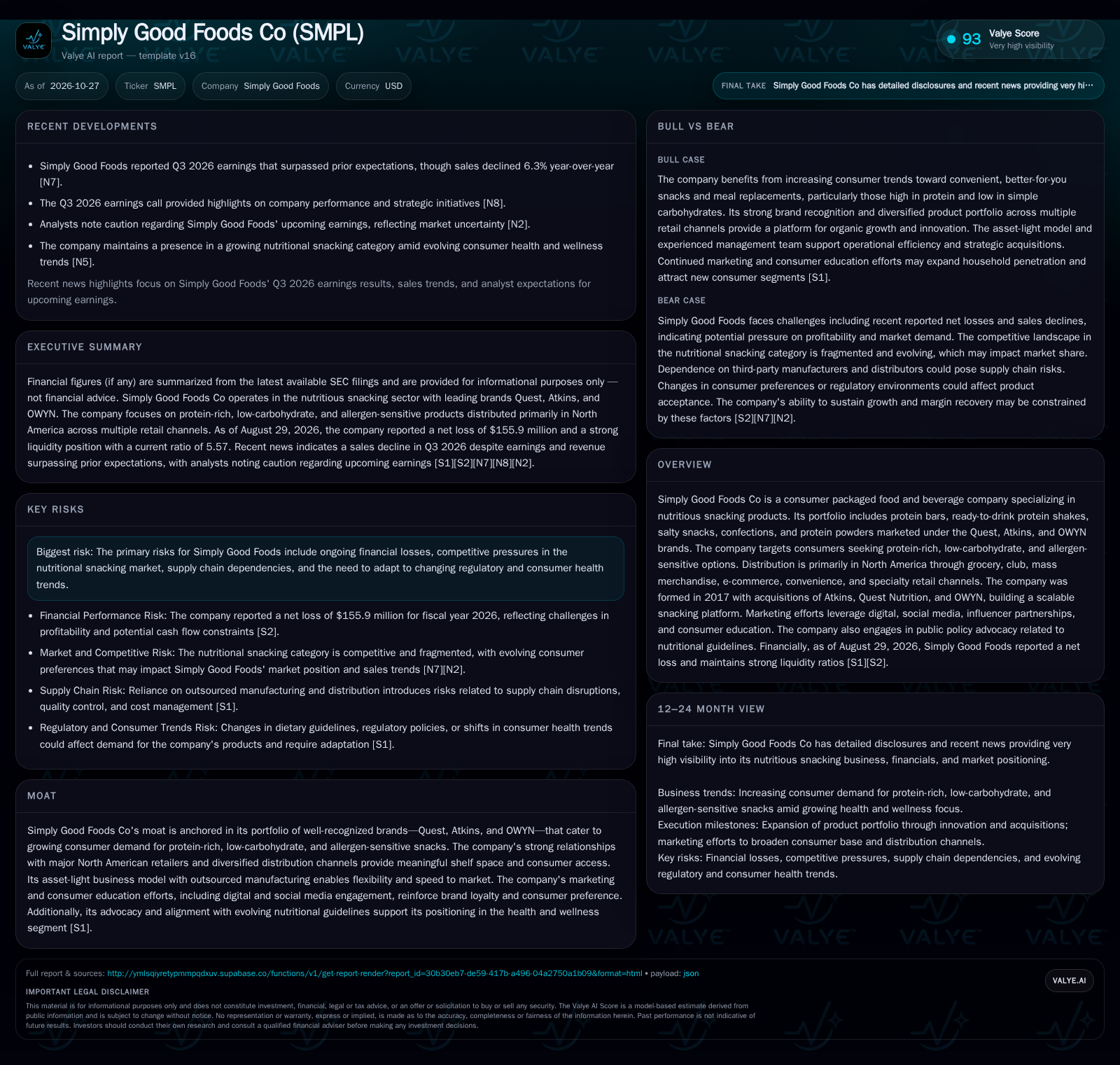
Simply Good Foods, owner of Quest, Atkins, and OWYN, reported a Q3 2026 sales decline of 6.3% year-over-year despite beating earnings expectations, and posted a $155.9 million net loss for fiscal 2026. Analysts remain cautious about near-term earnings momentum. [S1] [S2] [N7] [N8] [N2]
Simply Good Foods faces a pivotal moment: its established brands and alignment with health-conscious snacking trends have historically driven growth, but the recent combination of a significant net loss and a 6.3% year-over-year sales decline in Q3 2026 signals mounting challenges. While the company’s cash and current ratio metrics are strong, analysts and investors are increasingly focused on whether Simply Good Foods can regain momentum through innovation, marketing, and operational discipline—or if competitive and consumer headwinds will continue to erode its profitability and category leadership. The next several quarters will likely reveal whether Simply Good Foods can pivot from defensive posturing to renewed growth.
Recent Financial Results Highlight Demand and Margin Challenges
Simply Good Foods reported a 6.3% year-over-year sales decline in Q3 2026, despite surpassing earnings and revenue estimates for the quarter. This suggests that while the company outperformed consensus expectations, the underlying revenue contraction points to softening demand or increased competitive pressures. For the full fiscal year 2026, the company posted a net loss of $155.9 million, with both basic and diluted EPS at -$1.69. As of August 29, 2026, the company reported $138.4 million in cash and equivalents and a current ratio of 5.57, indicating a reported balance sheet position position on these metrics. However, profitability concerns now dominate the narrative. Analyst commentary preceding the latest report was cautious, anticipating further earnings declines—a sentiment that underscores persistent market skepticism about near-term recovery. [S2] [N2] [N7] [N8]
Revenue Streams and Operating Leverage in a Fragmented Market
Simply Good Foods generates revenue through the sale of branded protein bars, shakes, salty snacks, confections, and protein powders, targeting consumers seeking protein-rich, low-carbohydrate, and allergen-sensitive options. Its primary distribution channels include North American grocery, club, mass merchandise, e-commerce, convenience, and specialty retail. The company’s asset-light model—with outsourced manufacturing—limits fixed capital requirements and can support higher returns on invested capital if volume growth and pricing power are sustained.
Profitability is influenced by a mix of factors: product mix (higher-margin developed brands vs. challenger SKUs), channel mix (club and e-commerce can yield better margins but may face greater price transparency), and promotional intensity (which can erode gross margin to defend shelf space or drive trial). Operating leverage is present, but recent sales declines suggest the company may now be experiencing negative leverage, with fixed costs less easily absorbed. The company reported cash and liquidity metrics for the period; these figures do not by themselves establish operating runway, investment capacity, financial flexibility, or financing capacity.
Brand Equity and Distribution Depth—But Evolving Threats Loom
Simply Good Foods’ competitive advantage has traditionally stemmed from its portfolio of well-recognized brands—Quest, Atkins, and more recently OWYN—which are closely associated with the protein-rich, low-carb, and allergen-sensitive snacking trends. The company’s strong relationships with major retailers ensure broad shelf presence and access to large consumer segments. Its asset-light model allows for agility, but also exposes it to potential supply chain and quality-control risks.
The nutritional snacking sector is highly fragmented and evolving, with both legacy food conglomerates and newer direct-to-consumer upstarts aggressively targeting the same health-conscious demographics. Private-label expansion, increased innovation from competitors, and price-based promotions could erode Simply Good Foods’ share and margin. Additionally, consumer trends are shifting rapidly: while protein-rich and low-carb snacks remain popular, demand can pivot toward alternative nutritional philosophies (e.g., plant-based, functional foods, or lower-sugar formats) where the company may have less entrenched positioning. The ability to innovate meaningfully and communicate differentiated value—supported by marketing, influencer partnerships, and scientific advocacy—remains critical for defending share.
How Brand-Led Innovation and Channel Expansion Could Reignite Growth
A favorable outcome would see Simply Good Foods leveraging its strong brands to successfully launch new products that resonate with evolving consumer preferences—such as clean-label, plant-based, or functional snacking options—while maintaining its core positioning in protein-rich and low-carb categories. Expanded distribution into new retail channels (e.g., foodservice, international, or emerging online platforms) could offset domestic retail softness. Cost discipline and supply chain optimization could restore operating leverage, especially if input costs stabilize or promotional spending moderates.
This scenario would be confirmed by a return to revenue growth, visible margin improvement, and positive earnings surprises in subsequent quarters. Evidence would include new product launches gaining shelf traction, increased distribution footprints, and management commentary highlighting improved promotional efficiency or supply chain resilience. A reversal of the recent net loss trend and stabilization—or growth—in the core Atkins, Quest, and OWYN brands would validate the company’s ability to adapt and lead.
Stabilization Amid Ongoing Margin Pressure and Incremental Change
The most plausible near-term outcome is that Simply Good Foods stabilizes sales through incremental product innovation and targeted marketing, but continues to face margin pressure from competitive promotions and input cost volatility. Revenue may remain flat to modestly down, with gross margin recovery lagging as the company balances the need to defend shelf space and maintain consumer engagement. SG&A discipline may offset some pressure, but persistent losses could limit the scope for large-scale innovation or acquisitive growth.
Confirmation of this scenario would include muted sales growth (flat to low single-digit declines), ongoing but narrowing net losses, and management messaging focused on cost containment and selective innovation. If disclosed, gross margin trends, promotional spend as a percentage of sales, and channel mix data would further illuminate the company’s ability to defend profitability without sacrificing brand equity.
Sustained Category Headwinds and Erosion of Brand Advantage
A more adverse outcome involves Simply Good Foods suffering continued sales declines as consumer preferences shift away from its legacy value propositions or as competitive intensity from both established and emerging brands accelerates. If price-based promotions escalate, the company may be forced to sacrifice margin to retain shelf space, worsening net losses and eroding its ability to invest in brand support or innovation. Supply chain disruptions or quality incidents—risks inherent in an outsourced manufacturing model—could further damage brand equity and retailer relationships.
This scenario would be confirmed by consecutive quarters of accelerating sales declines, persistent or deepening net losses, negative gross margin trends, and market share losses reported by industry trackers. Management could signal retrenchment by reducing marketing spend, delaying innovation, or guiding for reduced revenue visibility.
Factors That Will Shape Simply Good Foods’ Recovery or Further Pressure
Quarterly revenue growth rates—especially whether the company can reverse the recent 6.3% year-over-year sales decline or if declines accelerate. [N7]
Gross margin and SG&A trends, if disclosed, to assess whether profitability is stabilizing or further eroding.
Performance of new product launches and innovation pipeline—traction in shelf space, consumer adoption, and repeat purchase rates would provide insight into brand vitality.
Promotional spending as a percentage of sales, if disclosed, as a proxy for competitive intensity and margin pressure.
Market share shifts within the nutritional snacking segment, particularly in core North American retail channels.
Updates on supply chain resilience and quality control, especially given the asset-light, outsourced manufacturing model.
Liquidity and cash flow trends—while current ratios are strong, persistent net losses could eventually strain the company’s ability to invest or weather shocks.
Disclaimer: This is research-only, informational analysis and not investment advice. It may include AI-generated interpretation and general industry context. Always verify important details using primary sources.

Comments