
Wave Life Sciences: Advancing RNA Therapeutics with reported cash balance, Clinical Milestones, and Sector Headwinds
Wave Life Sciences progresses its RNA editing platform with FDA support for its lead AATD therapy and a well-capitalized balance sheet, but faces the perennial clinical, regulatory, and competitive risks of the biotech sector.
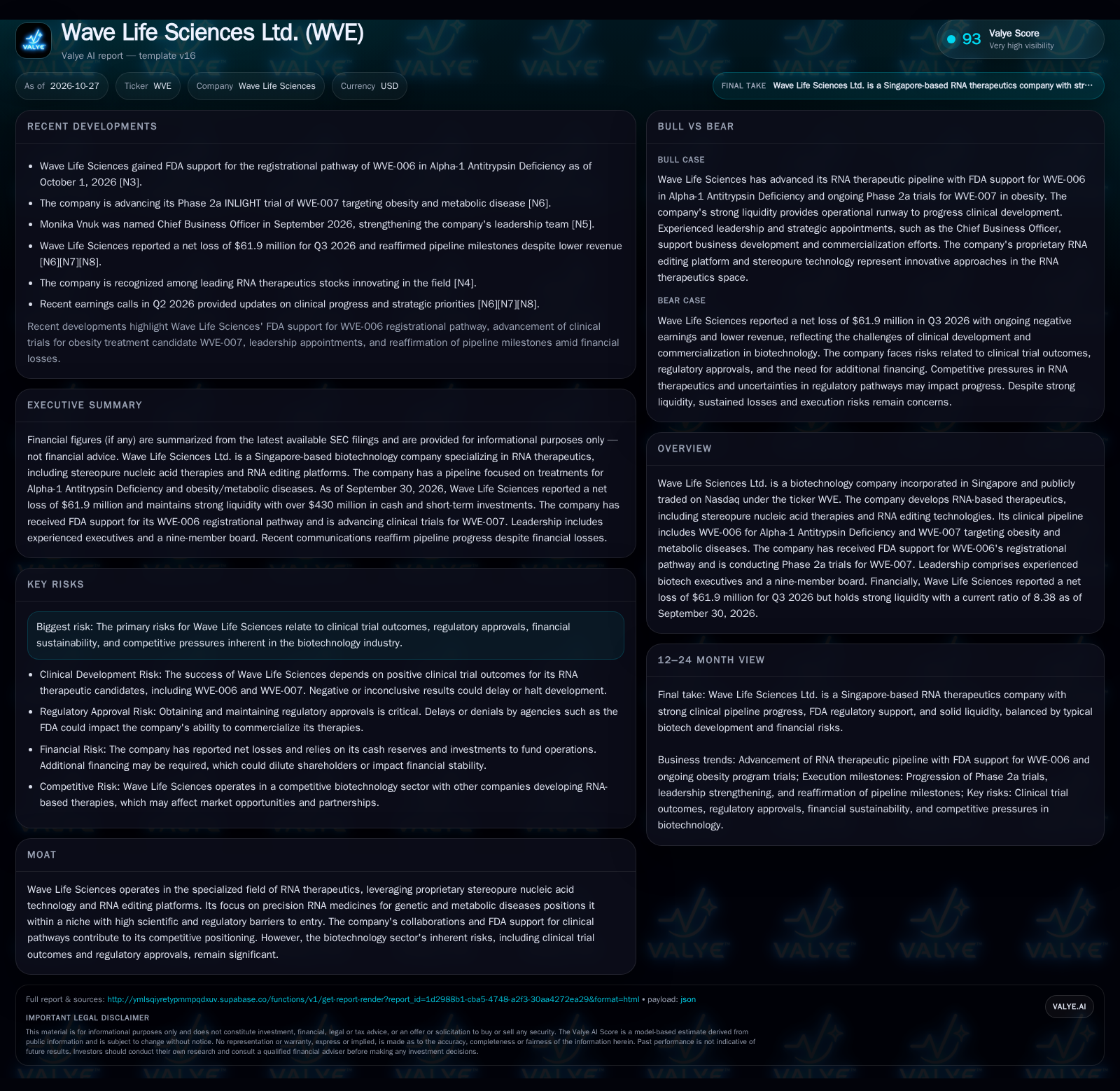
Wave Life Sciences is advancing RNA-based therapies with FDA-aligned registrational plans for its lead candidate in Alpha-1 Antitrypsin Deficiency (AATD) and ongoing clinical trials in obesity, underpinned by approximately $431 million in liquid assets. While the company’s proprietary technology and strong leadership provide a foundation for innovation, the business remains exposed to binary clinical outcomes, regulatory hurdles, and the capital-intensive nature of drug development.
The company’s focus on stereopure nucleic acid chemistry and RNA editing positions it within a scientific and regulatory niche, yet the business is still fundamentally tied to the high-risk, high-reward dynamics of clinical milestones and regulatory decisions. With a second clinical program targeting obesity and a recently strengthened management team, Wave’s next chapters will be defined by its ability to convert platform science into marketable therapies before financial runway pressures mount.
FDA Backing, Cash Reserves, and Clinical Progress Define the Current Landscape
Wave Life Sciences received FDA support for the registrational pathway of WVE-006, its lead candidate for Alpha-1 Antitrypsin Deficiency (AATD), as of October 2026. This endorsement provides credibility to the clinical development strategy and may streamline the regulatory review process for this high-need indication [N3]. Financially, the company reported a net loss of $61.9 million for Q3 2026, but holds approximately $430.7 million in combined cash and short-term investments as of September 30, 2026, with a current ratio of 8.38 and a cash ratio of 7.87, supporting operational continuity [S2]. Wave is also advancing a Phase 2a trial for WVE-007 targeting obesity and metabolic diseases, marking a diversification beyond rare genetic disorders [N6]. Leadership has been bolstered by the appointment of Monika Vnuk as Chief Business Officer in September 2026, which may enhance business development and commercial planning [N5].
The Economics of Platform-Driven Biotech: Cash Burn, Milestone Value, and Future Leverage
Wave Life Sciences operates under the classic biotech model: long periods of R&D spending and clinical validation, followed by the potential for outsized returns if therapies achieve regulatory approval and market adoption. The company reported cash and liquidity metrics for the period; these figures do not by themselves establish operating runway, investment capacity, financial flexibility, or financing capacity. [S2]
Revenue generation in this model is typically back-weighted, with near-term value creation tied to clinical and regulatory milestones that can trigger partner payments, equity appreciation, or eventual product royalties and sales. If WVE-006 achieves approval, pricing power may be significant given the lack of effective therapies for AATD, but payer negotiation, market access, and eventual generic/biosimilar competition will influence long-term economics. Fixed R&D and G&A expenses dominate until late-stage trials or commercialization, at which point operating leverage increases—though manufacturing, sales, and post-market studies introduce new cost layers. The potential for out-licensing or co-development deals could provide non-dilutive funding, but would also share future economics.
In addition to the timing and magnitude of milestone-driven revenue, a critical economic consideration is the scalability of Wave’s manufacturing processes for stereopure oligonucleotides. The ability to produce high-purity RNA therapeutics at commercial scale with consistent quality will directly impact cost of goods sold (COGS) and gross margins. If manufacturing efficiencies improve and supply chain risks are mitigated, Wave could achieve better unit economics, enhancing long-term profitability prospects. Conversely, complex synthesis and purification steps could constrain margins and require ongoing capital investment in manufacturing infrastructure or outsourcing partnerships, potentially diluting returns.
Another dimension influencing financial leverage is the potential for strategic collaborations beyond initial licensing deals. Partnerships that include co-development or co-commercialization can reduce Wave’s capital burden but necessitate profit sharing, which moderates upside capture. The terms of such deals—royalty rates, milestone structures, and territory rights—will significantly affect the net economic benefit. Moreover, the timing of partnership cash inflows relative to clinical milestones and cash burn dynamics will influence the company’s ability to self-fund future programs or necessitate equity raises, which can be dilutive and impact valuation.
Scientific Differentiation Meets a Crowded RNA Therapeutics Field
Wave’s core technological moat lies in its stereopure nucleic acid chemistry and proprietary RNA editing platform, which aim to improve specificity, efficacy, and safety over conventional oligonucleotide approaches [N4]. This could translate into better therapeutic windows or addressable indications with high unmet need. However, the RNA therapeutics space is increasingly crowded, with competitors ranging from established large-cap biotechs to well-funded startups pursuing similar modalities for both rare and common diseases. The barriers to entry are high due to scientific complexity and regulatory scrutiny, but successful differentiation depends on demonstrating superior clinical outcomes, safety, and manufacturability.
In the obesity and metabolic disease domain, the competitive landscape is especially intense, with peptide-based drugs, small molecules, and emerging RNA platforms all vying for attention. For rare diseases like AATD, the competitive set is smaller but includes companies with established regulatory and commercial expertise. The ability to secure strategic partnerships or licensing deals will depend on clinical data robustness and the perceived platform potential to be applied across multiple indications.
The competitive advantage of Wave’s stereopure platform also depends on intellectual property protection and freedom to operate within a rapidly evolving RNA therapeutics landscape. Robust patent portfolios covering chemistry, delivery mechanisms, and target indications can create barriers to entry and enhance licensing appeal. However, the emergence of alternative RNA editing technologies or delivery platforms could erode this moat if they demonstrate superior safety or efficacy profiles. Continuous innovation and patent strategy refinement will be critical to maintaining differentiation and negotiating leverage with partners and payers.
Furthermore, regulatory environment shifts can materially affect competitive positioning. Given the novelty of RNA editing therapies, regulatory agencies may evolve their requirements for clinical evidence, manufacturing standards, and post-market surveillance. Wave’s ability to anticipate, adapt to, and influence regulatory frameworks through early engagement and data generation will be pivotal. Companies that navigate these complexities efficiently can gain first-mover advantages, while those facing protracted reviews or additional data demands may see delayed market entry and increased costs, impacting competitive dynamics.
AATD Approval and Platform Validation Trigger a Step-Change in Value
If WVE-006 delivers positive late-stage clinical data and leverages its FDA-supported registrational pathway to achieve timely approval, Wave could transition from a development-stage to a commercial-stage company. This would not only unlock potential revenue from AATD but also validate the stereopure platform, increasing the probability of success for pipeline assets like WVE-007. Such a scenario could attract lucrative partnerships, non-dilutive capital, and higher investor confidence.
Confirmation of this upside would come from pivotal trial readouts demonstrating meaningful therapeutic benefit and safety, regulatory filings and approvals, and the announcement of commercial or licensing agreements. Evidence of payer coverage, initial sales traction, and subsequent pipeline advancement would further reinforce the thesis. Conversely, delays in clinical timelines, inconclusive efficacy, or adverse safety signals would falsify this scenario.
Clinical Milestones Drive Volatility While Cash Runway Buys Time
The most plausible outcome is a period of continued clinical progress interspersed with volatility around trial data and regulatory feedback. It is likely that at least one program will advance, but not without setbacks, delays, or the need for additional capital.
The base scenario would be confirmed by steady advancement of WVE-006 and WVE-007 through clinical milestones, the maintenance or expansion of the pipeline, and prudent expense management that extends the cash runway. Falsification would include negative clinical outcomes, unexpected regulatory hurdles, or rapid cash burn that accelerates the need for dilutive financing.
Clinical or Regulatory Setbacks Erode Platform Credibility and potential Financial Flexibility
The principal risk is that one or both lead programs fail to demonstrate efficacy or safety, either in pivotal trials or upon regulatory review. A negative outcome for WVE-006 would not only delay or eliminate potential revenue from AATD but could undermine confidence in the stereopure platform’s translatability to other indications. If WVE-007 were also to disappoint, Wave would be left with a depleted pipeline and limited strategic options.
This scenario would be confirmed by clinical trial discontinuations, negative regulatory decisions, or guidance indicating the need for significant additional funding in the absence of new partnerships. Share price pressure, workforce reductions, or pipeline reprioritization would also be consistent with a downside trajectory.
Milestones and Metrics That Will Signal Whether Wave’s Platform Delivers
Progression of WVE-006 through pivotal clinical trials, including the timing and content of top-line data releases.
Regulatory filings, feedback, and potential approval milestones for WVE-006 in AATD, including any updates on the FDA-aligned registrational pathway.
Clinical advancement and data readouts for WVE-007 in obesity and metabolic disease—particularly any efficacy or safety signals.
Cash burn rate and operating expense trends in quarterly filings, which will determine runway and the timing of potential capital raises.
Announcements of new partnerships, licensing deals, or non-dilutive funding that could extend operational runway or validate platform value.
Pipeline expansion or attrition, including the initiation or discontinuation of new programs based on platform read-through.
If disclosed, metrics on partnership revenue, milestone payments, or early commercial traction, as these would signal transition toward a revenue-generating model.
Changes in executive or board composition, particularly appointments with commercial or regulatory expertise, as signals of strategic focus.
Disclaimer: This is research-only, informational analysis and not investment advice. It may include AI-generated interpretation and general industry context. Always verify important details using primary sources.

Comments