
Nautilus Biotechnology: The Challenge of Commercializing Single-Molecule Proteomics
With its Nautilus Voyager platform nearing commercial launch, Nautilus Biotechnology stands at a critical juncture—balancing the promise of transformative proteomics technology against persistent technical, commercial, and capital hurdles.
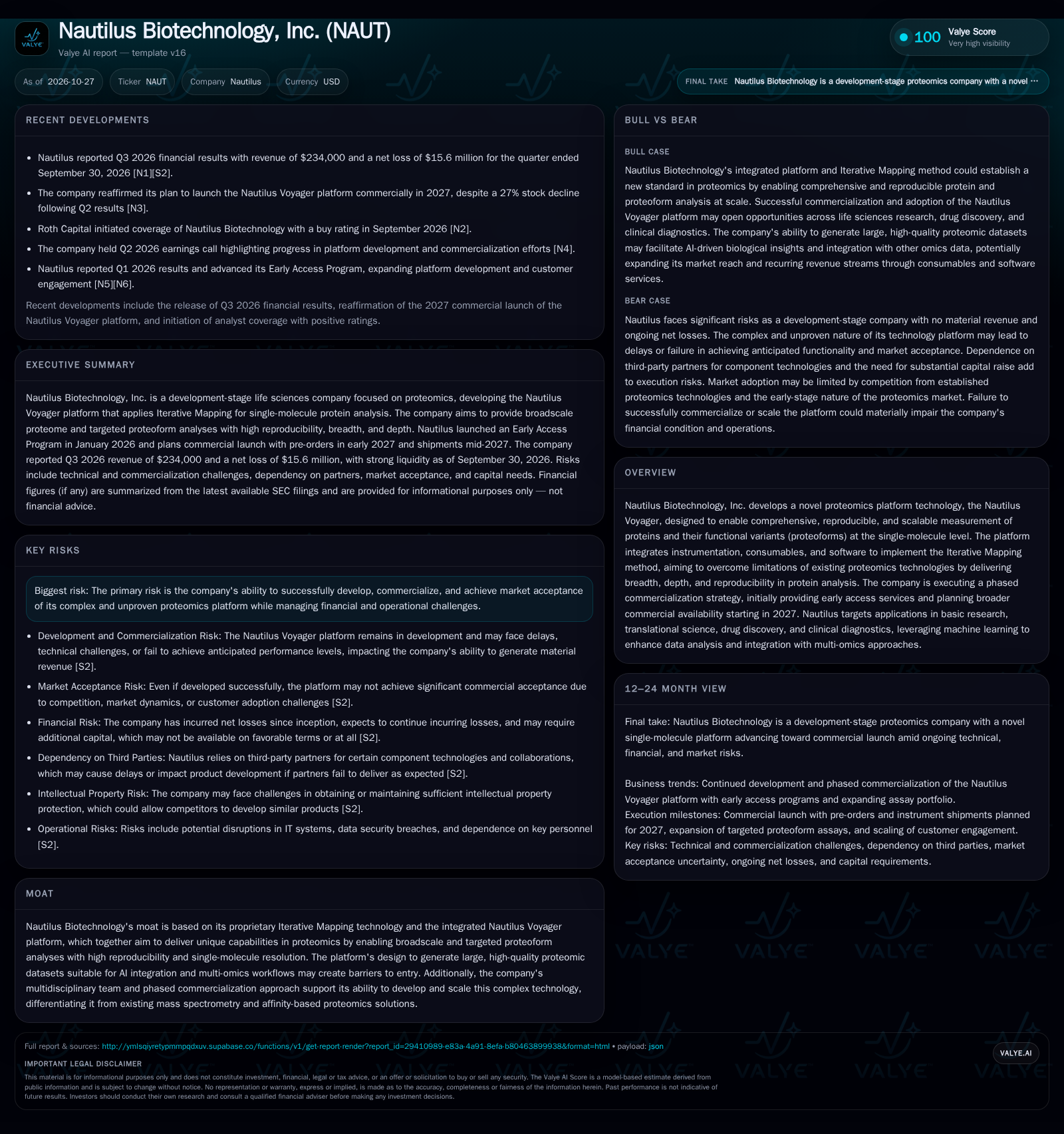
Nautilus Biotechnology remains a pre-commercial-stage company, advancing its Nautilus Voyager proteomics platform with a phased launch plan slated for 2027. The company’s Q3 2026 results reaffirmed its ongoing operating losses and limited current revenues, but also highlighted reported liquidity position and continued technical progress, including early access programs targeting high-impact disease areas. The near-term thesis hinges on Nautilus converting its differentiated technology into scalable commercial adoption while managing execution risks, capital needs, and market acceptance challenges. [S1] [S2] [N1] [N3]
Nautilus Biotechnology is approaching a pivotal moment as it transitions from a multi-year development phase to the cusp of commercializing its Nautilus Voyager platform—a technology promising to dramatically expand the depth and reliability of proteomic analysis. With its Early Access Program underway and a commercial launch targeted for 2027, Nautilus faces a classic life sciences inflection point: can it convert scientific differentiation into meaningful market traction before capital constraints or execution risk undermine the story? The next 18 months will test both the scalability of its technology and the commercial appetite for novel, integrated proteomics solutions. [S1] [S2]
Where Nautilus Stands: Early Access, Immaterial Revenue, and a reported cash balance
Nautilus Biotechnology remains in a pre-revenue, development-stage posture as of Q3 2026, reporting just $234,000 in revenue and a net loss of $15.6 million for the quarter. The company’s cash and equivalents totaled $10.5 million, with current assets of $90.2 million and liabilities of $9.7 million, translating to a current ratio of 9.25. This liquidity snapshot suggests Nautilus is not facing immediate balance-sheet stress, but it continues to burn cash and expects ongoing losses as it advances its platform. The company’s Early Access Program, launched January 2026, has begun delivering proteomic analysis services focused on Alzheimer’s disease, while commercial pre-orders for the Voyager platform are anticipated in early 2027, with shipments to follow mid-year. The period is thus defined by ongoing R&D investment, limited commercial traction, and a need to demonstrate both technical and business model viability in the coming quarters. [S1] [S2] [N1]
How Nautilus Hopes to Turn Proteomics Innovation into Revenue Streams
The economics of Nautilus hinge on the successful commercialization of its integrated Voyager platform, which bundles proprietary instrumentation, consumables, and software. In a typical life sciences tools model, initial instrument sales are lumpy but can seed recurring, higher-margin consumables and software streams as the installed base grows. If Nautilus can achieve robust placement of Voyager instruments, it could benefit from a razor/razorblade dynamic—where consumables (such as reagent kits or flow cells) and cloud-based analytics subscriptions provide ongoing revenue per customer. However, the capital intensity of scaling hardware manufacturing, supporting field applications, and building out sales and support infrastructure is significant. Gross margins in this sector are typically higher for consumables and software than for hardware, so Nautilus’s long-term profitability will depend on driving utilization and retention, not just placements. Operating leverage could materialize if R&D and SG&A costs do not scale linearly with revenue, but this presupposes successful adoption and technical reliability. The company’s ongoing net losses and cash burn reflect the upfront cost structure and the absence of meaningful commercial scale to date. [S1] [S2]
Differentiation in a Crowded Proteomics Landscape: Promise and Pitfalls
Nautilus positions its Voyager platform as a step-change in proteomic analysis, claiming single-molecule resolution, reproducibility, and scalability that outstrip conventional mass spectrometry and affinity-based approaches. If realized, these advantages could appeal to pharmaceutical R&D, translational research, and eventually clinical diagnostics—segments with high willingness to pay for improved data quality and breadth. However, the field is crowded and fast-moving: established life sciences instrumentation companies already offer robust proteomics solutions, and new entrants are exploring both incremental and disruptive approaches. Customer switching costs are nontrivial, especially when downstream workflows and bioinformatics pipelines are optimized for incumbent platforms. True competitive advantage will depend not only on technical performance but also on ease of integration, data compatibility, cost per assay, and demonstrated impact on research or clinical outcomes. Nautilus’s proprietary Iterative Mapping and end-to-end integration could become a moat, but only if they deliver enough incremental value to justify switching and drive ecosystem adoption.
What It Would Take for Nautilus to Become a Proteomics Platform Leader
The most compelling bull case for Nautilus is that its Voyager platform proves technically superior and commercially disruptive, enabling researchers and biopharma customers to access reproducible, deep, and scalable proteome data not otherwise attainable. In this scenario, early access users become reference accounts, driving a wave of pre-orders and rapid adoption upon the 2027 launch. A successful launch would be accompanied by a growing installed base, strong pull-through of consumables and software subscriptions, and validation in high-value disease areas—initially neurodegeneration and oncology. The result would be accelerating revenue growth, improving gross margins, and potentially strategic partnerships or licensing deals. Evidence supporting this scenario would include rapid expansion of the Early Access Program, robust pre-order pipelines, third-party validation studies, and early customer testimonials demonstrating clear scientific or economic benefits relative to incumbent technologies.
Realistic Expectations: Gradual Adoption and Ongoing Execution Risk
The most plausible near-term trajectory for Nautilus is one of incremental commercial progress punctuated by continued execution and financing challenges. The Voyager platform launches on schedule, but adoption is gradual—limited by the need for robust validation, customer training, and integration into existing workflows. Early customers may be primarily academic or translational research groups willing to experiment, while broader biopharma and clinical adoption lags pending further proof of value. Revenue begins to ramp, but remains modest relative to R&D and SG&A expenses, and the company likely seeks additional capital to fund operations and scale commercialization. Confirmation of this scenario would come from steady (but not explosive) growth in customer engagement, ongoing net losses, and periodic capital raises. Falsification would involve either a technical setback delaying launch or, conversely, a sudden surge in commercial demand that outpaces expectations. [S1] [S2]
How Technical or Commercial Hurdles Could Derail Nautilus’s Vision
The principal risk for Nautilus is that its platform fails to deliver sufficient technical or economic value to drive material market adoption. Technical setbacks—such as reliability issues, lower-than-promised reproducibility, or challenges scaling manufacturing—could delay or derail the commercial launch. Even if the platform works as intended, customer skepticism, budget constraints, or inertia could limit uptake, especially if incumbent solutions are seen as ‘good enough.’ In this scenario, revenue remains immaterial, cash burn accelerates, and Nautilus is forced to seek dilutive capital or strategic alternatives under pressure. Evidence supporting this downside would include project delays, negative early customer feedback, missed launch milestones, or difficulty raising capital on acceptable terms. [S2]
Milestones That Will Clarify Nautilus’s Commercialization Trajectory
Expansion rate and scientific profile of Early Access Program participants—especially reference customers in pharma or high-profile research institutes.
Pre-order volume and mix for the Voyager platform as commercial launch approaches in early/mid-2027.
Consumables and software pull-through per installed instrument, if disclosed, as an indicator of recurring revenue potential.
Gross margin evolution by product line—particularly the split between hardware, consumables, and software, if available.
Validation studies or third-party publications demonstrating significant scientific or clinical advantages versus incumbent proteomics platforms.
Timing, magnitude, and terms of any additional capital raises, which would signal management’s view of funding needs and market confidence.
Customer retention and repeat utilization rates, if disclosed, to assess stickiness and the potential for an installed base-driven model.
Progress in expanding assay menu beyond Tau and initial oncology targets, indicating the breadth and scalability of the platform.
Disclaimer: This is research-only, informational analysis and not investment advice. It may include AI-generated interpretation and general industry context. Always verify important details using primary sources.

Comments