
Chilwa Minerals: Early-Stage Exploration, Multi-Commodity Potential, and the Realities of African Critical Minerals Development
Chilwa Minerals Ltd has assembled a district-scale critical minerals project in Malawi, with promising results from heavy mineral sands and rare earth element exploration. The company’s prospects hinge on resource definition, metallurgical viability, and the ability to navigate the complexities of early-stage mining in an emerging African jurisdiction.
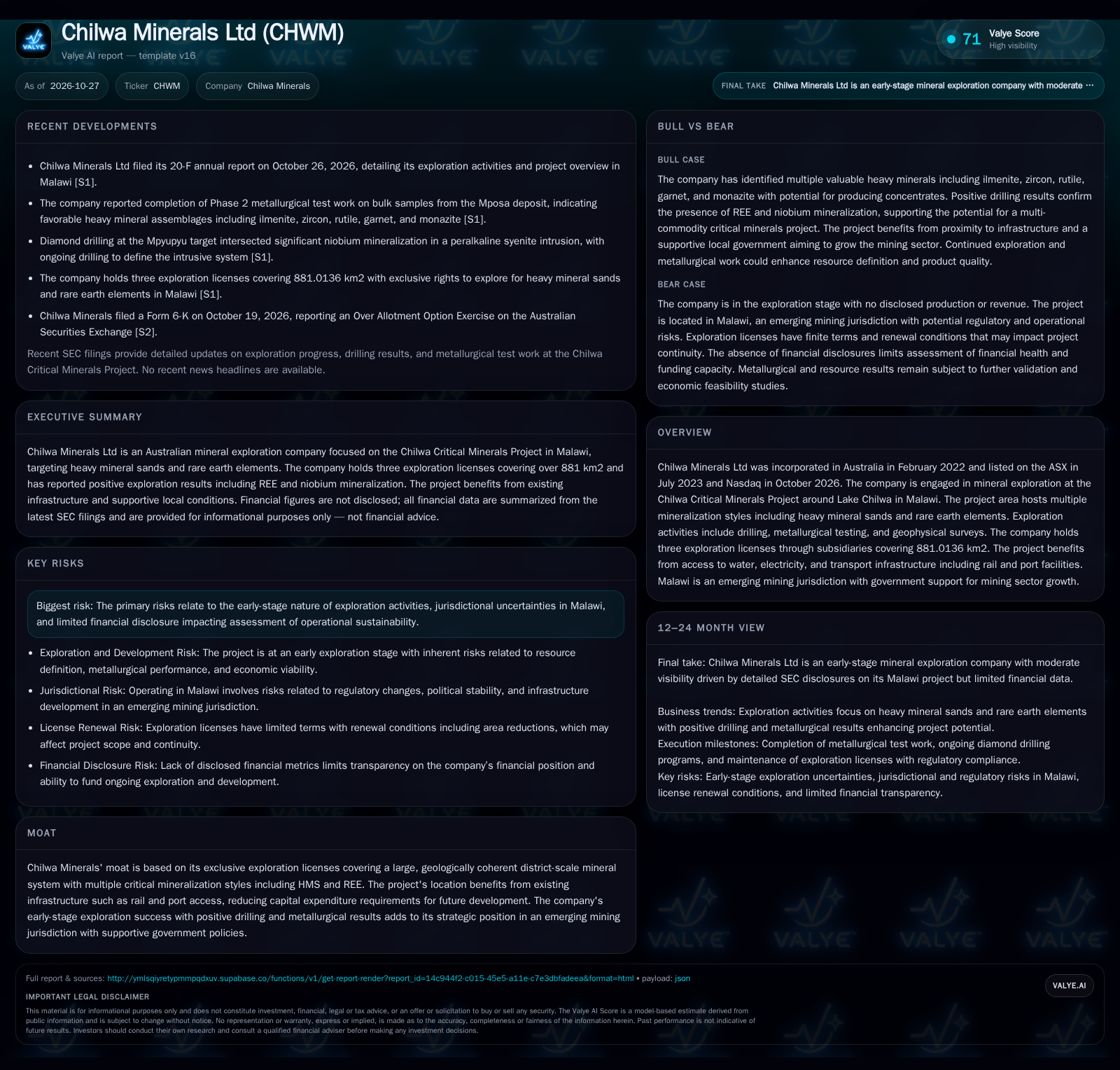
Chilwa Minerals holds three exclusive exploration licenses in southern Malawi and has reported positive early results for both heavy mineral sands and rare earth elements. Favorable infrastructure access and a supportive policy environment strengthen its position, but the absence of financial disclosures and the project's exploration-stage status introduce significant execution and funding risks. The company’s future depends on progressing from exploration to resource definition and ultimately demonstrating economic viability in a challenging jurisdiction. [S1] [S2]
Chilwa Minerals Ltd, a dual-listed Australian explorer, is advancing a 100%-owned critical minerals project in southern Malawi, targeting both heavy mineral sands (HMS) and rare earth elements (REE). With exclusive rights over 881 km² and positive early drilling and metallurgical test results, Chilwa is positioning itself as a possible multi-commodity supplier. However, the company remains firmly in the exploration stage, with no disclosed revenue or financial data, and faces the inherent challenges of operating in an emerging mining jurisdiction. The next phase will test whether Chilwa can translate geological promise into a viable business model amid funding and regulatory uncertainties.
Recent Exploration Progress and Its Implications for Chilwa’s Trajectory
Chilwa Minerals’ most material current developments are concentrated in its ongoing exploration at the Chilwa Critical Minerals Project in Malawi. The company holds three exploration licenses covering 881 km², granting exclusive rights to target both heavy mineral sands (HMS) and rare earth elements (REE). Notably, Phase 2 metallurgical test work at the Mposa deposit confirmed favorable heavy mineral assemblages—ilmenite, zircon, rutile, garnet, and monazite—suggesting the technical potential to produce concentrates. Separately, diamond drilling at the Mpyupyu target intersected significant niobium mineralization within a peralkaline syenite intrusion, with further drilling underway to define the system. These results validate the geological concept and indicate a multi-commodity opportunity, but the absence of production or revenue means Chilwa’s value remains tied to the successful conversion of exploration results into delineated, economically viable resources. [S1]
What Will Determine Chilwa’s Economic Viability?
Chilwa Minerals’ business model is currently not generating revenue and is entirely dependent on the value creation chain typical of early-stage explorers: successful discovery, resource delineation, economic studies, and eventual development or sale/joint venture of assets. In the exploration phase, the principal value drivers are positive drill and metallurgical results, the scale and quality of resources defined, and evidence that the mineralization can be economically extracted and processed.
Should Chilwa advance to production, the economics of HMS and REE projects are typically influenced by ore grade, mineral recovery rates, strip ratios, and the ability to produce marketable concentrates. HMS operations often benefit from relatively low operating costs and high-value by-product streams, but require significant upfront capital for plant and infrastructure. REE and niobium deposits add complexity due to specialized metallurgy and volatile pricing. Infrastructure access can materially improve project economics by lowering transport costs—an advantage for Chilwa given its proximity to water, power, rail, and port facilities in Malawi. However, capital needs for feasibility studies, permitting, and development will likely be significant, and access to funding could become a gating factor unless the company attracts partners, secures offtake, or raises equity at acceptable terms.
Strategic Positioning in the African Critical Minerals Landscape
Chilwa Minerals benefits from first-mover status with exclusive exploration rights over a large, contiguous district in southern Malawi—an area with multiple mineralization styles. This district-scale control is a strategic asset, as it enables the company to pursue both HMS and REE/niobium opportunities within a single project area, potentially allowing for resource clustering and operational synergies if development proceeds.
The competitive landscape for critical minerals in Africa is rapidly evolving, with established regional players and global commodity groups pursuing similar resources in Malawi, Mozambique, Madagascar, and across the continent. Competition centers on the ability to define large, high-grade, and economically recoverable resources, as well as on access to infrastructure and the ability to navigate jurisdictional risk. Substitutes and new entrants remain a threat, especially as global supply chains for REE and HMS remain fragmented and subject to rapid shifts in demand, pricing, and regulatory environments. Chilwa’s access to infrastructure and supportive local policy are relative strengths, but these advantages must be weighed against the lack of operational track record and the risks of maintaining social license and regulatory compliance in an emerging jurisdiction.
How Early-Stage Discoveries Could Translate into a Multi-Commodity Development Opportunity
The favorable scenario for Chilwa Minerals is predicated on the successful conversion of current exploration momentum into delineated, economically viable resources. If ongoing drilling at the Mpyupyu target continues to intersect high-grade niobium mineralization, and further test work at the Mposa deposit confirms the ability to produce high-quality HMS and monazite concentrates, Chilwa could position itself as a candidate for a multi-commodity critical minerals development.
Additional upside could come from the demonstration of ionic adsorption clay REE mineralization, which—if present in economic quantities—would open the door to low-cost, near-surface extraction techniques favored by global REE markets. Confirmation of large, high-grade resources and robust metallurgical recoveries would attract potential partners or acquirers, potentially derisking development funding. Evidence confirming this scenario would include the publication of an initial mineral resource estimate with competitive grades and tonnages, successful completion of scoping or pre-feasibility studies, and announcements of strategic partnerships or offtake agreements.
Moving from Exploration Success to Defining a Path to Feasibility
The most plausible near-term scenario is that Chilwa continues to report positive but incremental exploration results—expanding its geological understanding and gradually firming up the resource base at Mposa, Mpyupyu, and other targets. Under this path, the company would likely prioritize resource delineation drilling, metallurgical optimization, and initial scoping studies. Actual project development would remain several years away, contingent on further resource definition, regulatory approvals, environmental studies, and the securing of development capital.
Evidence supporting this scenario would be a steady cadence of drill results, metallurgical updates, and early-stage technical studies, but without a formal resource declaration or feasibility-level economics. Falsifying this scenario would require either a sharp deterioration in exploration results, loss of license tenure, or a breakdown in access to capital.
Exploration Uncertainties, Funding Gaps, and Jurisdictional Friction
The adverse scenario for Chilwa Minerals involves a combination of disappointing exploration outcomes, delays or failures in license renewal, and/or an inability to secure sufficient funding to advance the project. This could result from technical setbacks—such as lower-than-expected grades, poor metallurgical recoveries, or resource tonnages insufficient to support a stand-alone development.
Additional downside risks include regulatory or political headwinds in Malawi, shifts in government policy, or increased competition for tenure and infrastructure access. Lack of financial disclosure already clouds the assessment of Chilwa’s funding runway; if the company is unable to raise capital on acceptable terms, project momentum could stall. Evidence confirming this scenario would include negative or inconclusive drill results, non-renewal or reduction of exploration license areas, or announcements of cost-cutting, project delays, or failed capital raises.
Milestones That Will Shape Chilwa Minerals’ Investment Case
Publication of initial mineral resource estimates for HMS, REE, and niobium—if disclosed—would be a critical milestone for resource validation.
Updates on metallurgical test work, including concentrate grades and recoveries, would help test the technical viability of future production.
Progress reports on ongoing drilling campaigns at Mpyupyu and other targets, with particular attention to grade continuity, depth, and scale.
Announcements regarding license renewals, area reductions, or changes to tenure status, which would directly affect project scope.
Disclosure of capital raises, joint venture agreements, or offtake partnerships, as these would clarify Chilwa’s funding runway and strategic appeal.
Any major changes in Malawi’s mining policy, regulatory environment, or infrastructure development that could impact project economics.
Evidence of community engagement, environmental permitting progress, or local stakeholder relations, as these are often gating factors for African mining projects.
If disclosed, cash burn rates and exploration expenditure trends would help assess the sustainability of ongoing fieldwork and development activities.
Disclaimer: This is research-only, informational analysis and not investment advice. It may include AI-generated interpretation and general industry context. Always verify important details using primary sources.

Comments