
Rambus Powers AI Infrastructure: Memory Interface Leverage, Patent Moat, and the Next Growth Phase
Rambus Inc. stands at the intersection of AI-driven demand and memory technology innovation, leveraging a fabless model and robust intellectual property portfolio. With recent earnings strength and a sharpened focus on data center infrastructure, the company faces both the promise of accelerating adoption and the structural risks of concentration and industry cyclicality.
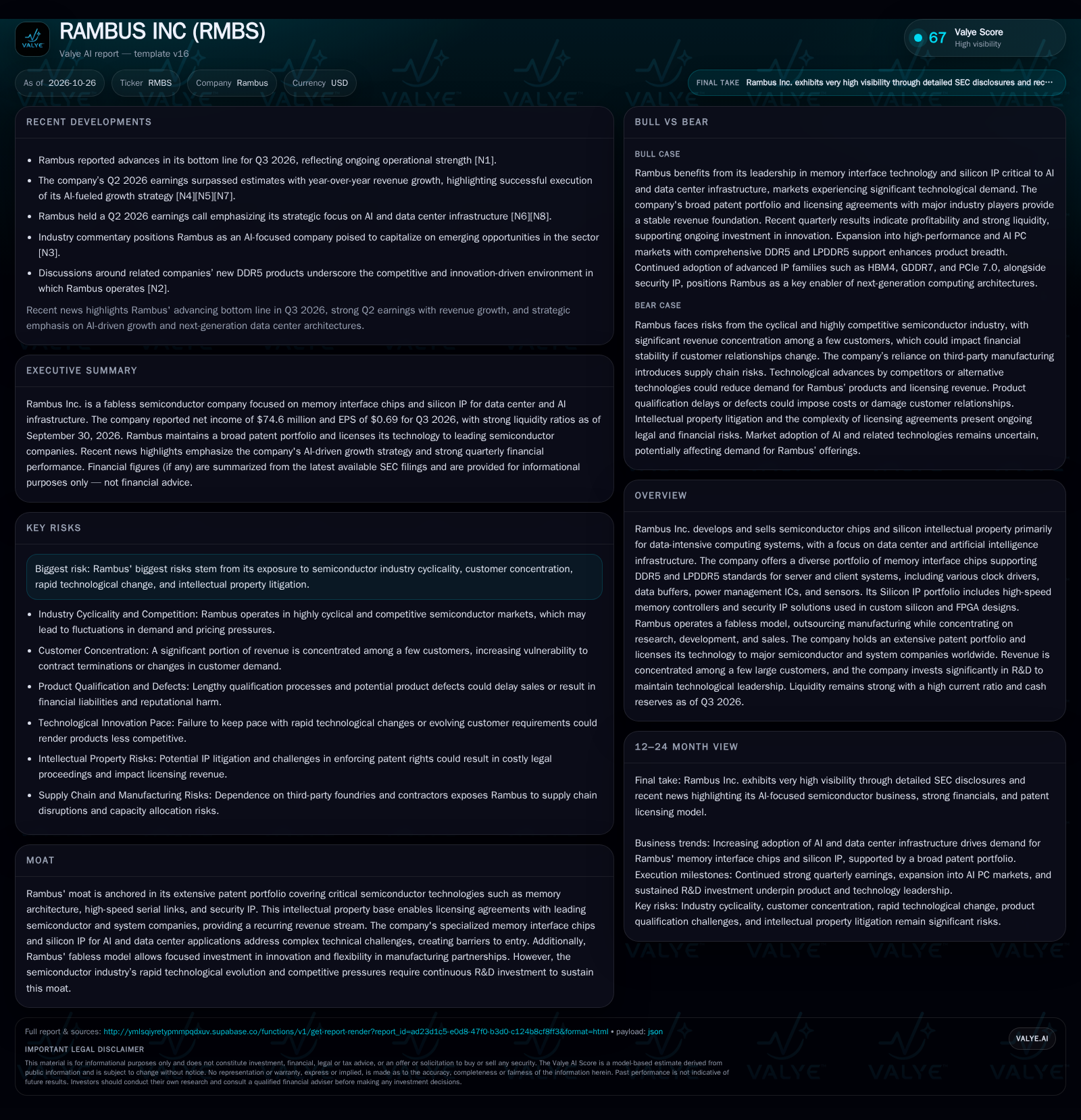
Rambus reported strong Q3 2026 profitability and continues to execute an AI-focused growth strategy, anchored by its memory interface chips and licensing model. The company's high customer concentration and reliance on third-party manufacturing introduce potential volatility, but its patent portfolio and investment in next-generation memory standards position it to benefit from ongoing AI and data center infrastructure expansion. Monitoring adoption rates, customer dynamics, and R&D output will be pivotal for assessing Rambus' ability to sustain momentum in a rapidly evolving semiconductor landscape. [S2] [N1] [N4] [N5] [N7]
Rambus Inc. is increasingly positioned as a vital supplier and licensor for the memory and interconnect technologies underpinning AI and data center infrastructure. Recent quarterly results highlight robust profitability and ongoing investment in R&D, even as the company faces industry cyclicality and revenue concentration risks. Rambus’ fabless model permits agility in innovation, but its continued success will hinge on maintaining technological leadership, navigating customer concentration, and capitalizing on the accelerating adoption of advanced memory standards in AI workloads.
Recent Profitability and AI Momentum Define Rambus’ 2026 Landscape
Rambus reported a net income of $74.6 million and earnings per share of $0.69 for Q3 2026, reflecting ongoing operational strength and improved bottom-line performance. [S2] [N1] The company’s Q2 2026 results also surpassed consensus estimates, with year-over-year revenue growth attributed to successful execution of its AI-focused strategy. [N4] [N5] [N7] These outcomes underscore Rambus’ ability to capture demand in the expanding AI and data center infrastructure markets.
The company’s reported liquidity position is characterized by a reported current ratio and significant cash reserves as of September 2026. [S2] However, Rambus' revenue remains concentrated among a handful of large customers, which introduces potential volatility if any customer relationship changes materially. [S2]
Rambus’ product and IP portfolio now spans DDR5, LPDDR5, HBM4, GDDR7, and PCIe 7.0, highlighting its commitment to supporting next-generation memory and interconnect standards critical for AI and high-performance computing. [S2]
Fabless Model and Licensing: How Rambus Converts Innovation into Profit
Rambus operates a fabless semiconductor model, focusing on design, research, and development while outsourcing manufacturing. This structure allows the company to allocate capital more efficiently, reducing fixed asset intensity and enabling higher R&D spend relative to revenue than many integrated peers. The primary revenue streams are: (1) sales of memory interface chips—such as DDR5 and LPDDR5 clock drivers, data buffers, and power management ICs—and (2) licensing fees from its extensive silicon intellectual property (IP) portfolio.
The chip business is volume-driven, with margins influenced by product mix and the technical requirements of end markets. Licensing can generate high incremental margins due to the low variable costs of additional agreements, but the specific degree of recurring revenue from licensing depends on contract structures and renewal rates, which are not detailed in current disclosures. Thus, while licensing is a key pillar, the predictability and duration of these revenues are subject to the terms and renewals of individual agreements.
R&D is a major expense, essential for keeping pace with rapid advances in memory and interconnect standards. Capital requirements are largely tied to engineering talent, IP development, and product qualification, rather than plant and equipment. If Rambus can maintain or expand licensing penetration while scaling chip sales into new AI and data center deployments, operating leverage could increase over time, provided customer concentration risks are managed.
Patent Moat and Technology Breadth: Defenses and Vulnerabilities in a Shifting Semiconductor Arena
Rambus’ competitive positioning is anchored by its broad patent portfolio, covering memory architectures, high-speed serial links, and security IP. This intellectual property allows the company to license core technologies to major semiconductor and system companies, creating a recurring revenue foundation and raising barriers to entry for competitors.
In the memory interface and controller space, Rambus competes with both major semiconductor companies with in-house IP and specialized design houses. The rapid pace of innovation in AI and data center markets means that technological leadership is transient—sustained advantage depends on continuous R&D investment and successful adoption of new standards (e.g., HBM4, GDDR7, PCIe 7.0).
While the fabless model provides flexibility and focus, it also exposes Rambus to supply chain risks inherent in third-party manufacturing. Moreover, the company’s customer concentration makes it vulnerable to shifts in procurement strategies, insourcing of IP, or changes in industry alliances. Potential substitutes include alternative memory architectures, proprietary controller designs by large customers, and emerging compute paradigms that could bypass traditional DRAM-centric architectures.
AI Infrastructure Boom Accelerates: Rambus as a Key Enabler
In a favorable scenario, global AI adoption drives a sustained upgrade cycle in data center and high-performance computing infrastructure. Demand for advanced memory interface chips and silicon IP—especially those supporting standards like DDR5, HBM4, and PCIe 7.0—accelerates, and Rambus leverages its technology breadth and patent position to win new design slots and expand licensing agreements.
If the company can deepen penetration into AI PC and edge infrastructure markets, while maintaining its licensing relationships with major ecosystem players, revenue growth could outpace industry averages. Confirmation of this scenario would include continued above-consensus revenue growth, new or expanded licensing deals with top-tier semiconductor companies, and increased product adoption in next-generation AI platforms. Evidence would also include strong R&D output translating into commercialized IP for emerging standards and higher-margin product mix in chip sales.
This scenario could be falsified by a slowdown in industry AI infrastructure investment, loss of major customer design wins, or failure to commercialize new IP in pace with evolving standards.
Sustained Innovation, Cyclical Volatility: Rambus’ Most Likely Trajectory
The most plausible outcome is that Rambus continues to grow in line with AI and data center infrastructure adoption but experiences typical semiconductor industry cyclicality. The company maintains its core licensing relationships and chip sales momentum, but revenue growth moderates as competition intensifies and customer concentration remains high.
R&D expenses stay elevated as Rambus invests to refresh its IP portfolio and address new standards. Margins are sustained or improve modestly if licensing revenue remains stable and high-value chip sales expand. Periodic supply chain pressures or qualification delays may cause quarterly volatility, but the underlying business model remains intact.
This scenario would be confirmed by quarterly financials showing stable or slightly growing revenue, high gross margins (especially in licensing), and continued announcements of support for new memory and interconnect standards. It would be challenged if notable customers reduce purchases, if new standards shift away from Rambus’ core IP, or if legal/IP disputes materially affect revenue.
Customer Concentration and Supply Chain Disruption: Structural Vulnerabilities Exposed
The adverse scenario unfolds if one or more major customers reduce or terminate their relationships, whether due to insourcing, competitive displacement, or shifts in industry alliances. Given Rambus’ high revenue concentration, even a single large customer loss could result in a sudden drop in revenue and profitability.
Compounding this risk, supply chain disruptions at third-party foundries or qualification failures in new products could delay key launches, erode customer trust, or trigger financial penalties. Industry cyclicality could exacerbate these effects, especially if AI infrastructure spending slows amid macroeconomic headwinds.
This scenario would be confirmed by sharp quarter-over-quarter revenue declines, reduced licensing income, public disclosures of lost design wins or customer transitions, or negative impacts from patent litigation. It would be challenged by evidence of customer diversification, resilient licensing renewals, or successful mitigation of supply chain shocks.
Milestones and Metrics That Will Define Rambus’ Next Phase
Quarterly revenue and net income growth, especially in relation to AI infrastructure and data center segment expansion, will help gauge the sustainability of Rambus’ current momentum. [S2] [N1] [N4] [N5] [N7]
Customer concentration metrics—such as the proportion of revenue from the top three or five customers, if disclosed—would clarify exposure to contract or demand shifts.
The pace and breadth of new product and IP standard launches (DDR5, HBM4, PCIe 7.0, security IP) will indicate whether Rambus is keeping up with industry innovation cycles.
Licensing agreement renewals and new multi-year deals, if disclosed, would provide visibility into the recurring revenue base and IP monetization health.
Gross margin trends by segment (chip sales vs. licensing), if disclosed, would help assess the impact of product mix and pricing power.
Supply chain resilience—evidence of on-time product qualifications and absence of major foundry disruptions—will be critical to maintaining sales momentum.
R&D expenditure levels and the ratio of R&D to revenue will reflect the company’s commitment to sustaining its innovation moat.
Any material legal or patent litigation developments, including resolutions or new filings, could have direct impacts on costs and licensing income.
Disclaimer: This is research-only, informational analysis and not investment advice. It may include AI-generated interpretation and general industry context. Always verify important details using primary sources.

Comments