
Agilysys Leverages AI-Driven Hospitality Tech: Strong Revenue, Competitive Pressures, and the Next Phase of Growth
Agilysys posts record revenue and expands its AI-enhanced software suite, but faces mounting competition and margin risks as hospitality technology evolves. Execution on R&D and international expansion will be pivotal amid sector volatility.
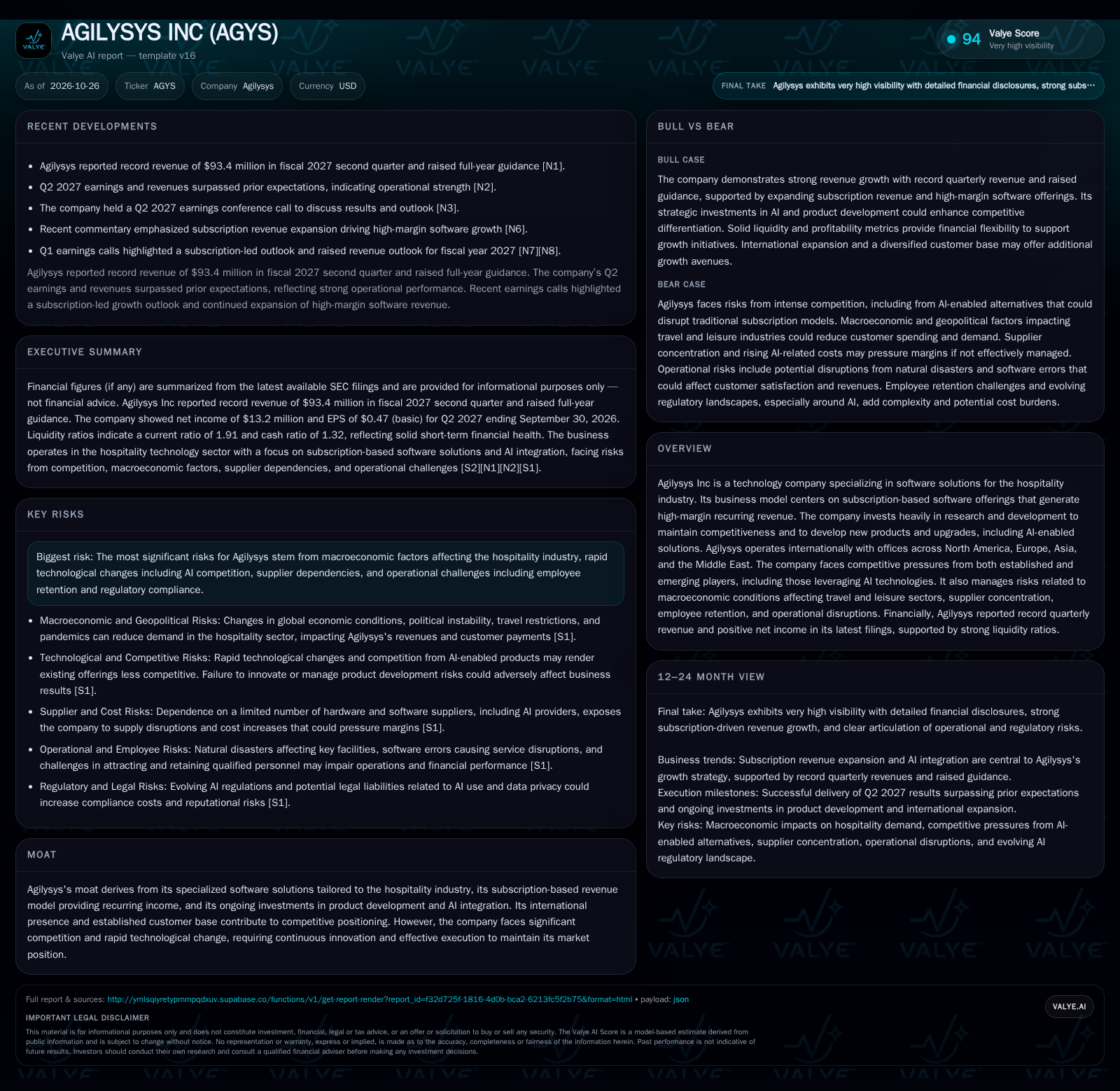
Agilysys reported a record $93.4 million in Q2 fiscal 2027 revenue and raised full-year guidance, underpinned by expanding subscription-driven software. While liquidity and profitability metrics remain solid, the company must navigate intensifying competition from AI-enabled entrants, supplier dependencies, and macroeconomic pressures affecting the hospitality sector. Sustained R&D investment and successful international execution are critical to preserving its edge as technology and customer needs shift rapidly [N1] [S2] [S1].
Agilysys Inc. enters fiscal 2027 with momentum, posting record quarterly revenue and raising its outlook as demand for hospitality technology rebounds. The company’s strategic pivot to subscription-based, AI-enhanced software underpins its growth story, but also exposes Agilysys to a wave of new risks—including fierce competition from AI-native providers, cost pressures from supplier concentration, and the inherent volatility of the global hospitality sector. As the industry rapidly digitizes, Agilysys’s ability to innovate, scale internationally, and manage operational complexity will determine whether its current gains can be sustained or eroded.
Recent Performance: Record Revenue, Upbeat Guidance, and Reported Liquidity Position
Agilysys reported record revenue of $93.4 million for the fiscal 2027 second quarter and raised its full-year guidance, signaling robust demand for its hospitality-focused software offerings [N1]. Net income for Q2 2027 reached $13.2 million, with basic EPS of $0.47 and diluted EPS of $0.46 as of September 30, 2026 [S2]. reported liquidity position, with $137.6 million in cash and equivalents, a current ratio of 1.91, and a cash ratio of 1.32 [S2]. The company’s financial position provides flexibility for continued investment in R&D and international expansion. However, these headline results mask underlying challenges: Agilysys’s growth is intertwined with macroeconomic volatility in the travel and leisure sectors, and its expansion into AI-enabled solutions brings new competitive and cost dynamics [S1].
Subscription Model and AI: Profit Streams and Cost Structures in Flux
Agilysys generates much of its revenue from software solutions tailored to the hospitality sector, with a strategic pivot toward subscription-based models that offer recurring, higher-margin income streams [N6] [S1]. This shift aligns with broader industry trends, as hotels and resorts seek scalable, cloud-based platforms to manage property operations, guest engagement, and analytics. Subscription expansion supports more predictable revenue, but also requires ongoing investment in R&D for feature updates and AI integration—costs that are largely fixed and may rise as competitive intensity increases.
The company’s AI initiatives—both in internal operations and customer-facing products—could drive new value, such as predictive analytics for guest preferences or automated resource allocation. However, AI integration introduces new cost centers: licensing fees to third-party providers, increased cloud infrastructure charges, and the need for specialized talent. Supplier concentration, especially for hardware and AI components, could further pressure gross margins if input costs rise or if vendor relationships deteriorate [S1]. Agilysys’s international presence also means exposure to local pricing dynamics, regulatory costs, and potential currency fluctuations, adding complexity to its overall economics.
Navigating a Crowded Hospitality Tech Landscape
Agilysys operates in a market with both established and emerging competitors, including traditional hospitality software vendors and new entrants leveraging AI and machine learning [S1]. The competitive landscape is rapidly evolving, with larger tech firms and nimble startups offering modular, cloud-native, and AI-enhanced solutions that could erode Agilysys’s pricing power and customer stickiness.
While Agilysys benefits from a global customer base and a portfolio of integrated solutions, these advantages are not unassailable. Switching costs in hospitality IT can be moderate, as cloud-based platforms often feature open APIs and integration tools, reducing customer lock-in. The company’s ability to maintain differentiation hinges on continuous product innovation, high service reliability, and demonstrable ROI for its clients. The entry of AI-native competitors may accelerate the pace of product cycles and force price competition, particularly in commoditized software modules.
AI-Enabled Differentiation Spurs Share Gains and Margin Expansion
If Agilysys successfully leverages its ongoing R&D investments to deliver AI-driven features that meaningfully enhance operational efficiency or guest experience for hospitality clients, it could achieve outsized share gains—particularly among enterprise and international customers seeking advanced capabilities. Demonstrable improvements in customer KPIs such as occupancy, upsell rates, or guest satisfaction, attributable to Agilysys’s solutions, would support premium pricing and reduce churn.
This upside scenario would be confirmed by accelerating subscription revenue growth outpacing industry averages, expanding gross margins (despite AI-related costs), and visible customer wins against both legacy and AI-native competitors. Additional evidence would include successful entry into new geographic markets, sustained R&D velocity (as measured by new product releases or patents), and positive referenceability from marquee clients adopting AI modules.
Sustaining Growth Amid Competitive and Operational Complexity
The most plausible trajectory for Agilysys is continued revenue growth at a moderate pace, supported by the ongoing digital transformation of the hospitality sector and incremental product upgrades. Subscription revenue may steadily increase as existing clients migrate from legacy licenses and new clients onboard, but pricing power could be capped by competition and the commoditization of core modules.
In this scenario, gross margins remain healthy but do not materially expand, as higher R&D and supplier costs offset operational efficiencies. International operations add diversification but also expose the company to episodic regulatory or macro shocks. Confirmation would come from steady quarterly revenue and margin trends, stable customer retention rates (if disclosed), and a balanced cadence of new product launches without major cost overruns or implementation failures.
Margin Compression and Share Losses as AI Competition Intensifies
The adverse scenario for Agilysys centers on accelerated disruption from AI-native competitors, leading to margin compression and loss of key accounts. If rivals deploy more advanced or cost-effective AI platforms, Agilysys may be forced into price competition, eroding the high-margin profile of its subscription business. Supplier concentration—especially for AI and cloud infrastructure—could amplify this effect if input costs rise or vendors assert greater bargaining power.
Operationally, execution missteps—such as delayed product launches, service outages, or high developer turnover—could undermine customer trust and slow new bookings. The downside case would be confirmed by declining gross margins, missed revenue guidance, rising customer churn (if disclosed), and negative commentary from clients or partners regarding product gaps or service reliability.
Milestones That Will Determine Agilysys’s Next Chapter in Hospitality Tech
Quarterly subscription revenue growth rate: Sustained acceleration would signal effective AI-driven product uptake and support the upside scenario; stagnation or deceleration would suggest competitive or adoption headwinds.
Gross margin trends: Expansion would indicate pricing power or operational leverage from AI integration, while compression would highlight cost or price competition pressures.
R&D spending as a percentage of revenue: Increases may be necessary for innovation but could pressure margins if not matched by revenue growth; declines might suggest underinvestment or execution risk.
Customer retention and churn rates (if disclosed): Improvements would point to product stickiness; rising churn would indicate vulnerability to competitive displacement.
New product and AI feature launch cadence: A steady stream of meaningful innovations would reinforce differentiation and customer value.
International market revenue mix: Growth outside core regions would test Agilysys’s ability to scale and localize its offerings amid regulatory and operational complexity.
Supplier cost trends and concentration: Changes in AI or hardware supplier terms could materially impact margins and operational stability.
Talent retention and developer attrition rates (if disclosed): High turnover could slow innovation and impair execution, while stability would support R&D continuity.
Disclaimer: This is research-only, informational analysis and not investment advice. It may include AI-generated interpretation and general industry context. Always verify important details using primary sources.

Comments