
Brixmor’s Grocery-Anchored Advantage: Portfolio Expansion, Dividend Growth, and the Risks of Scaling in Retail Real Estate
Brixmor Property Group is reinforcing its position in the U.S. open-air retail market with a focus on grocery-anchored centers, a 7.3% dividend hike, and a $2.34B acquisition of Slate Grocery REIT. While these moves promise stable cash flow and potential portfolio synergies, execution risks and changing retail dynamics remain central to the investment debate.
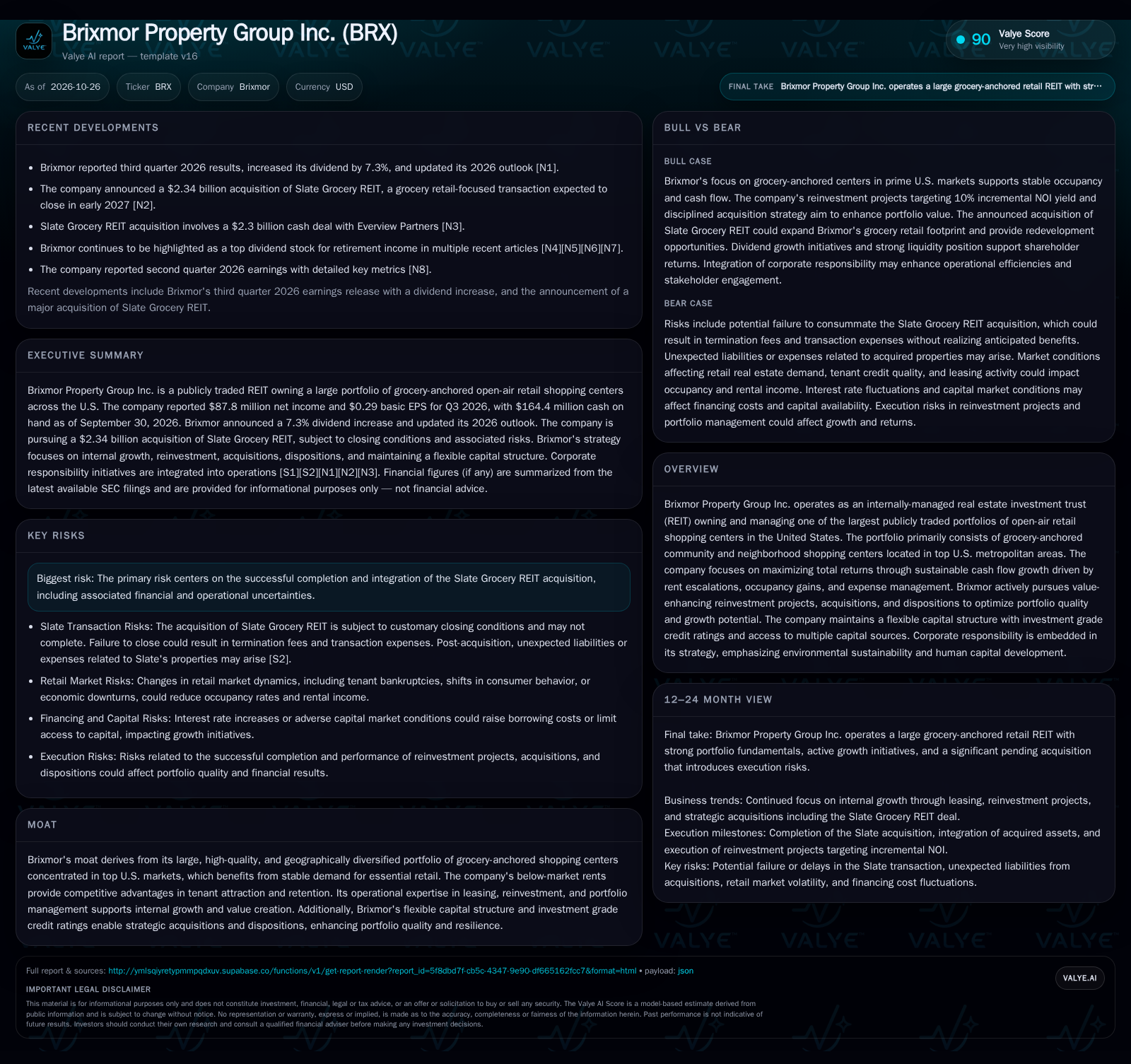
Brixmor Property Group reported $87.8M in Q3 2026 net income and raised its dividend by 7.3%. The planned $2.34B acquisition of Slate Grocery REIT signals a major portfolio expansion, amplifying Brixmor’s bet on the resilience of grocery-anchored shopping centers. The strategy emphasizes internal growth, reinvestment, and disciplined capital management, but faces execution and market risks as retail real estate evolves. [S2] [N1] [N2]
Brixmor Property Group is doubling down on its core strength: grocery-anchored, open-air retail centers in top U.S. markets. The cited source reports dividend-related activity; that disclosure alone does not establish dividend-policy continuity, management confidence, or a material constraint on capital flexibility. The company’s operating results and capital allocation moves underscore a strategy emphasizing durable cash flow, disciplined reinvestment, and portfolio optimization. Yet, as Brixmor scales, the risks of integration missteps, tenant churn, and shifting retail trends loom large, making execution and adaptability the key variables to watch. [S2] [N1] [N2]
Portfolio Expansion, Dividend Growth, and Strategic Moves in 2026
Brixmor reported $87.8 million in net income and $0.29 basic EPS for Q3 2026, reflecting continued profitability amid a dynamic retail environment. The company reported cash and liquidity metrics for the period; these figures do not by themselves establish operating runway, investment capacity, financial flexibility, or financing capacity. The cited source reports dividend-related activity; that disclosure alone does not establish dividend-policy continuity, management confidence, or a material constraint on capital flexibility. Most notably, Brixmor agreed to acquire Slate Grocery REIT for $2.34 billion in cash, a transaction that, if completed, would materially expand its grocery-anchored portfolio and reinforce its focus on essential retail real estate in key U.S. markets. These developments collectively highlight Brixmor’s pursuit of scale, cash flow durability, and portfolio optimization. [S2] [N1] [N2] [N3]
How Brixmor’s Model Converts Grocery-Anchored Stability into Cash Flow
Brixmor’s revenue and earnings are fundamentally driven by leasing space in grocery-anchored, open-air shopping centers—an asset class historically characterized by high occupancy rates and relatively stable rental streams. This stability is anchored in the essential nature of grocery tenants, whose draw supports both foot traffic and the viability of surrounding in-line retailers. Rental income is typically structured around multi-year leases with embedded annual escalations, providing visibility and incremental growth.
Operating leverage is achieved through a mix of fixed property costs (taxes, maintenance, G&A) and variable expenses. As occupancy rises or market rents reset higher, incremental revenue tends to flow through at attractive margins, boosting NOI and FFO. Brixmor’s strategy of targeted reinvestment—including redevelopments and anchor repositionings—aims to drive higher yields (often targeting 10% incremental NOI on such projects) without the full risk profile of ground-up development.
Capital needs are significant but manageable for a REIT of Brixmor’s scale, with acquisitions (such as the Slate deal) and property improvements funded through a mix of retained cash, debt, and equity. Maintaining investment grade credit ratings and a flexible capital structure is central to the company’s ability to pursue growth while managing risk. The cited source reports dividend-related activity; that disclosure alone does not establish dividend-policy continuity, management confidence, or a material constraint on capital flexibility.
Defending Share in a Shifting Retail Landscape: Brixmor’s Structural Advantages and Exposures
Brixmor’s competitive edge lies in its large, geographically diversified portfolio of grocery-anchored centers, concentrated in top U.S. metropolitan areas. These assets benefit from below-market base rents, which may aid in tenant retention and attraction, particularly during periods of retail stress. The company’s operational expertise in leasing, redevelopment, and portfolio curation further differentiates it from smaller or less specialized peers.
However, the broader retail real estate sector faces secular headwinds. E-commerce substitution continues to pressure certain categories of in-line tenants, and the health of anchor grocers—while resilient—can be impacted by shifts in consumer habits, discount competition, or consolidation. Additionally, private market and institutional competitors vie for high-quality grocery-anchored properties, raising acquisition multiples and compressing yields. Brixmor’s access to diverse capital sources and investment grade ratings are advantages in competitive bidding, but integration and execution risks rise with scale, especially in large acquisitions like Slate.
If Integration and Leasing Momentum Outpace Headwinds: What a Bullish Outcome Looks Like
A favorable scenario for Brixmor would see the successful, seamless integration of the Slate Grocery REIT assets, enabling immediate accretion to NOI and FFO per share. If Brixmor can leverage its leasing platform to quickly backfill any vacancies, realize cost synergies, and execute value-add reinvestments at high incremental yields, the combined portfolio could deliver above-peer growth in both cash flow and dividend distributions.
Evidence of successful tenant retention, increased leasing spreads, and minimal tenant churn within the newly acquired assets would further validate the bull case. Additionally, maintaining or improving investment grade credit ratings during the integration would signal prudent capital management and operational discipline.
Scaling with Caution: What Steady Execution Would Entail for Brixmor
The most likely outcome is that Brixmor completes the Slate acquisition with manageable integration friction, supporting moderate incremental growth in NOI and AFFO. Internal growth would continue to be driven by steady leasing activity, periodic rent escalations, and targeted reinvestments yielding modest returns. While occupancy could remain stable, some lease roll-down risk may emerge if retail market conditions soften or if tenant credit quality deteriorates.
Evidence supporting this scenario would include mid-single-digit same-property NOI growth, modest increases in the dividend, and maintenance of current investment grade ratings. Any delays or cost overruns in integrating the Slate assets, or higher-than-expected tenant churn, would temper but not derail overall portfolio performance. This scenario assumes continued access to capital markets for refinancing and periodic asset recycling through disciplined dispositions.
What Could Go Wrong: Integration Stumbles, Tenant Distress, and Capital Market Strain
A negative outcome could materialize if Brixmor encounters significant integration challenges with the Slate portfolio, such as unforeseen property-level liabilities, higher-than-expected capital expenditure needs, or failure to realize anticipated synergies. If retail market conditions deteriorate—due to a recession, major tenant bankruptcies, or shifts in grocery retailing—occupancy could fall and rent collections could weaken, pressuring NOI and dividend coverage.
Capital market volatility or rising interest rates could further complicate refinancing needs or limit access to accretive growth capital, especially if credit spreads widen or asset values decline. This scenario would be confirmed by declining same-property NOI, increased vacancy, negative leasing spreads, and any need to cut or freeze the dividend. Downgrades in credit ratings or covenant pressures would further evidence financial strain.
Concrete Markers That Will Test Brixmor’s Portfolio Growth and Resilience Thesis
The pace and cost of integrating the Slate Grocery REIT portfolio—measured by realized synergies, property-level NOI trends, and any unexpected liabilities.
Quarterly same-property NOI growth rates, as a proxy for internal cash generation and portfolio health.
Occupancy and leasing spread metrics, particularly within the newly acquired assets, if disclosed.
Changes in tenant mix and credit quality, especially exposure to non-grocery anchors or at-risk in-line tenants.
Progress and returns on value-add reinvestment projects, including redevelopment yields and timelines, if disclosed.
External retail market developments—major tenant bankruptcies, grocery chain M&A, or shifts in consumer traffic patterns—that could impact portfolio performance.
Disclaimer: This is research-only, informational analysis and not investment advice. It may include AI-generated interpretation and general industry context. Always verify important details using primary sources.

Comments