
AudioEye’s Profitability Milestone: What Sustains—and What Could Disrupt—Its Operating Momentum
AudioEye reported $11 million in Q3 2026 revenue and positive net income, marking a notable profitability milestone.
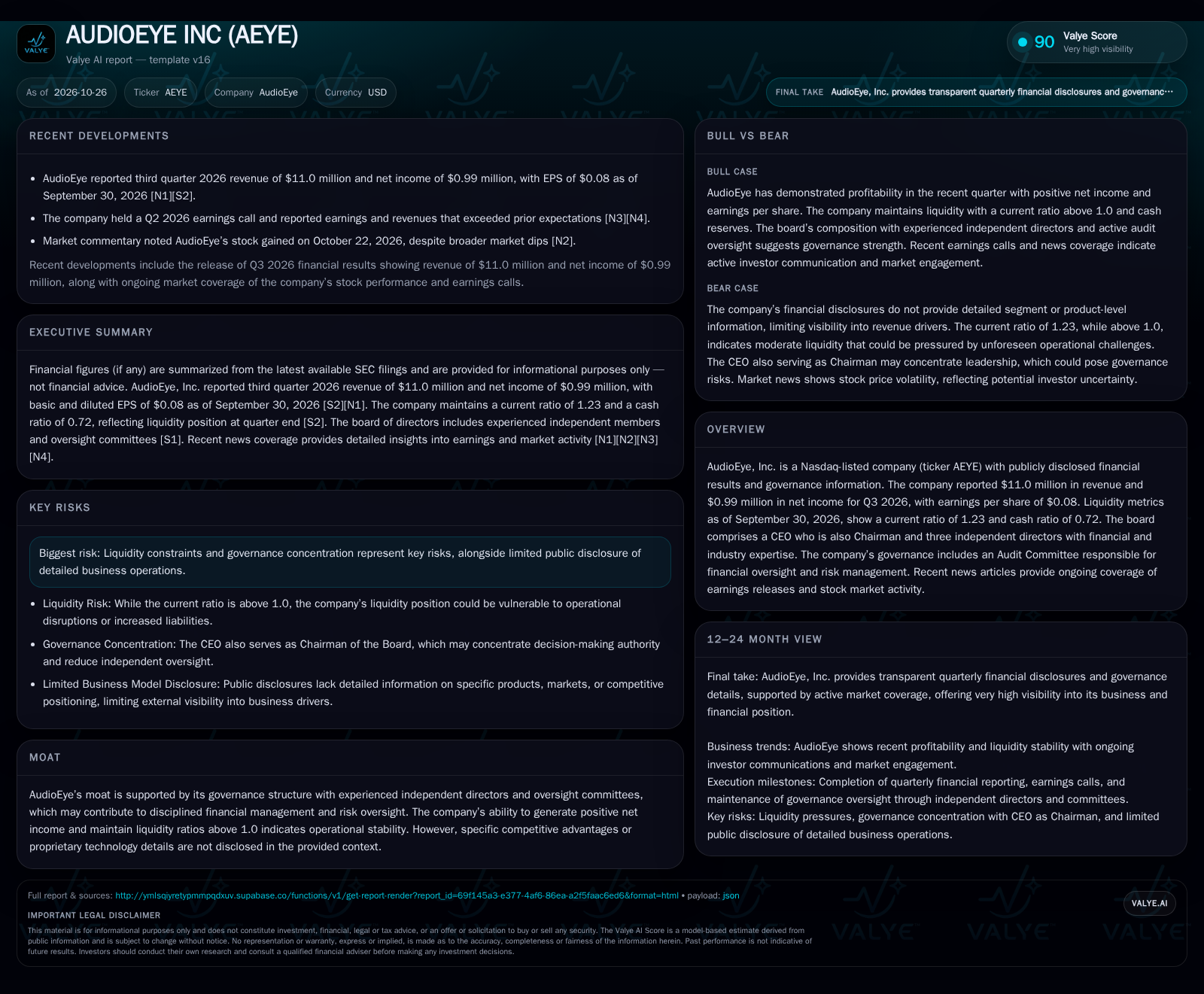
AudioEye’s Q3 2026 results show positive net income and $11 million in revenue, with liquidity metrics above minimum thresholds. While governance includes experienced independent directors, the CEO’s dual role as Chairman concentrates authority. [S2] [N1]
AudioEye’s latest quarterly report marks a significant operating milestone: the company achieved $11 million in revenue and nearly $1 million in net income in Q3 2026, with per-share earnings of $0.08. While these figures highlight clear progress on profitability, the company’s liquidity profile is only moderately above minimum comfort levels, and transparency into its underlying business mechanics remains limited. The governance structure combines experienced independent oversight with a concentration of authority in the CEO/Chairman, setting up a complex backdrop for the company’s next phase. Whether AudioEye can sustain this momentum—or is vulnerable to operational or disclosure headwinds—will depend on its ability to scale, clarify its economic engine, and manage both risk and investor expectations.
Profitability Achieved, Liquidity Tight, and Governance in Focus
AudioEye reported $11.0 million in revenue and net income of $0.99 million for Q3 2026, with earnings per share of $0.08. These results mark a period of sustained profitability after prior quarters of mixed performance [S2] [N1]. As of September 30, 2026, the company held $9.33 million in cash and equivalents, with a current ratio of 1.23 and a cash ratio of 0.72—metrics that indicate moderate but not reported liquidity position [S2]. The board structure includes a CEO who also serves as Chairman, alongside three independent directors with relevant financial and industry backgrounds and an Audit Committee with risk oversight responsibilities [S1]. The company reported cash and liquidity metrics for the period; these figures do not by themselves establish operating runway, investment capacity, financial flexibility, or financing capacity.
Evaluating AudioEye’s liquidity beyond headline ratios requires understanding the timing and predictability of cash inflows and outflows. In the absence of detailed disclosure, stakeholders must consider how seasonal revenue patterns or contract billing cycles might influence short-term cash dynamics.
Interpreting AudioEye’s Economic Model: Scalability and Margin Levers
While AudioEye’s quarterly profitability is now established, the lack of product-level or segment disclosure means the precise drivers behind revenue and margin are unclear. If AudioEye operates a SaaS-based model—as is common in digital accessibility solutions—recurring subscription revenues could underpin revenue stability and offer scalable gross margins, especially as customer acquisition costs are amortized over multi-year contracts. However, without explicit confirmation, it remains possible that revenue includes a mix of recurring and project-based work, which would impact predictability and operating leverage.
Operating leverage is suggested by the positive net income on $11 million in quarterly revenue, implying fixed cost absorption at current scale. Yet, this leverage could reverse if revenue growth stalls or if customer churn rises. [S2] Capital needs may remain modest if the business is primarily software-driven, but any shift toward hardware, custom services, or aggressive customer acquisition could increase capital intensity.
The scalability of AudioEye’s economic model also hinges on customer acquisition and retention dynamics. If the company’s cost structure includes significant upfront sales and implementation expenses, the payback period on new customer investments becomes critical to sustaining profitability. Longer contract durations with recurring billing would facilitate amortization of these costs, enhancing operating leverage. Conversely, if revenue includes a substantial proportion of one-off projects or professional services, margin volatility may increase and capital requirements could rise to support service delivery capacity. Additionally, the potential for cross-selling or upselling within an existing customer base would influence lifetime value and revenue growth prospects.
Margins may further depend on the degree of automation and standardization in AudioEye’s service delivery. High levels of manual customization or bespoke solutions could limit gross margin expansion and increase operational complexity. Conversely, leveraging proprietary technology platforms or AI-driven compliance tools could reduce incremental costs per customer and support margin improvement as the customer base scales. The balance between investing in product development versus sales and marketing spend will also shape profitability trajectories, particularly if competitive pressures necessitate enhanced feature sets or differentiated offerings to maintain market share.
Assessing Differentiation Amid Limited Disclosure
AudioEye’s competitive position is difficult to pinpoint due to limited public disclosure of its specific products, technology stack, or go-to-market approach. In the digital accessibility sector, companies typically compete on the breadth and efficacy of compliance solutions, integration with web platforms, automation capabilities, and customer support. Proprietary technology, regulatory tailwinds, and ecosystem partnerships can provide durable advantages, but the report does not clarify if AudioEye possesses any of these moats.
The presence of three independent directors and an active audit committee may help the company maintain disciplined operations and risk management [S1]. However, the CEO’s dual role as Chairman may reduce independent oversight, which could become an issue if strategic decisions are closely held. In a market where customers often face switching costs once embedded, the absence of explicit detail about contract length or renewal rates makes it hard to assess retention or pricing power. Competitive threats could come from larger SaaS vendors, web development platforms, or specialized accessibility software providers.
The competitive landscape for digital accessibility solutions is shaped by evolving regulatory frameworks and customer expectations. Companies that can demonstrate rapid compliance updates, seamless integration with diverse web technologies, and robust reporting capabilities often secure stronger market positions. Without clarity on AudioEye’s technology stack or integration capabilities, it is challenging to assess how well positioned the company is to respond to such demands. Moreover, partnerships with larger platform providers or inclusion in broader digital compliance ecosystems could serve as strategic advantages, enabling distribution scale and customer stickiness. The absence of such disclosures leaves open questions about the company’s ability to fend off competition from both established players and emerging entrants.
Profit Expansion If Recurring Revenue Dominates and Retention Holds
If AudioEye’s revenue base is largely recurring and churn rates remain low, the company could experience continued operating leverage as new customer wins drop directly to the bottom line. Additional upside could come from regulatory changes mandating digital accessibility, driving new customer demand without proportional increases in sales and marketing expense. Confirmation of this scenario would require evidence of rising deferred revenue, explicit discussion of multi-year contracts, or disclosure of high net dollar retention rates.
Further, if the company leverages automation or proprietary AI to deliver compliance at lower incremental cost, gross margins could expand. Upside would also be supported by signs that the company’s liquidity is sufficient to fund organic growth initiatives—such as product enhancements or targeted marketing—without the need for dilutive capital raises. A track record of earnings beats, increased operating cash flow, and expansion into new verticals would help validate this scenario [N3] [N4].
Sustained Modest Profitability with Scrutiny on Growth Drivers
The most plausible near-term scenario is for AudioEye to sustain modest profitability, with quarterly net income and positive operating margins, but limited acceleration in revenue growth. In this case, steady execution and cost control enable ongoing positive earnings, but the lack of disclosure on customer concentration, contract duration, or market share means that investors remain cautious about durability.
This scenario would be confirmed by continued reporting of net income in future quarters, maintenance of liquidity ratios above 1.0, and ongoing but unspectacular revenue growth. Falsification would come from a return to operating losses, a sharp decline in cash or current assets, or disclosures indicating rising customer churn or competitive pricing pressure. The absence of product or segment data would perpetuate market uncertainty, with valuation multiple expansion unlikely until transparency improves.
Vulnerabilities from Liquidity Strain or Strategic Stumbles
[S2] Governance concentration—where the CEO is also Chairman—could increase the risk of delayed or suboptimal responses to emerging threats, especially if dissenting perspectives are muted.
Additional warning signs would include customer loss to competitors, margin compression, or regulatory changes that increase compliance costs without commensurate revenue uplift. Market volatility and stock price declines, as seen in previous periods, could exacerbate external funding risk if sentiment turns negative [N2].
Milestones and Metrics That Will Define AudioEye’s Next Chapter
Quarterly revenue and net income trends: Sustained profitability and the pace of top-line growth will indicate whether current momentum is durable [S2] [N1].
Operating cash flow (if disclosed): Positive, stable, or improving operating cash flow would strengthen the case for underlying business health.
Disclosure of revenue mix: Any segmentation by recurring versus non-recurring revenue, customer concentration, or verticals would clarify business model quality.
Governance changes: Shifts in board composition, separation of CEO and Chairman roles, or expanded independent oversight would affect risk profile [S1].
Customer retention and renewal metrics (if disclosed): High retention rates and multi-year contracts would confirm sticky revenue and pricing power.
Gross margin evolution: Trends in gross margin, if reported, would illuminate scalability and competitive cost structure.
Market or regulatory developments: New accessibility mandates or competitor actions that reshape demand or pricing landscapes.
Disclaimer: This is research-only, informational analysis and not investment advice. It may include AI-generated interpretation and general industry context. Always verify important details using primary sources.

Comments