
Alexandria Real Estate Equities: Dividend Focus, Cash Flow Tension, and the Life Science Niche
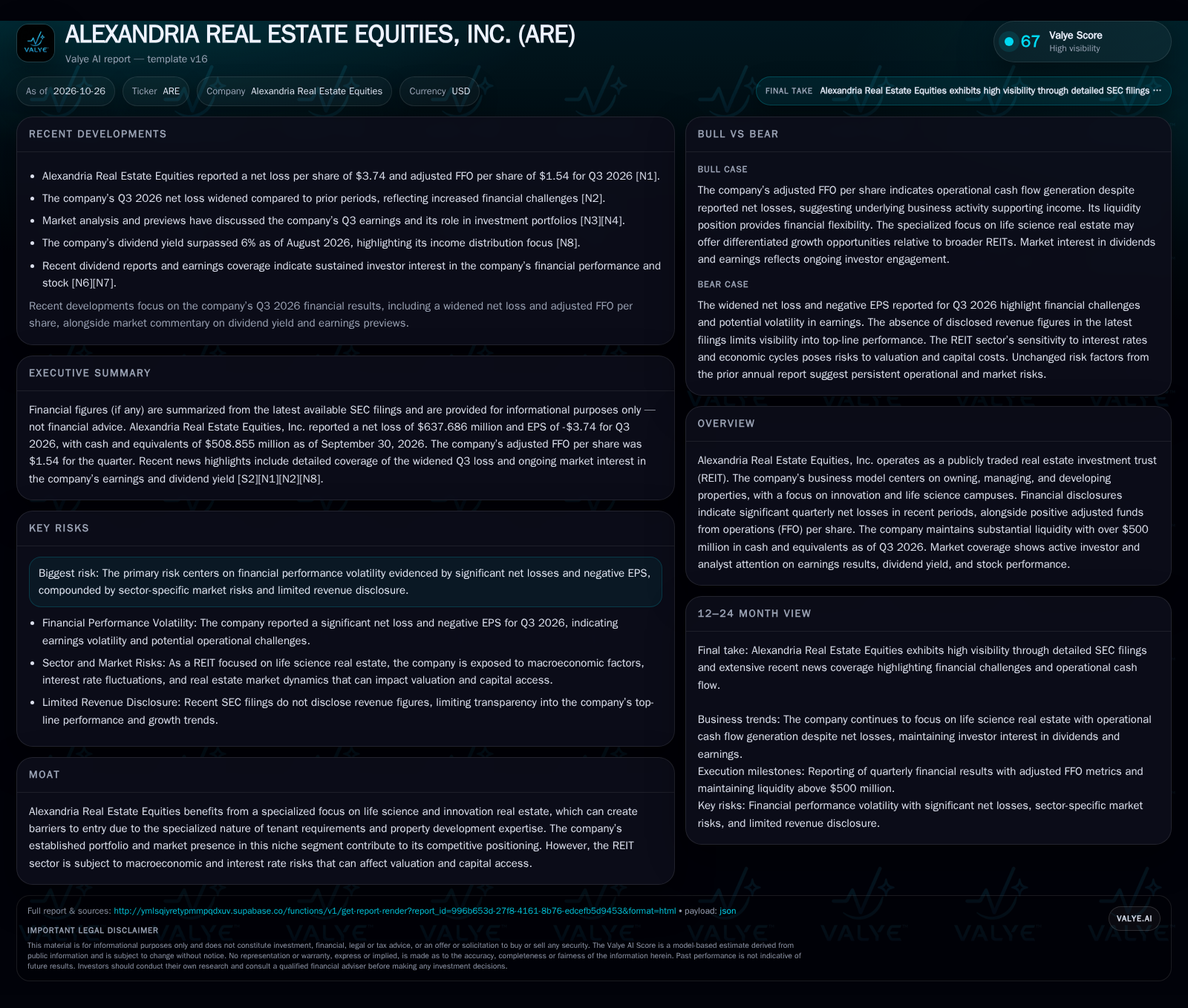
Alexandria Real Estate Equities faces a widening net loss and a dividend yield exceeding 6%, underscoring the tension between income distribution and underlying profitability. Its specialized life science real estate portfolio provides both a competitive moat and exposure to sector-specific risk, while operational cash flow remains a crucial—but nuanced—pillar for sustaining investor confidence.
The cited source reports dividend-related activity; that disclosure alone does not establish dividend-policy continuity, management confidence, or a material constraint on capital flexibility. [S2] [N8]
Alexandria Real Estate Equities, a REIT specializing in life science and innovation campuses, is navigating a critical juncture. The cited source reports dividend-related activity; that disclosure alone does not establish dividend-policy continuity, management confidence, or a material constraint on capital flexibility. With over $500 million in cash and positive adjusted FFO, Alexandria’s operational foundation remains active. Yet, the absence of detailed revenue disclosure and persistent sector risk factors raise questions about the sustainability of its current strategy and the durability of its competitive edge in a shifting real estate environment. [S2] [N8]
Net Loss Deepens as Dividend Yield Rises: The Current Financial Picture
For the quarter ended September 30, 2026, Alexandria Real Estate Equities reported a net loss of $637.686 million, translating to -$3.74 per share. This marks a notable deterioration from prior periods and has drawn market attention to the company’s profitability trajectory. Despite the loss, the company reported positive adjusted funds from operations (FFO) per share of $1.54, indicating that operational real estate activities continue to generate distributable cash flow. The company reported cash and liquidity metrics for the period; these figures do not by themselves establish operating runway, investment capacity, financial flexibility, or financing capacity. The company’s dividend yield exceeding 6% as of August 2026 further emphasizes its income-distribution stance, but also reflects investor skepticism regarding underlying fundamentals and future growth prospects. [S2] [N1] [N8]
How Alexandria’s Life Science Model Generates—and Consumes—Cash
Alexandria’s business model as a REIT centers on acquiring, developing, and leasing specialized properties—primarily life science campuses—to tenants in the biotechnology, pharmaceutical, and research sectors. Revenue is typically generated through long-term leases, which may offer some degree of cash flow predictability. However, the economics of specialized life science real estate are capital intensive: building and maintaining lab-ready facilities require significant upfront investment, and ongoing tenant improvements can be costly.
That said, the widening net loss points to either non-cash charges (such as depreciation or impairments), higher interest expense, or other structural pressures. The lack of disclosed revenue figures in recent filings clouds visibility into rental growth, occupancy trends, and the true health of the top line. In a rising-rate environment, Alexandria’s ability to refinance debt or fund new developments at attractive terms could also be challenged, potentially squeezing both margins and growth optionality.
Specialization as a Double-Edged Sword: Niche Strength Meets Sector Headwinds
Alexandria’s focus on life science and innovation real estate provides a degree of differentiation from general office and commercial REITs. The technical requirements for biotech tenants—such as lab infrastructure, utility redundancy, and proximity to research clusters—create barriers to entry for new competitors and support longer lease terms. This specialization can translate into higher average rents and stickier tenant relationships.
However, this niche focus also exposes Alexandria to concentrated demand risk. Life science tenants, while often well-capitalized, can be sensitive to funding cycles, regulatory changes, and shifting R&D priorities. Broader macroeconomic and interest rate pressures may dampen capital availability for biotech expansion, leading to potential softness in leasing demand or rent growth. Competing landlords with deep sector expertise or access to lower-cost capital could also erode Alexandria’s relative advantage if the sector’s growth slows or tenant credit quality deteriorates.
Unlocking Value Through Operational Resilience and Sector Tailwinds
The most constructive scenario for Alexandria hinges on continued demand for high-quality life science real estate, enabling stable occupancy, resilient rental rates, and robust operational cash flow. If biotech and pharmaceutical R&D spending remains strong, Alexandria could see lease renewals at favorable terms and new development opportunities in key innovation hubs.
Confirmation of this scenario would require evidence of rising occupancy rates, growth in adjusted FFO, and a narrowing gap between GAAP net income and FFO (suggesting fewer non-cash or non-recurring charges). External validation could come from new multi-year lease announcements with blue-chip tenants, or successful refinancing of debt at manageable rates despite a challenging capital markets environment.
Stability Amid Financial Strain: Sustaining Dividends Despite Headwinds
Adjusted FFO remains positive, covering the dividend, but net losses persist due to high depreciation, interest costs, or asset impairments. The company’s liquidity position remains adequate, but new development is selectively curtailed or funded at higher costs.
A modest reduction in net loss—driven by cost controls or asset sales—would support the view that Alexandria is managing through the cycle without destabilizing its core platform. However, any sharp drop in occupancy, negative lease spreads, or a dividend cut would falsify this scenario and point to deeper structural issues.
Dividend at Risk if Operational Cash Flow Falters or Sector Weakness Deepens
In a more adverse scenario, Alexandria’s operational cash flow declines due to sector contraction, tenant defaults, or a sharp drop in leasing demand. Rising interest rates or tightening credit markets could further pressure financing costs, while ongoing capital expenditures for tenant improvements continue to drain cash. If adjusted FFO falls below the dividend requirement, the company may be forced to cut its payout, eroding its appeal to income-focused investors.
A further widening of net losses, especially tied to asset impairments or failed developments, would reinforce the risk of longer-term value erosion.
Testing the Alexandria Thesis: What Could Shift the Outlook
Any disclosure or reporting of top-line revenue figures, which would provide needed visibility into rental growth, occupancy, and portfolio health.
Quarterly changes in cash and cash equivalents, as declining balances could signal funding stress or unsustainable payout levels.
Updates on lease renewal rates, new lease signings, and occupancy levels—particularly in core life science hubs—which would indicate real-time demand strength or weakness.
Announcements regarding new development starts, major capital expenditures, or asset sales, as these moves would reveal management’s appetite for growth versus balance-sheet preservation.
Interest rate trends and the company’s weighted average cost of debt, since higher rates could pressure both profitability and development economics.
Disclaimer: This is research-only, informational analysis and not investment advice. It may include AI-generated interpretation and general industry context. Always verify important details using primary sources.

Comments