
Acumen Pharmaceuticals: Alzheimer’s Trial Data and Delivery Advances Set Stage for Upcoming Year
Acumen Pharmaceuticals stands at a clinical and strategic crossroads as it targets late-2026 topline results for its Phase 2 Alzheimer’s antibody, sabirnetug. The company’s focused approach to toxic amyloid-beta oligomers, paired with advances in drug delivery and a collaborative pipeline, underpins its differentiated thesis.
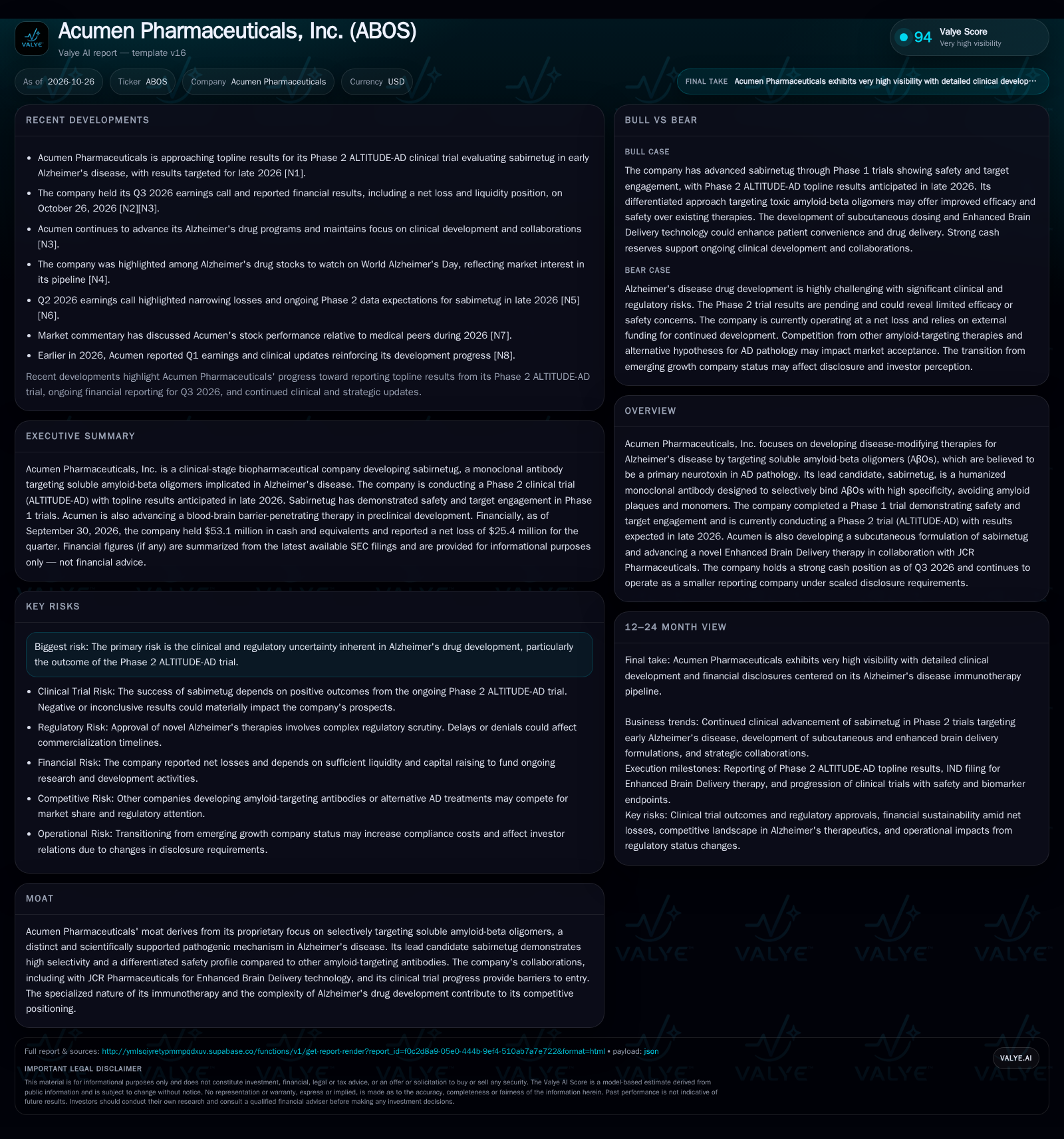
Acumen’s lead Alzheimer’s antibody, sabirnetug, is set for late-2026 Phase 2 readout, with intravenous and subcutaneous formulations in development. The company is advancing blood-brain barrier-penetrating therapies and has $53.1 million in cash alongside $25.5 million in short-term investments as of Q3 2026. The next year will likely determine the company’s clinical and financial trajectory, with topline ALTITUDE-AD results as the central inflection point. [S1] [S2] [N3]
Acumen Pharmaceuticals is approaching a defining moment as it advances sabirnetug, a next-generation antibody against soluble amyloid-beta oligomers, through a pivotal Phase 2 trial targeting Alzheimer’s disease. With topline results expected in late 2026, the company’s future hinges on clinical success, innovative delivery strategies, and its ability to finance development in a notoriously high-risk field.
Upcoming 12 Months Marked by Alzheimer’s Trial Progress and Financial Viability
Acumen Pharmaceuticals’ most material current facts are: (1) its lead candidate, sabirnetug, is in a 542-patient Phase 2 trial (ALTITUDE-AD) for early Alzheimer’s disease, with topline results expected in late 2026; (2) the company reported $53.1 million in cash and $25.5 million in short-term investments as of September 30, 2026; (3) Acumen posted a quarterly net loss of $25.4 million, reflecting the capital-intensive nature of late-stage drug development; and (4) it is advancing both intravenous and subcutaneous formulations, along with a next-generation, blood-brain barrier-penetrating therapy in preclinical development. The company reported cash and liquidity metrics for the period; these figures do not by themselves establish operating runway, investment capacity, financial flexibility, or financing capacity. [S1] [S2] [N3]
Potential Revenue Outcomes Tied to Clinical-Stage Alzheimer’s Innovations and Efficacy Results
Acumen’s business model is classic high-risk, high-reward biopharma: invest heavily in R&D with the aim of creating a first- or best-in-class therapy for a massive unmet need. If sabirnetug demonstrates clear efficacy and safety, the company could monetize through out-licensing, co-commercialization, or direct sales, each with distinct economics. Pricing power for novel Alzheimer’s immunotherapies has been demonstrated by recent FDA-approved entrants, which often command annual prices in the $15,000–$30,000 range. However, payer and regulatory scrutiny is intense, and real-world adoption depends on both clinical benefit and practical delivery.
The development of subcutaneous and Enhanced Brain Delivery (EBD) versions could improve patient convenience and penetration, potentially expanding the addressable market and supporting premium pricing—provided these innovations are validated clinically and commercially. Fixed R&D and G&A costs create significant operating leverage, but the company’s net losses and finite cash position mean that, absent a major partnership or capital raise, dilution or debt may be needed to bridge to commercialization. If the technology is out-licensed, economics would hinge on upfronts, milestones, and royalties, which can vary widely depending on clinical data strength and competitive context.
Acumen’s Focus on Toxic Oligomers Differentiates It in a Competitive and Uncertain Landscape
Acumen’s claim to competitive advantage lies in its focus on soluble amyloid-beta oligomers rather than plaques or monomers, pursuing a scientifically supported but clinically unproven pathogenic mechanism in Alzheimer’s disease. If sabirnetug’s selectivity translates into better efficacy and fewer side effects (such as lower ARIA rates), it could differentiate against current amyloid-targeting antibodies approved in the U.S. and abroad. However, the Alzheimer’s field is intensely competitive, with large pharma and biotech peers pursuing both similar and alternative mechanisms—including tau-targeted therapies, small molecules, and even non-amyloid approaches.
The company’s proprietary EBD platform, developed with JCR Pharmaceuticals, could offer a future edge by improving brain penetration, but this remains preclinical. Switching costs and stickiness in the Alzheimer’s market are typically low unless a product demonstrates clear clinical superiority or significant ease-of-use advantages—such as subcutaneous administration or less burdensome monitoring. Acumen’s competitive position will ultimately depend on comparative data, regulatory outcomes, and its ability to secure commercial or development partners.
Positive Sabirnetug Results Could Elevate Acumen’s Appeal for Partnerships or Acquisition
The most favorable scenario for Acumen is that ALTITUDE-AD delivers statistically significant and clinically meaningful cognitive and biomarker improvements, with acceptable safety, in its target population. This would validate the toxic oligomer hypothesis and position sabirnetug as a differentiated entrant in the Alzheimer’s market. The development of subcutaneous and EBD formulations could further broaden the market by improving access and convenience.
Such an outcome would likely attract major pharma partners or acquirers, enabling lucrative licensing deals or a premium buyout, and would provide the leverage to negotiate strong economics (upfront payments, milestones, and royalties) on future commercialization. Evidence that would confirm this scenario includes robust topline efficacy and safety data, positive biomarker shifts, and post-readout announcements of new collaborations or strategic investments. Falsification would come from neutral or negative Phase 2 results or safety signals that limit the drug’s profile.
Data Readout Likely to Trigger Revaluation, with Financing and Partnerships Crucial for Continuity
The most likely path is that Acumen advances sabirnetug through the Phase 2 trial, with results that are ambiguous or modestly positive—insufficient for immediate regulatory filing but enough to justify further development. In this scenario, the company may need to raise additional capital before data readout or shortly thereafter, potentially through equity or partnership. The subcutaneous and EBD programs offer valuable optionality but will require further validation and investment.
Confirmation of this scenario would come from continued R&D progress, measured cash burn, efforts to secure non-dilutive funding, and constructive dialogue with potential partners. Falsification would occur if the company encounters clinical setbacks, unforeseen safety issues, or an inability to secure necessary funding before the pivotal data milestone.
Negative Trial Outcomes or Funding Gaps May Lead to Strategic Retrenchment or Asset Divestiture
The primary risk is that ALTITUDE-AD results are negative or fail to meaningfully differentiate sabirnetug from existing or emerging therapies, undermining the core scientific thesis. In this case, Acumen would likely struggle to attract partners or investors, and the value of its EBD and other pipeline assets would be discounted heavily. With ongoing net losses and a cash runway that does not extend beyond the next major milestone, the company could be forced to pursue strategic alternatives—such as out-licensing remaining assets on unfavorable terms, reducing workforce and R&D spend, or seeking a sale under distressed conditions.
Confirmation of the downside would include disappointing clinical data, a sharp drop in stock price, delays or difficulties in fundraising, and public statements about exploring strategic options. Falsification would require clear positive data or evidence of non-dilutive funding secured in advance of the readout.
Upcoming Milestones and Clinical Results Will Determine Acumen’s Alzheimer’s Outlook
Pace of enrollment and protocol adherence in the Phase 2 ALTITUDE-AD trial, as delays could impact the timing and credibility of topline data. [S1] [N3]
Clarity and magnitude of topline efficacy and safety data for sabirnetug, particularly cognitive endpoints and ARIA rates relative to existing antibodies. [S1] [N3]
Progression of subcutaneous and Enhanced Brain Delivery programs, including new clinical or preclinical data releases and regulatory filings. [S1]
Updates on partnership discussions, licensing deals, or strategic collaborations—particularly any with large pharma or global biotech. [S1]
Any announced plans for equity or debt financing, including timing, size, and terms, which would clarify the company’s ability to reach and exploit key inflection points. [S2]
Changes in regulatory or reimbursement landscape for Alzheimer’s drugs, which could affect market access and pricing assumptions for sabirnetug and future assets.
If disclosed, early signals of real-world demand or interest from clinicians and patients, such as expanded access requests or advocacy group endorsements.
Disclaimer: This is research-only, informational analysis and not investment advice. It may include AI-generated interpretation and general industry context. Always verify important details using primary sources.

Comments