
Hartford Insurance Group: Underwriting Gains, Strategic Moves, and the Next Phase of Leadership
Hartford Insurance Group’s latest quarter saw underwriting gains and investment income drive net income higher, despite pressure from disability losses and rising costs. With a new CEO set to take the helm and the Equitable deal targeting benefits growth, the company’s ability to execute disciplined risk management and strategic integration becomes the central test for sustaining momentum.
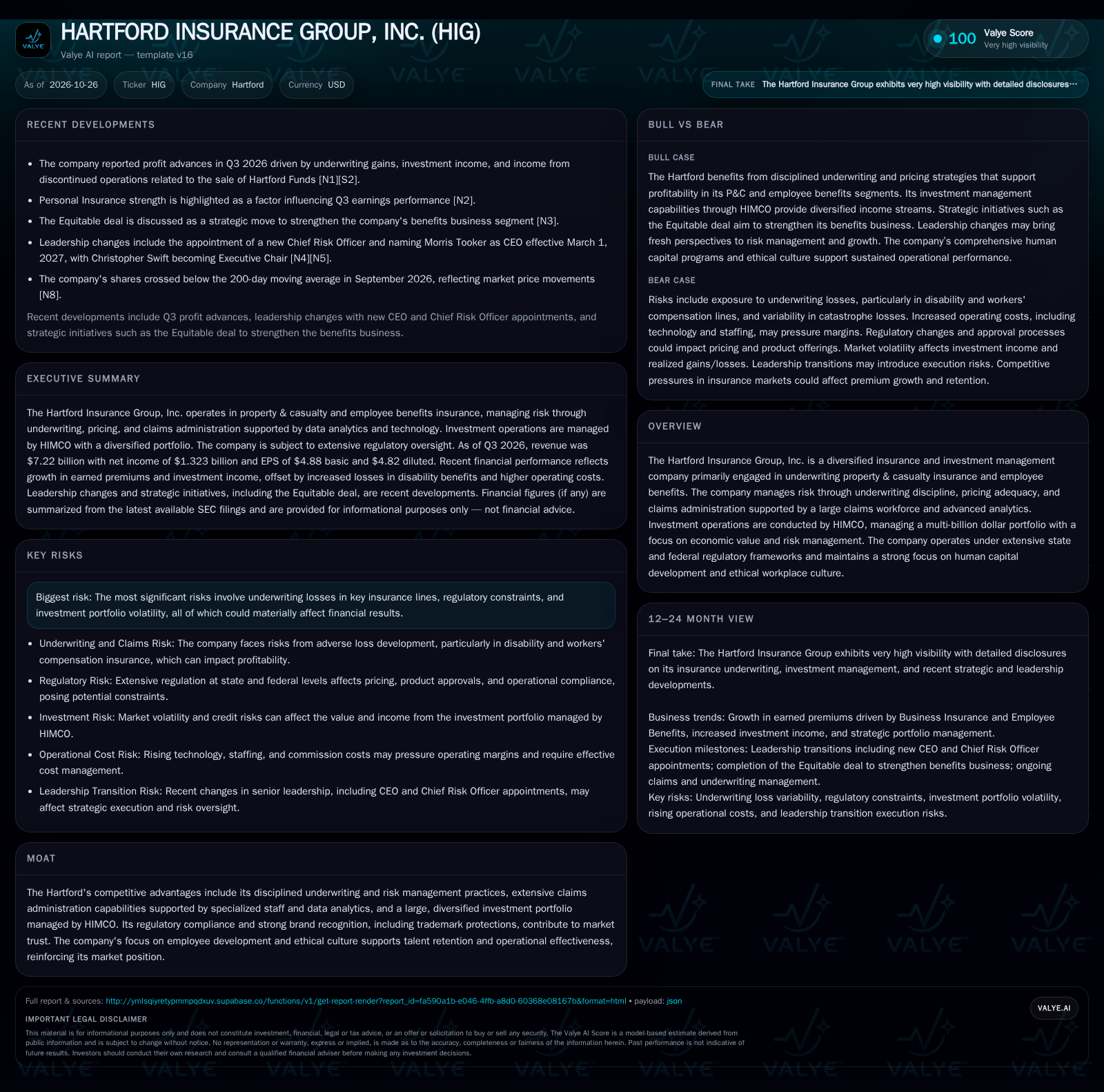
Hartford Insurance Group reported strong Q3 2026 results, with net income growth supported by gains in property & casualty underwriting, higher investment income, and the sale of Hartford Funds. Leadership transitions and the Equitable deal mark a strategic shift, focusing on expanding the benefits segment. Key challenges include rising disability losses, increased operating costs, and the need to maintain underwriting discipline in a competitive, regulated market. The company’s investment management arm, HIMCO, continues to contribute to earnings, but market volatility and regulatory constraints remain material risks. Execution on benefits integration and leadership transition will be pivotal over the next year. [S2] [N1] [N3] [N4] [N5]
Hartford Insurance Group’s recent financial results underscore a business in transition. While the company posted robust Q3 2026 earnings, propelled by property & casualty underwriting gains and higher investment returns, it also faces mounting disability insurance losses and rising operating costs. At the same time, Hartford is undergoing significant leadership changes and pursuing strategic deals, notably the Equitable acquisition to bolster its employee benefits franchise. The next phase will test Hartford’s ability to maintain disciplined risk selection and cost control as it integrates new assets and leaders in a challenging, regulated insurance landscape.
Recent Results and Strategic Shifts: What’s Changing at Hartford?
Hartford Insurance Group reported Q3 2026 revenue of $7.22 billion and net income of $1.323 billion, with basic EPS of $4.88 and diluted EPS of $4.82. This performance was powered by higher property & casualty (P&C) underwriting gains, increased investment income, and a one-time income boost from the sale of Hartford Funds. Earned premiums grew 5%, led by Business Insurance and Employee Benefits, while Personal Insurance auto policies saw a decline. Disability losses in Employee Benefits rose, but P&C losses dropped due to favorable reserve development and lower catastrophe claims. Operating costs also increased, particularly from technology upgrades, staffing, and commissions. The company is executing a strategic pivot with the Equitable deal to expand its benefits business, and is in the midst of a leadership transition, with Morris Tooker set to become CEO in March 2027 and Christopher Swift moving to Executive Chair. [S2] [N1] [N3] [N4] [N5]
How Hartford Makes—and Risks—Money: Pricing, Claims, and Investment Leverage
Hartford’s core economic engine is the underwriting of property & casualty and employee benefits insurance, where profitability depends on disciplined risk selection, pricing adequacy, and effective claims management. Premium pricing is generally regulated, especially in standard lines, limiting immediate pricing flexibility and making risk modeling and portfolio diversification essential for margin protection. The company’s excess and surplus lines provide some leeway for risk-based pricing, but these are a smaller portion of the overall book.
On the cost side, claims administration is labor-intensive, with over 6,700 employees dedicated to this function and significant investment in analytics and catastrophe response. Loss and loss adjustment expenses are a major variable cost, particularly in volatile lines like disability and workers’ compensation. Fixed costs are rising, especially from technology and compliance, contributing to operational leverage but also margin sensitivity if premium growth slows.
Investment income, managed through HIMCO, is the second pillar of earnings. Hartford’s $121.9 billion managed portfolio leverages diversification, duration matching, and active asset allocation—including alternatives and derivatives—to both fund insurance liabilities and generate returns. This means Hartford’s bottom line is exposed to interest rate moves, credit cycles, and capital market volatility. While the company’s investment approach can smooth earnings over time, sudden market shocks or asset impairments could pressure results. [S1] [S2]
Competitive Edge or Squeezed Margins? Assessing Hartford’s Position in Insurance and Asset Management
Hartford competes with other national and regional insurers in P&C and employee benefits, including both legacy carriers and digitally enabled new entrants. Its discipline in underwriting and risk management, along with a long-standing brand and regulatory standing, provides trust and some insulation against purely price-based competition. The breadth of its product suite across business, personal, and group lines allows for diversification, but also exposes the company to multiple sources of claims volatility.
The company’s claims administration scale, data analytics, and catastrophe response teams are potential differentiators—especially in handling complex, multi-jurisdictional events or large group accounts. However, technological advances are rapidly diffusing across the industry, and maintaining a lead in analytics and service may require sustained capital investment. In asset management, HIMCO’s scale offers Hartford the ability to manage both proprietary and third-party assets, but returns are subject to the same market forces affecting peers. Regulatory compliance is both a moat and a constraint: while it creates barriers to entry, it also limits pricing agility and product innovation.
What Would Drive Sustained Outperformance? The Case for Hartford’s Next Leg of Growth
A favorable scenario hinges on Hartford successfully integrating the Equitable deal to expand its Employee Benefits segment, achieving cross-selling with existing business clients, and maintaining underwriting discipline as it grows. If the company leverages advanced analytics to further refine risk selection—especially in disability and workers’ compensation lines—it could mitigate loss volatility and improve combined ratios. Technology investments that translate into automation and better customer experience could drive efficiency and retention.
On the investment side, if HIMCO continues to outperform benchmarks through active management and alternative asset allocations, investment income could remain a stable earnings driver even amid rate volatility. Leadership transition would need to proceed smoothly, with new management keeping the company’s risk culture intact while pursuing growth. Evidence confirming this scenario would include sustained premium growth in Employee Benefits, improved loss ratios in disability, visible expense discipline, and higher recurring investment income. [N3] [N4] [N5]
Disciplined Growth Amid Margin Pressure: The Most Likely Outcome
The most plausible scenario is that Hartford continues to grow premiums modestly in Business Insurance and Employee Benefits, offsetting headwinds in Personal Insurance auto. Underwriting discipline is mostly maintained, but occasional spikes in disability or catastrophe claims cause earnings volatility. Operating costs, especially in technology and staffing, continue to rise, putting pressure on margins despite efficiency gains elsewhere. Investment income remains a positive but cyclical contributor, with returns tracking broader market trends.
The leadership transition is completed without major disruption, but integration of the Equitable acquisition delivers only gradual improvements to earnings and scale. Regulatory approval processes and rate constraints continue to limit rapid pricing adjustments, especially in competitive markets. Confirmation of this scenario would come from steady (but not accelerating) premium growth, relatively stable combined ratios, and persistent but manageable cost inflation. Misses on expense control or unexpected loss spikes would indicate downside risk. [S2] [N1] [N2]
When Risk Management Fails: Margin Compression and Strategic Missteps
The adverse scenario would see Hartford’s underwriting discipline erode—perhaps as a result of integration challenges with Equitable, talent turnover during leadership transition, or misjudged pricing in disability and workers’ compensation. If loss ratios in Employee Benefits or catastrophe-exposed P&C lines spike, earnings could fall sharply. Persistent inflation in technology and staffing costs, without offsetting efficiency, would further compress margins.
On the investment side, a market downturn or credit event could cause realized losses or impairments in the portfolio, reducing income and potentially pressuring capital. Regulatory action—such as disallowed rate increases or new compliance burdens—could further constrain profitability. Evidence supporting this scenario would be a sharp rise in combined ratios, negative reserve development, cost overruns, or delayed/incomplete execution of the Equitable integration or leadership transition. [S2] [N3] [N4] [N5]
Milestones That Will Define Hartford’s Strategic and Financial Trajectory
Earned premium growth rates by segment, especially Employee Benefits and Business Insurance, as a sign of successful integration and cross-selling from the Equitable deal.
Trends in loss ratios for disability and workers’ compensation insurance—if disclosed—to gauge underwriting discipline and claims volatility.
Expense growth, particularly technology and staffing costs, and the ratio of operating costs to premiums written.
Investment income stability and composition, including the proportion from alternatives and limited partnerships—would help assess portfolio resilience.
Progress on leadership transition, including retention of key executives and clarity on strategic direction under the new CEO.
Regulatory approvals and product rate filings, particularly in major markets like California, New York, Texas, and Florida.
Disclosures on realized investment gains/losses and any material impairments, which could signal portfolio stress or market-driven volatility.
Any updates on integration milestones and synergies from the Equitable deal—would help test the benefits expansion thesis.
Disclaimer: This is research-only, informational analysis and not investment advice. It may include AI-generated interpretation and general industry context. Always verify important details using primary sources.

Comments