
Brown & Brown’s Acquisition-Driven Playbook: Can Scale and Resilience Outpace Industry Headwinds?
Despite solid Q3 earnings and a reported liquidity position, Brown & Brown’s growth hinges on successfully integrating acquisitions and defending its commission-driven model against evolving market pressures. The next phase will test whether operational discipline and network scale can continue to deliver amid litigation risk and insurance pricing dynamics.
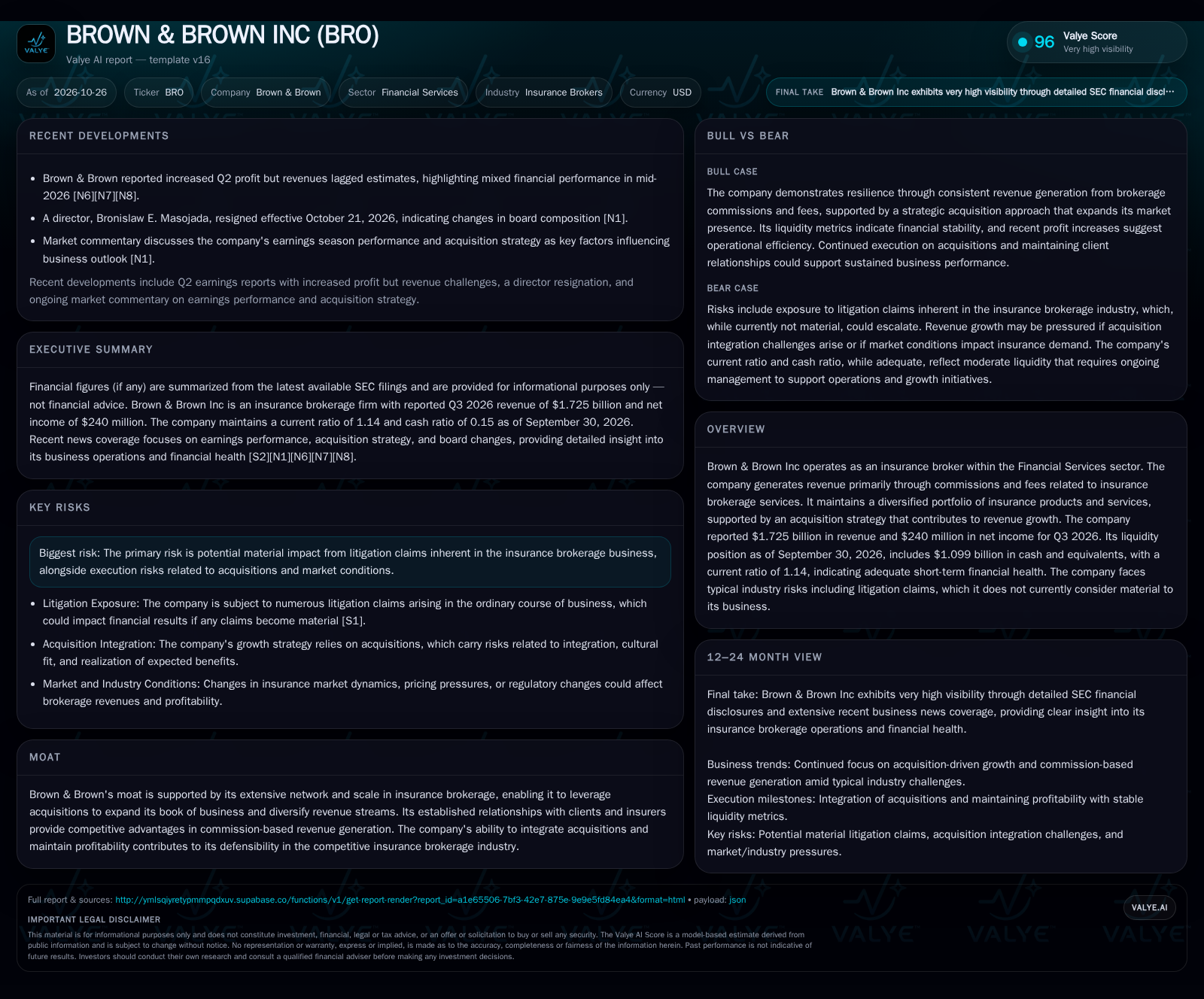
Brown & Brown reported Q3 2026 revenue of $1.725 billion and net income of $240 million, reflecting stable operations and modest profit growth. The company’s business model depends on commission and fee income, with recent profit improvement counterbalanced by revenue that lagged estimates. As it pursues an acquisition-led strategy, successful integration and risk management will be critical for sustaining momentum in a competitive brokerage landscape [S2] [N6] [N7] [N8].
Brown & Brown Inc, one of the largest insurance brokers in the U.S., continues to demonstrate both scale and adaptability in a shifting financial services landscape. With Q3 2026 revenue of $1.725 billion and net income of $240 million, the company’s stable operating results reflect resilience in its core commission-based model, even as revenue growth has recently lagged estimates. The company’s strategy of expanding through acquisitions brings both opportunity and integration risk, while industry-specific litigation and evolving market conditions present ongoing challenges. The next 12-24 months will reveal whether Brown & Brown’s disciplined approach and network advantages are sufficient to sustain outperformance in a competitive sector [S2] [N6] [N7] [N8].
Recent Earnings, Board Changes, and Litigation Snapshot: Setting the Stage
Brown & Brown reported $1.725 billion in revenue and $240 million in net income for Q3 2026, underscoring its ongoing profitability in the insurance brokerage sector [S2]. This performance follows a Q2 that saw profit increases but revenue short of analyst expectations, suggesting that margin management—rather than top-line acceleration—has been the near-term focus [N6] [N7] [N8]. The company reported cash and liquidity metrics for the period; these figures do not by themselves establish operating runway, investment capacity, financial flexibility, or financing capacity. [S2] Notably, a director resignation in October 2026 signals board-level evolution, while litigation exposure remains a background risk but is not currently material to operations [S1] [N1]. Together, these facts frame a business that is operationally sound but facing classic industry headwinds and execution tests.
Commission Revenue and Operating Leverage: Anatomy of Brown & Brown’s Profit Engine
Brown & Brown’s core economics are rooted in commissions and fees earned by brokering insurance policies for commercial and retail clients. This model is characterized by relatively low capital intensity versus primary insurers: the company does not underwrite risk but acts as an intermediary, earning a share of premiums placed. Revenue scales with policy volume, premium pricing, and client retention, while costs are largely variable—primarily compensation for producers and sales teams—though fixed overhead can rise with expansion.
Operating leverage emerges as the company grows its book: incremental commission revenue can drive profit expansion if fixed costs are contained. However, the model is exposed to fluctuations in insurance pricing cycles and competition from both large and boutique brokers. Brown & Brown’s acquisition strategy introduces additional economics—acquired books of business may yield immediate revenue but require integration spend, and the realization of synergies is not guaranteed. Cash flow is typically strong, but ongoing acquisition activity can place demands on liquidity and management bandwidth. [S2]
A deeper examination of Brown & Brown's commission-based revenue model reveals sensitivity to external insurance market cycles, which can influence premium pricing and client retention patterns. In periods of rising insurance rates, commission revenues may increase, but higher premiums can also pressure client budgets, potentially reducing policy volumes or prompting clients to seek alternative coverage options. Conversely, soft market conditions with declining premiums can compress commission income unless offset by volume growth. This cyclical exposure requires the company to maintain agile cost structures and diversify its client base across industries and geographies to mitigate localized downturns. Furthermore, the reliance on producer compensation as a significant variable cost introduces operational risk: incentive structures must balance motivating sales growth against margin preservation, especially during integration phases when cultural alignment and retention are critical.
Defending Share in a Crowded Brokerage Arena: Scale, Relationships, and Acquisition Prowess
Brown & Brown competes in a market dominated by a handful of global brokers and numerous regional players. Its competitive advantages stem from national scale, a broad network of insurer and client relationships, and a demonstrated ability to grow through acquisitions. This scale enables some negotiating leverage and cross-selling, but the industry remains highly fragmented, with new digital platforms and insurtech entrants threatening to erode traditional broker margins.
The company's defensibility is underpinned by established relationships and the complexity of insurance placement, which can create moderate switching frictions for commercial clients. However, commoditization pressures, regulatory change, and the potential for direct-to-consumer digital channels could weaken the broker’s role over time. Brown & Brown’s ability to integrate acquired agencies efficiently and maintain service quality is central to preserving its edge. If integration stumbles or client churn rises, competitive position could erode quickly.
The brokerage industry’s competitive dynamics are increasingly shaped by technological innovation and evolving client expectations. Brown & Brown’s scale provides advantages in negotiating with insurers and cross-selling, but the rise of digital platforms introduces disintermediation risk, especially for commoditized insurance products. The complexity of commercial insurance placements currently supports broker value-add, but as insurtech solutions mature, automation of routine underwriting and claims processes could reduce barriers to entry for new competitors. Brown & Brown’s ability to invest in technology-enabled service delivery and data analytics will be crucial to sustaining differentiation. Additionally, regulatory developments impacting broker compensation structures or data privacy could alter competitive positioning, underscoring the importance of proactive compliance and adaptive business models to preserve client trust and operational resilience.
When Acquisitions Click: Unlocking Synergy and Expanding Margins
The most favorable outcome for Brown & Brown involves a continuation of successful acquisitions, with rapid integration, minimal client attrition, and realization of cost and revenue synergies. In this scenario, the company leverages its scale to negotiate better terms with insurers, cross-sell additional products, and maintain high retention rates among acquired clients. Operating leverage could drive margins higher as fixed costs are spread over a growing revenue base.
Confirmation would come from above-industry-average organic revenue growth, expanding margins, and consistently positive free cash flow even after acquisition outlays. Evidence of declining expense ratios, stable or improving client retention (if disclosed), and continued profit growth despite market volatility would all support this scenario. Accelerated acquisition activity with minimal disruption—reflected in smooth quarterly results and stable management turnover—would further validate the upside thesis.
Acquisition Integration Balances Margin Gains with Competitive Pressures
The most likely course is that Brown & Brown continues to add to its book of business through a steady cadence of acquisitions, while maintaining moderate organic growth from its existing base. Margins may improve incrementally as integration processes become more standardized, but revenue growth is likely to remain in line with broader insurance market trends and subject to cyclical pricing.
Cost discipline and reported liquidity position will allow the company to weather periodic litigation or regulatory events, but not without episodic headwinds to profit or cash flow. [S2] The base case would be supported by continued, if modest, net income growth, stable or improving operating margins, and the absence of material litigation or integration failures.
Integration Missteps or Litigation Surprises Could Derail Growth
A negative turn could occur if Brown & Brown faces significant litigation that becomes material, resulting in financial penalties or reputational harm. Alternatively, if the pace of acquisitions accelerates beyond management’s ability to integrate them, operational disruptions could lead to client losses, unexpected expenses, and margin compression.
Rising turnover among producers or key executives, if disclosed, would also be a red flag. In this scenario, the company could be forced to slow its acquisition pace or divest underperforming segments, ceding market share to more efficient competitors.
Milestones That Will Define Brown & Brown’s Next Chapter
Organic revenue growth rate, if disclosed, to differentiate between acquisition-driven and underlying business momentum.
Expense ratio trends: sustained declines would indicate successful integration and operating leverage.
Client retention and churn rates, if disclosed, as a measure of integration success and competitive pressure.
Size, frequency, and structure of new acquisitions—including purchase multiples and integration costs.
Legal expense trends and any disclosure of material litigation or regulatory investigations.
Changes in cash flow from operations and free cash flow after acquisition outlays.
Board and management turnover—particularly in integration, compliance, or key producer roles.
Any evidence of pricing pressure or commission compression from insurers or digital competitors.
Disclaimer: This is research-only, informational analysis and not investment advice. It may include AI-generated interpretation and general industry context. Always verify important details using primary sources.

Comments