
Bone Biologics: Advancing NELL-1 Bone Regeneration Amid Clinical Hurdles and Capital Pressures
Bone Biologics is aiming to transform spinal fusion outcomes through its proprietary NELL-1/DBM device, but faces a gauntlet of regulatory, clinical, and competitive risks as it moves from promising preclinical results into early-stage human trials—testing both scientific and commercial viability.
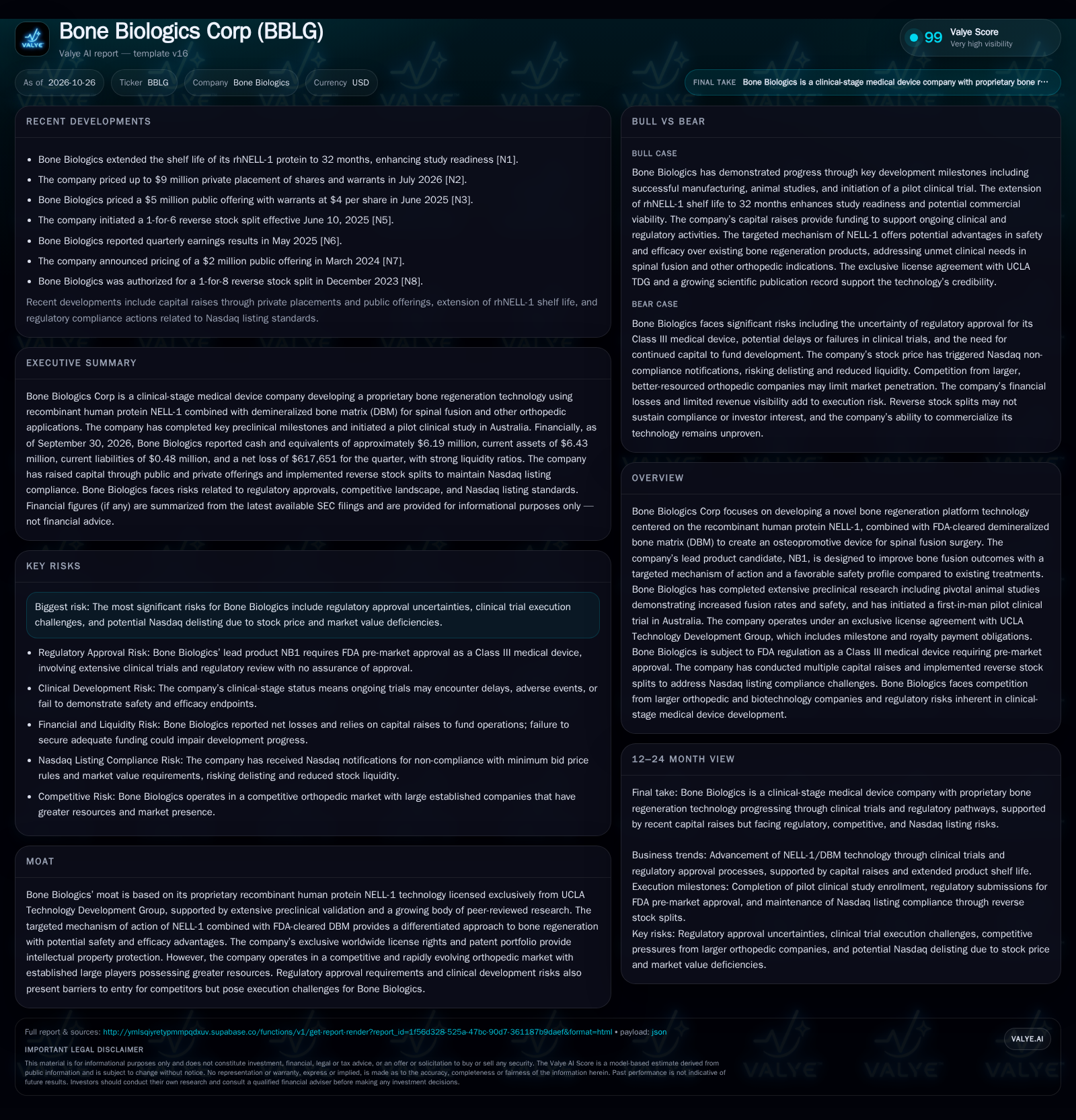
Bone Biologics is a clinical-stage medtech company developing the NELL-1/DBM device for enhanced spinal fusion. Recent milestones include the extension of rhNELL-1 shelf life to 32 months, ongoing pilot human trials, and substantial capital raises. However, the company is contending with persistent losses, Nasdaq compliance threats, and the daunting challenge of moving a Class III device through FDA approval. Its prospects hinge on clinical trial outcomes, regulatory progress, and ability to carve out a niche in a market dominated by established orthopedic giants. [S2] [N1] [N2]
Bone Biologics sits at a critical junction for clinical-stage medical technology companies: having advanced its proprietary NELL-1/DBM device from years of preclinical research into a first-in-human pilot trial, it now faces the steep hill of clinical validation, regulatory approval, and commercial adoption. With recent advances such as extending the shelf life of rhNELL-1—potentially improving operational flexibility—and fresh capital infusions, the company has shored up some near-term resources. Yet, persistent net losses, Nasdaq listing challenges, and the formidable landscape of established orthopedic competitors mean that the company’s future will be determined less by historical technical milestones and more by its ability to deliver clinical results, regulatory progress, and a credible commercial plan over the next 12-24 months. [S2] [N1] [N2]
Recent Milestones and Financial Position: Where Bone Biologics Stands Now
Bone Biologics has recently extended the shelf life of its recombinant human NELL-1 protein to 32 months, which is a practical step forward for supporting ongoing and future clinical studies, as longer shelf life reduces supply chain risks and enhances readiness for multi-site or extended-duration trials. [N1]
The company is running a first-in-man pilot clinical study in Australia, targeting up to 30 adults undergoing lumbar spinal fusion for degenerative disc disease. This trial is designed to generate the first human safety and effectiveness data for the NB1 device, a critical requirement for eventual FDA pre-market approval as a Class III device. [S2]
Financially, as of September 30, 2026, Bone Biologics reported a cash and equivalents balance of $6.19 million, current assets of $6.43 million, and current liabilities of $0.48 million, resulting in a current ratio above 13. The company posted a net loss of $617,651 for the quarter. [S2]
Recent capital raises include a $9 million private placement in July 2026 and a $5 million public offering in June 2025. However, Nasdaq has notified the company of non-compliance with minimum bid price rules, and management is considering further reverse stock splits to maintain listing status. [N2] [S2]
How Commercial Value Could Be Created—and the Economic Levers at Stake
The business model for Bone Biologics hinges on successfully bringing the NB1 device to market for spinal fusion procedures—a segment with high clinical need but also intense competition and regulatory scrutiny. Revenue would likely be driven by per-procedure device sales to hospitals and surgeons, with pricing power dependent on demonstrated superiority over existing bone grafts and biologics. The NB1 kit, combining proprietary NELL-1 protein with FDA-cleared DBM, could command premium pricing if it delivers better fusion rates, safety, or convenience.
As a medical device, gross margins may be attractive if the recombinant protein can be manufactured at scale and the DBM component continues to be sourced efficiently. However, the cost structure at this stage is dominated by R&D, clinical trial expenses, regulatory consulting, and milestone/royalty payments to UCLA. Fixed costs are high and operating leverage will only emerge if the company transitions to commercial sales after FDA approval.
Capital needs remain substantial: ongoing clinical study costs, regulatory submissions, and potential expansion into other orthopedic indications all require persistent funding. The company has relied on equity offerings, but future dilution is likely unless non-dilutive partnerships, licensing, or strategic investments can be secured.
Defining—and Testing—the Edge in a Crowded Orthopedic Market
Bone Biologics claims differentiation via the targeted mechanism of NELL-1, which is designed to promote bone regeneration more selectively than generic bone morphogenetic proteins (BMPs) or autograft solutions. If clinical data confirm a superior safety and efficacy profile, NB1 could address known limitations of existing products, such as adverse events linked to BMP-2.
The company’s exclusive license from UCLA and supporting patent portfolio provide some intellectual property protection, but the orthopedic market is dominated by large players with established surgeon relationships, broad product lines, and significant marketing resources. These incumbents can rapidly respond to new entrants via pricing, bundling, or accelerated development of their own biologic solutions.
Switching frictions in spinal fusion are significant: surgeons and hospitals are risk-averse, and payers demand robust evidence of value. Penetration will depend on peer-reviewed clinical results, reimbursement coverage, and the ability to integrate into established surgical workflows. Without clear, differentiated outcomes, NB1 risks being marginalized to niche or last-resort use.
What Success Would Look Like: From Clinical Proof to Market Uptake
The most favorable scenario is that Bone Biologics’ current pilot clinical study demonstrates compelling safety and efficacy, resulting in successful completion and positive data publication. This would provide the basis for a pivotal trial, support regulatory submissions, and potentially attract strategic partners or acquirers interested in novel bone regeneration technologies.
If the company can maintain sufficient funding through to regulatory milestones—either via additional capital raises, grants, or partnerships—it could progress toward FDA pre-market approval. Early commercial adoption could be accelerated if reimbursement is secured and if key opinion leaders validate the technology.
Evidence that would confirm this scenario includes: timely enrollment and completion of the current human trial, clear demonstration of clinical benefit over standard of care, announcements of partnership or licensing deals, and regulatory progress (e.g., FDA IDE or PMA submissions and acceptances).
Incremental Progress Amid Funding and Regulatory Uncertainties
The most plausible scenario is a drawn-out development path: Bone Biologics completes its pilot study, but results are mixed or require further validation, necessitating additional trials and prolonging the time to regulatory approval. The company continues to raise capital through dilutive offerings, keeping the lights on but limiting commercial momentum.
Market adoption remains on hold until substantial clinical evidence is available. The NB1 device may generate interest in niche academic or clinical settings, but broad uptake is unlikely without clear, peer-reviewed data and reimbursement clarity.
This scenario is confirmed by steady but slow progress in trial enrollment, lack of major partnership announcements, continued net losses, and recurring efforts to address Nasdaq compliance via reverse splits or new offerings.
Clinical, Regulatory, or Capital Setbacks Could Trigger Existential Risk
An adverse scenario unfolds if the ongoing clinical trial encounters safety issues, fails to meet efficacy endpoints, or experiences significant delays. Negative or inconclusive data would stall regulatory progress and could make further capital raising challenging.
If Nasdaq delisting occurs due to persistent bid price and market value deficiencies, public market access could be cut off, further restricting funding options and eroding investor confidence. In this scenario, Bone Biologics may be forced to pursue asset sales, strategic alternatives, or even wind-down if it cannot secure alternative funding.
Confirmation would come in the form of adverse trial readouts, major delays or modifications to study protocols, public disclosures of going concern risks, or actual delisting from Nasdaq.
Signals That Will Reveal the Commercial and Clinical Trajectory for Bone Biologics
Progress and outcomes from the ongoing first-in-man pilot clinical study—including enrollment rates, interim safety results, and eventual efficacy data—are the single most decisive factor.
Updates on FDA or international regulatory submissions, feedback, or milestones (such as IDE or PMA filings and acceptances) would clarify timelines and risk.
Any announcements of strategic partnerships, licensing deals, or non-dilutive funding sources would help validate commercial potential and reduce financing risk.
Nasdaq compliance status—including reverse split plans, minimum bid price cures, or actual delisting events—will affect capital markets access and investor sentiment.
Surgeon and hospital feedback, if disclosed, regarding trial participation or early use of the NB1 device would help assess real-world adoption prospects.
Extension of clinical applications beyond spinal fusion (e.g., trauma or osteoporosis indications) would indicate broader market ambition and potential upside.
Disclaimer: This is research-only, informational analysis and not investment advice. It may include AI-generated interpretation and general industry context. Always verify important details using primary sources.

Comments