
Easterly Government Properties: Navigating Government-Focused Real Estate Amid Revenue Headwinds
Despite a specialized focus on leasing to federal agencies, Easterly Government Properties faces pressure from missing recent revenue and FFO estimates. The durability of its government-tenant model, governance rigor, and risk management are strengths—yet ongoing questions remain about growth, capital allocation, and market resilience.
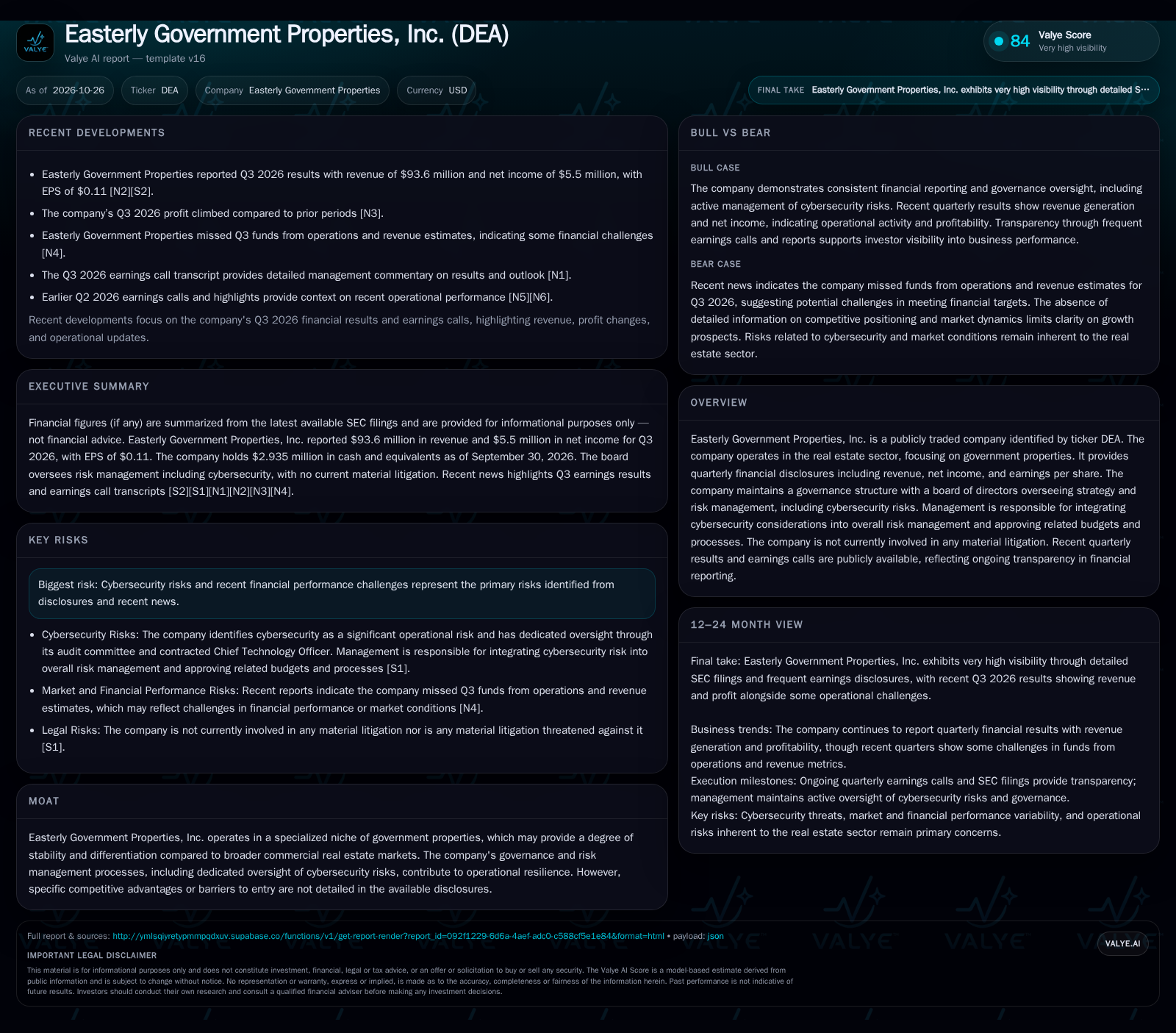
Easterly Government Properties reported $93.6 million in Q3 2026 revenue and $5.5 million in net income, but missed both funds from operations (FFO) and revenue estimates for the quarter. The company’s business centers on owning and managing government-leased properties, offering potential stability but raising questions about its ability to grow or defend margins as cost pressures and funding uncertainties mount. [S2] [N2] [N4]
Easterly Government Properties, Inc. is emblematic of a niche real estate investment trust (REIT) strategy: focusing on properties leased primarily to U.S. government agencies. While this approach is designed to deliver occupancy stability and relatively predictable cash flows, Q3 2026 results reveal a more complex picture. The company reported $93.6 million in revenue and $5.5 million in net income, but fell short of FFO and revenue expectations—a signal that even government-focused portfolios are not immune to performance pressures. [S2] [N2] [N4]
Recent Earnings Misses Highlight Execution Questions
Easterly Government Properties reported $93.6 million in revenue and $5.5 million in net income for Q3 2026, translating to $0.11 per share. However, the company missed both funds from operations (FFO) and revenue estimates for the quarter, according to recent news coverage. The company’s cash and cash equivalents stood at $2.935 million as of September 30, 2026. Notably, Easterly is not involved in any material litigation, and its board maintains active oversight of risk, including cybersecurity. [S2] [N2] [N4] [S1]
How the Government-Leased REIT Model Shapes Earnings and Capital Needs
Easterly’s core economics are driven by acquiring, owning, and managing properties leased to federal government agencies. This model is designed to provide high occupancy rates, long lease terms, and creditworthy tenants—attributes that typically translate to predictable cash flows and lower credit risk than most commercial REITs. Lease structures with government agencies often limit rent escalation and make operational flexibility more challenging, potentially capping upside during inflationary periods or in tight markets.
The company’s cost structure is characterized by high fixed costs (property maintenance, interest expense, and overhead), with variable costs largely limited to property-level operating expenses. Operating leverage can be favorable when occupancy is high and rents are stable, but the flip side is limited pricing power and less ability to pass through cost increases. Capital needs are ongoing: acquisitions, property improvements, and refinancing all require access to debt or equity markets.
Rental income from government agencies is generally stable, but the timing and magnitude of lease renewals, as well as the government’s own real estate footprint optimization efforts, can introduce lumpiness to cash flows. If disclosed, metrics such as lease rollover schedules, weighted average lease term (WALT), and government agency renewal rates would clarify the degree of cash flow predictability and risk.
Specialization as Differentiator—and Constraint
Easterly’s focus on government-leased properties sets it apart from more diversified or retail/commercial-oriented REITs. The government as tenant confers some insulation from private-sector volatility and credit risk, but also introduces unique constraints. The federal government tends to favor long-term leases and has high standards for security and facility quality, resulting in rigorous acquisition criteria and potentially higher upfront capex. However, rent escalations are often modest and government agencies periodically consolidate or reduce space, pressuring long-term growth.
Competition comes from other REITs and institutional investors targeting government and mission-critical real estate. The barriers to entry are moderate: while the federal leasing process is complex and relationship-driven, there is no absolute moat against well-capitalized rivals or new entrants with government contracting expertise. Substitution risk is limited in the sense that government agencies are unlikely to shift suddenly to alternative office models, but secular trends toward space efficiency and hybrid work could gradually erode demand.
In the current environment, the company’s competitive position hinges on its ability to source attractive properties, maintain high occupancy, and manage costs effectively. The absence of material litigation and visible governance rigor are positives, but the broader REIT sector’s challenges—rising interest rates, asset revaluations, and constrained capital flows—are also relevant here.
If Government Leasing Stability Outweighs Funding and Cost Pressures
The most favorable scenario for Easterly would be a period of continued high occupancy, successful lease renewals, and disciplined cost management, allowing the company to maintain or grow FFO and dividends despite sector headwinds. This outcome would be supported if government demand for secure, mission-critical facilities remains robust and portfolio churn is low. If interest rates stabilize or decline, refinancing and acquisition economics could improve, enabling accretive growth through new property acquisitions or selective development.
Evidence for this scenario would include a rebound in FFO per share, stable or rising occupancy rates, successful renewal of expiring leases (especially with major federal tenants), and the ability to close new deals at attractive cap rates. Improved capital markets access—such as a successful equity or debt raise—or a demonstrated ability to recycle capital through asset sales would also support the upside thesis.
Falsification would come from continued FFO misses, persistent revenue stagnation, or signs that government agencies are reducing leased space or demanding significant rent concessions.
Government-Tenant Stability Mitigates, But Doesn’t Eliminate, Revenue and Growth Headwinds
The most plausible near-term outcome is that Easterly maintains high occupancy and modest profitability, but with limited organic growth and ongoing margin pressure. The government-tenant model should continue to deliver low volatility in occupancy and rent collections, but muted rent escalations and cost inflation will likely constrain FFO and dividend growth. Acquisitions may be sporadic or opportunistic, rather than transformational, given the reported cash balance and likely dependence on external capital.
Confirmation would come from stable quarterly occupancy and rent collections, flattish FFO per share, and ongoing board oversight of risk and cybersecurity. Evidence of active lease renewal or gradual portfolio expansion would reinforce the base case. Falsification would be signaled by an unanticipated drop in occupancy, a spike in operating costs not offset by rent increases, or inability to refinance debt on reasonable terms.
Margin Compression and Funding Constraints Undermine the Defensive Thesis
A less favorable scenario would see Easterly’s FFO and earnings decline meaningfully due to a combination of rising operating and interest costs, inability to pass through rent increases, and difficulty accessing external capital for acquisitions or refinancing. In this scenario, government agencies could consolidate office space, delay renewals, or demand rent reductions, driving higher vacancy or lower effective rents.
Prolonged FFO underperformance, negative rental spreads, or a cut to the dividend would be clear evidence of downside realization.
A sudden increase in lease expirations without renewal, or a government policy shift toward reducing leased real estate, would further exacerbate the downside.
What Will Clarify the Resilience of Easterly’s Government-Focused Portfolio?
Portfolio occupancy rates and weighted average lease term (WALT), if disclosed, will indicate the stability and forward visibility of rental income.
Disclosure of lease renewal rates with federal tenants, or commentary on upcoming expirations, would help gauge the risk of revenue slippage.
Updates on government agency leasing trends, such as consolidation or space reduction initiatives, would directly impact demand for Easterly’s properties.
Any changes in interest expense or debt maturities, and management commentary on refinancing risk, will be critical given sector-wide credit tightening.
Cybersecurity incidents or elevated spending on risk mitigation, if reported, could influence both operating costs and tenant confidence.
Disclaimer: This is research-only, informational analysis and not investment advice. It may include AI-generated interpretation and general industry context. Always verify important details using primary sources.

Comments