
MindForge Inc.: Capital Raises, Rebranding, and the Challenge of Building Operational Credibility
MindForge Inc., formerly U-BX Technology Ltd., faces the dual task of remediating internal control weaknesses and demonstrating a viable business model amid persistent net losses and reported liquidity position. Recent capital raises and a rebranding initiative suggest strategic repositioning, but the company's future hinges on operational transparency, financial discipline, and the successful implementation of governance reforms.
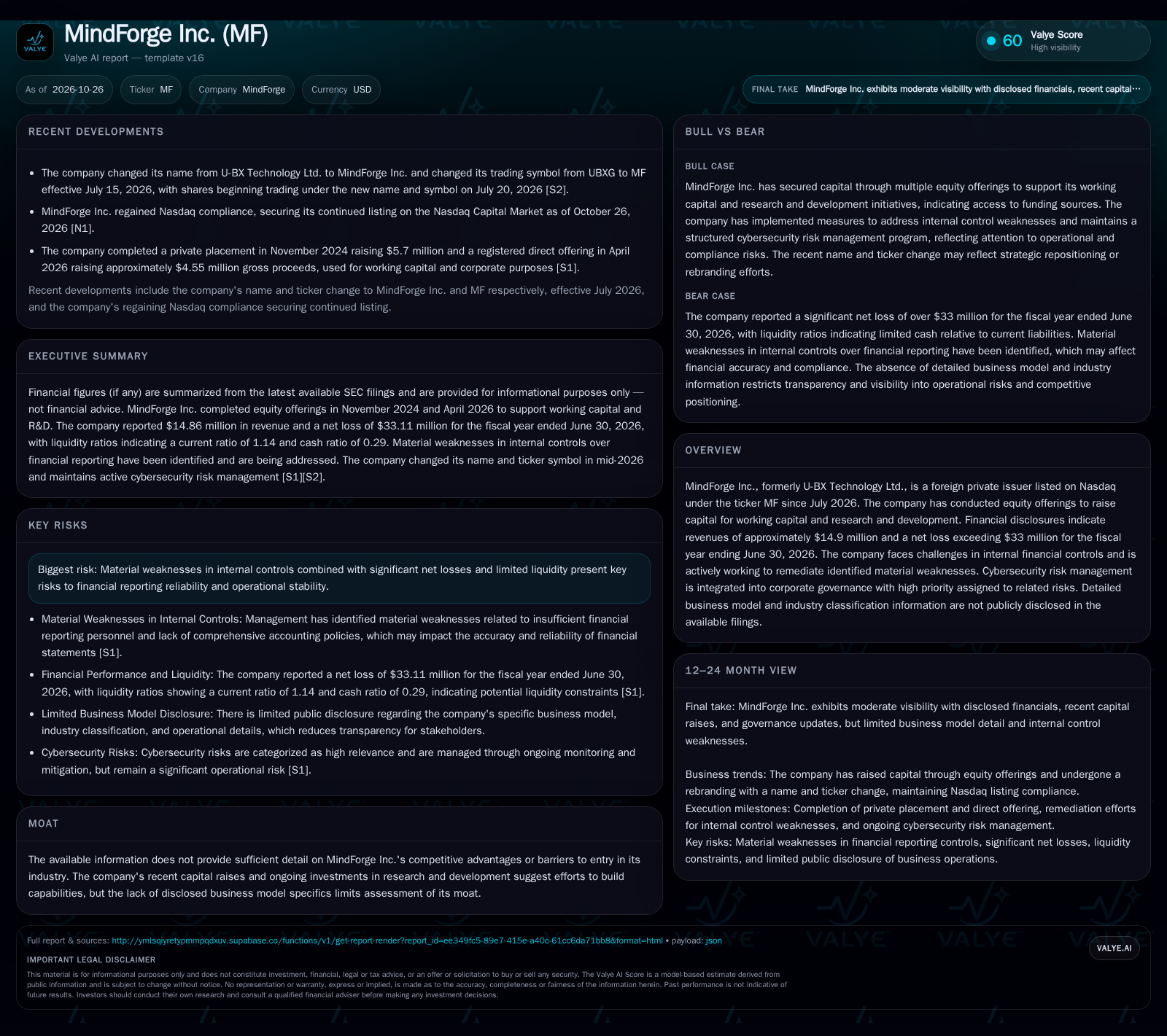
The company is addressing material weaknesses in internal controls and prioritizes cybersecurity, but lacks detailed public disclosure on its business model or industry, making future prospects highly dependent on credible execution and improved transparency. [S1] [S2]
MindForge Inc.’s recent financial disclosures paint a picture of a company at a crossroads: after raising over $10 million in equity and rebranding itself, it still contends with significant operating losses and material weaknesses in its internal controls. Whether MindForge can leverage its fresh capital and strategic rebranding into sustainable value creation remains an open question, one that will be answered as management executes on remediation and clarifies its commercial direction.
Recent Capital Infusions and Rebranding Mark a Transitional Phase
The company reported cash and liquidity metrics for the period; these figures do not by themselves establish operating runway, investment capacity, financial flexibility, or financing capacity. [S1] As of June 30, 2026, the company reported revenues of $14.86 million but a net loss of $33.11 million for the fiscal year, with cash and equivalents of $5.13 million against current liabilities of $17.69 million [S1]. Liquidity metrics, including a current ratio of 1.14 and cash ratio of 0.29, highlight ongoing financial strain despite the capital raises. The company’s name and ticker change to MindForge Inc. (MF) in July 2026 signals a strategic repositioning, potentially aimed at resetting market perception and aligning with new business ambitions [S2]. Meanwhile, management’s identification of material weaknesses in internal controls has prompted remediation efforts, including engaging financial consultants and providing additional CFO training [S1].
A critical aspect of MindForge’s transitional phase involves the interplay between its capital structure and operational execution. While the recent equity raises provide a temporary buffer against immediate liquidity pressures, the sustainability of this financial cushion depends heavily on the company’s ability to convert capital into productive assets or initiatives that generate positive cash flow. The timing and scale of investment in growth versus cost containment will be pivotal. If capital is disproportionately allocated toward unproven projects or if operational inefficiencies persist, the company risks accelerating cash depletion despite fresh funding. Conversely, disciplined capital deployment aligned with clear milestones could extend runway and improve investor confidence.
Uncertainty Around Revenue Drivers and Cost Structure Clouds Path to Profitability
While MindForge Inc. generated $14.86 million in revenue for the fiscal year, the lack of publicly disclosed business model details makes it difficult to assess the sustainability or scalability of its revenue streams [S1]. Without clarity on whether revenue is product- or service-driven, recurring or transactional, or the underlying customer base, it is challenging to gauge gross margins or the company’s ability to scale profitably. The net loss of $33.11 million suggests significant fixed or semi-fixed costs, likely from R&D, personnel, or infrastructure, that are not being covered by current revenues. The persistent losses highlight a business model that, at present, lacks operating leverage. If MindForge is pursuing an innovation- or technology-driven business, as the R&D spending hints, the economics could eventually improve with scale, but only if operating expenses become better aligned with revenue growth.
The cost structure underlying MindForge’s financials likely includes a mix of fixed and variable expenses, with a significant portion attributable to research and development and personnel costs. If the company’s business model is technology-centric, early-stage investment in innovation is expected, but it must eventually transition toward scalable revenue generation to achieve profitability. Economies of scale could reduce per-unit costs if the company secures larger customer contracts or expands recurring revenue streams. However, without visibility into customer concentration or contract terms, it is difficult to assess revenue predictability or risk of churn. A useful metric would be the ratio of recurring revenue to total revenue, which would help evaluate the stability and growth potential of the revenue base.
Opaque Market Positioning Limits Assessment of Defensibility
The absence of detailed disclosure about MindForge’s industry, customer segments, or core products makes it impossible to identify its direct competitors or evaluate its competitive moat [S1]. The company’s ongoing investments in R&D and the rebranding effort may signal an attempt to reposition itself in a technology- or innovation-focused market. However, without information on product differentiation, intellectual property, or customer relationships, it is not possible to determine whether MindForge enjoys any sustainable advantages or faces significant barriers to entry. If the company operates in a highly competitive sector—such as enterprise software, hardware, or cybersecurity—established incumbents and well-funded startups could exert substantial pricing and innovation pressures. Conversely, if MindForge is targeting a niche or emerging segment, first-mover advantage or specialized capabilities could support future defensibility, but evidence for such a position is not currently disclosed.
Market positioning also depends on the company’s ability to differentiate its offerings amid competitive pressures. If MindForge operates in a sector characterized by rapid technological change, continuous innovation and intellectual property protection become critical to maintaining advantage. The company’s investment in R&D may signal an attempt to build such differentiation, but the absence of disclosed patents or proprietary technology makes it challenging to assess the durability of any competitive moat. Furthermore, customer relationships and brand recognition are vital intangible assets that contribute to defensibility. Without insight into customer retention rates or satisfaction metrics, the risk remains that competitors could more easily erode MindForge’s market share, especially if switching costs are low.
Operational Discipline and Business Model Transparency Could Unlock Value
The most constructive scenario for MindForge involves successful remediation of internal control weaknesses, improved financial discipline, and a clear articulation of its business model and growth strategy. If management can demonstrate progress in closing the gap between expenses and revenues—perhaps through cost containment, revenue acceleration, or both—the company could begin to build credibility with investors and stakeholders. A detailed investor update or public disclosure outlining its core offerings, target markets, and go-to-market strategy would help clarify the sustainability of its revenue base. Evidence of recurring revenue, strong customer retention, or unique intellectual property would further strengthen the case for long-term value creation. Confirmation would come from narrowing operating losses, consistent execution on internal controls, and increased transparency in filings and investor communications.
Incremental Progress Amid Persistent Challenges
Absent a step change in business performance or disclosure, MindForge is likely to experience incremental progress in remediating internal control weaknesses and stabilizing operations, while continuing to face persistent net losses and tight liquidity. The company may achieve partial improvement in governance and compliance, particularly if consultant engagement and CFO training yield better financial reporting controls. However, unless there is a corresponding improvement in underlying business economics—such as cost reductions, revenue mix shift, or new customer wins—cash burn is likely to remain an issue, necessitating further external funding. Evidence supporting this scenario would include gradual improvement in control-related disclosures, but continued negative EPS and working capital pressure. Falsification would come from a sudden, material shift in business model transparency, a sharp reduction in net losses, or a significant capital infusion that alters the company’s operating runway.
Liquidity Pressures and Control Weaknesses Could Trigger Destabilization
If MindForge fails to remediate its material control weaknesses or to improve its cash flow profile, it could face heightened risk of operational destabilization. Persistent net losses in the face of reported liquidity position may force the company to seek additional dilutive equity raises or potentially consider restructuring options. A worsening of internal controls could also erode stakeholder confidence, increasing the risk of regulatory scrutiny, adverse audit opinions, or Nasdaq compliance challenges. If business model opacity continues and the market perceives a lack of credible path to profitability, MindForge’s cost of capital could rise, further constraining growth or innovation initiatives. This scenario would be confirmed by continued negative operating trends, delayed or failed control remediation, and any signals of funding stress such as emergency capital raises or covenant breaches.
What Will Determine the Next Chapter for MindForge?
Progress on remediating material weaknesses in internal control over financial reporting, as evidenced by updated audit opinions or improved disclosures, would help test management’s execution capabilities.
Updated investor communication or regulatory filings that provide detailed business model and industry classification information would clarify underlying revenue drivers and competitive positioning.
Trends in net loss and operating cash flow, particularly any signs of narrowing losses or improved gross margins, would signal whether the company is moving toward breakeven.
Any announced customer wins, product launches, or strategic partnerships would provide evidence of traction in target markets and potential revenue visibility.
Board or management changes, especially those involving finance or compliance leadership, would be relevant for tracking internal control remediation.
Disclosure of intellectual property assets, patents, or proprietary technology would help gauge the company’s competitive edge and potential for defensible margins.
Regulatory compliance updates, including Nasdaq listing status or responses to audit findings, would be important for monitoring operational stability.
Disclaimer: This is research-only, informational analysis and not investment advice. It may include AI-generated interpretation and general industry context. Always verify important details using primary sources.

Comments