
CN Healthy Food Tech Group: Can Innovation Overcome Regulatory Headwinds and Capital Strains?
Despite a promising blend of AI-driven food biotechnology and traditional Chinese medicine, CN Healthy Food Tech Group faces a Nasdaq trading halt, unresolved regulatory hurdles, and looming dilution risk from defaulted promissory notes. The company’s ability to restore market access and maintain operational momentum hinges on navigating China’s evolving regulatory landscape and resolving its capital structure challenges.
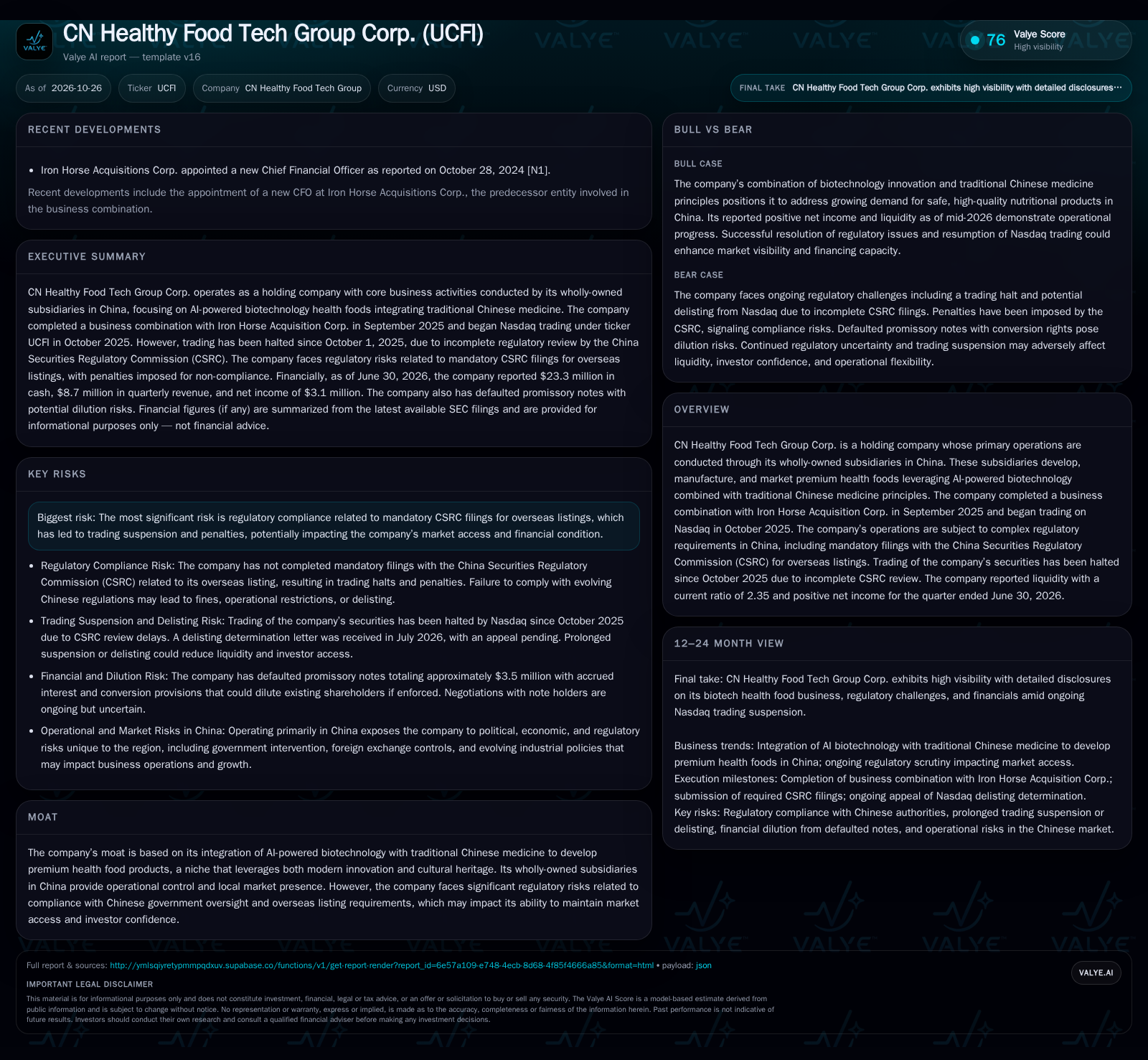
CN Healthy Food Tech Group operates a portfolio of biotech health food subsidiaries in China, combining AI-powered innovation with traditional Chinese medicine. While it reported $8.7 million in Q2 2026 revenue and $3.1 million in net income, its Nasdaq-listed shares have been suspended since October 2025 due to incomplete CSRC filings. The company faces regulatory penalties, delisting risk, and possible shareholder dilution from $3.5 million in defaulted notes. Its future depends on regulatory resolution, capital structure management, and sustained operational execution. [S2]
CN Healthy Food Tech Group Corp. stands at a crossroads: its core business leverages AI-powered biotechnology and traditional Chinese medicine to tap into China’s premium health food market, but its growth ambitions are threatened by a prolonged Nasdaq trading halt, unresolved Chinese regulatory filings, and $3.5 million in defaulted promissory notes. While the company has demonstrated operational profitability and maintains a liquidity buffer, its market access and capital structure remain in flux. The next chapter will depend on whether CN Healthy Food Tech can resolve its regulatory impasse and mitigate dilution risk before operational momentum is undermined.
Trading Suspension, Regulatory Fines, and Defaulted Debt: The Present Reality
CN Healthy Food Tech Group’s most pressing issues are external to its core operations: its Nasdaq-listed securities have been halted from trading since October 2025 due to the company’s incomplete review by the China Securities Regulatory Commission (CSRC). In July 2026, the company received a delisting determination letter from Nasdaq, which it is appealing, but the trading halt persists. These regulatory setbacks stem from the company’s failure to complete mandatory CSRC filings before its U.S. listing, leading to administrative penalties totaling roughly $660,000 paid in May 2026. Compounding this, the company has three promissory notes in default, totaling $3.5 million in principal plus accrued interest, with conversion provisions that could dilute shareholders if enforced. These factors overshadow the company’s reported operational profitability and liquidity, which as of June 30, 2026 stood at $23.3 million in cash and a current ratio of 2.35. [S2]
Profitability and Capital Structure: Unpacking the Model’s Fragility
CN Healthy Food Tech’s business model is built on developing, manufacturing, and marketing premium health foods in China, leveraging AI-powered biotechnology and traditional Chinese medicine. The company’s reported $8.7 million in quarterly revenue and $3.1 million net income for Q2 2026 suggest that, at least in the short term, the operating subsidiaries are generating both top-line growth and margin. However, the capital structure is under stress: the $3.5 million in defaulted promissory notes, if converted, could significantly dilute existing shareholders, and ongoing negotiations create uncertainty over future ownership and potential cash outflows.
The company reported cash and liquidity metrics for the period; these figures do not by themselves establish operating runway, investment capacity, financial flexibility, or financing capacity. Fixed costs are likely driven by R&D, manufacturing capacity, compliance, and distribution in China. Variable costs would be tied to raw materials and production volumes, but the company’s premium positioning could allow for higher gross margins—if demand holds and regulatory overhang does not spook customers or partners.
A key question is whether the company’s integration of AI and traditional medicine provides enough differentiation to sustain pricing power and defend margins in a competitive and policy-driven sector. In the absence of recurring revenue or disclosed contract structures, the business’s revenue visibility and customer retention remain unclear.
Niche Differentiation vs. Regulatory and Market Counterforces
The company’s primary differentiator is its blend of AI-powered biotechnology with traditional Chinese medicine principles—an approach that could appeal to health-conscious consumers in China’s rapidly evolving premium food market. This integration may allow the company to position itself as both innovative and culturally resonant, potentially commanding a premium over generic supplements or mass-market health foods.
However, the competitive environment is intense. The Chinese health food sector includes established domestic players, multinational food conglomerates, and a growing number of biotech startups, all vying for share in a market shaped by shifting consumer preferences and heavy government oversight. Regulatory scrutiny is not just a compliance cost—it can become an existential threat, as demonstrated by the current trading halt and CSRC penalties.
Furthermore, customer switching costs in the health food sector are typically low unless the company succeeds in building strong brand loyalty or proprietary formulations that are not easily replicated. Without clear evidence of recurring contract structures, the stickiness of the business remains an open question. Finally, rapid innovation cycles, policy shifts, and the threat of new entrants leveraging similar AI and biotech capabilities mean any advantage could be transitory unless the company can continuously execute and adapt.
Regulatory Resolution Unlocks Growth and Market Confidence
The most bullish scenario begins with the company successfully completing its CSRC filings, resulting in the resumption of Nasdaq trading and the reversal of the delisting determination. This restoration of market access could unlock new financing opportunities, allow for greater investor participation, and improve the company’s standing with business partners and customers who value regulatory clarity.
Operationally, if the company demonstrates sustained revenue growth and margin expansion—potentially by rolling out new AI-driven product lines or forging distribution partnerships—the narrative could shift from regulatory overhang to innovation-driven growth. Successful renegotiation or settlement of the defaulted promissory notes, ideally without onerous dilution, would further stabilize the capital structure.
Confirmation of this scenario would come from public disclosure of completed CSRC filings, Nasdaq reinstatement notices, new capital raises or strategic investments, and continued profitability. Evidence of expanded product distribution, new customer wins, or improved gross margins would further validate the upside thesis.
Sustained Operations Amid Prolonged Uncertainty
The most plausible near-term outcome is that CN Healthy Food Tech continues operating its Chinese subsidiaries profitably while regulatory and capital structure uncertainties persist.
Negotiations around the defaulted notes may drag on, with some risk of partial conversion and dilution. The company’s ability to retain customers and partners, manage compliance, and innovate within the constraints of the Chinese regulatory environment will determine whether it can sustain its current performance. The lack of recurring revenue or disclosed contract structures means revenue visibility is limited, and a sudden regulatory or market shock could quickly alter the trajectory.
Evidence confirming this scenario would include continued operational profitability, no material progress on CSRC filings or Nasdaq reinstatement, and stable but unremarkable liquidity metrics. Falsification would come from either a regulatory breakthrough (pivoting to upside) or a sharp deterioration in financial or operational performance (pivoting to downside).
Regulatory and Capital Structure Failures Trigger Value Erosion
In a negative scenario, the company’s appeal is denied, resulting in permanent delisting from Nasdaq and the loss of U.S. market access. This outcome could severely limit the company’s ability to raise capital internationally, reduce liquidity for current shareholders, and negatively impact the company’s reputation with business partners and customers.
If negotiations with holders of the defaulted promissory notes break down, forced conversion could result in significant dilution of existing shareholders, or worse, trigger legal or operational restrictions. Additional regulatory penalties or compliance failures could further drain resources or even result in operational suspensions in China.
Confirmation of this scenario would be official Nasdaq delisting, disclosure of forced note conversions with material dilution, worsening liquidity metrics, and signs of operational contraction or customer attrition. Falsification would require clear evidence of regulatory resolution or successful capital structure stabilization.
What Will Determine CN Healthy Food Tech’s Next Act?
Progress on CSRC filings and any public confirmation of completed regulatory requirements for overseas listings.
Updates on the status of Nasdaq trading—either reinstatement, continued suspension, or official delisting.
Resolution of the $3.5 million in defaulted promissory notes, including terms of any conversion or settlement.
Disclosure of contract structures, recurring revenue metrics, or customer retention rates, if provided, to gauge business stickiness.
Quarterly revenue and net income trends to assess whether operational profitability is sustained or deteriorates.
Evidence of new product launches, partnerships, or geographic/channel expansion that could diversify revenue streams.
Any further regulatory actions, penalties, or government interventions affecting subsidiaries or management.
Disclaimer: This is research-only, informational analysis and not investment advice. It may include AI-generated interpretation and general industry context. Always verify important details using primary sources.

Comments