
JetBlue’s Strategic Route Expansions Collide with Persistent Financial Strain
Despite notable moves to secure airport slots and grow its premium and international offerings, JetBlue confronts mounting losses and tight liquidity. The airline’s future will hinge on its ability to translate network investments into sustainable margin improvement under the shadow of industry-wide volatility.
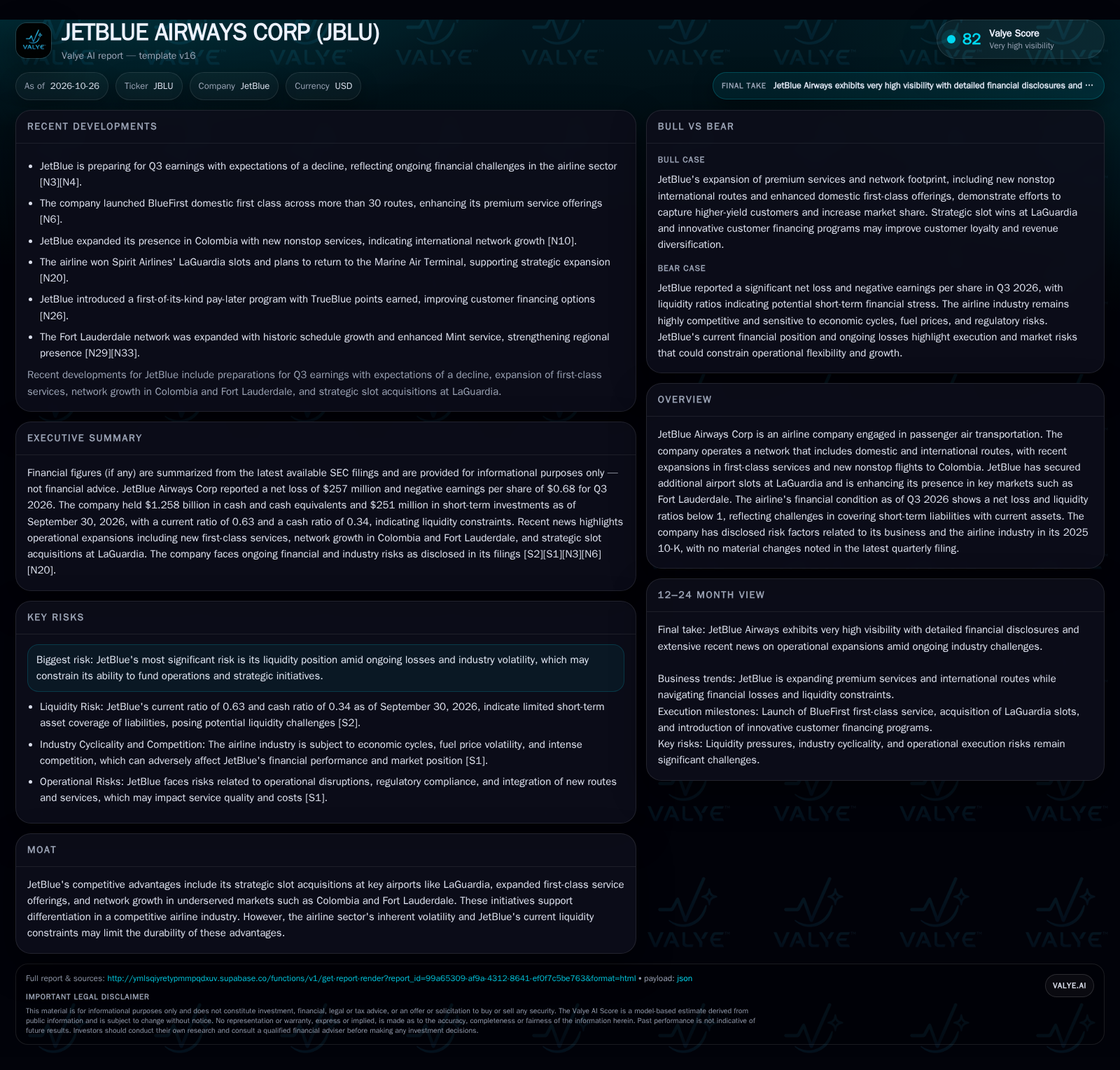
JetBlue’s recent network and service expansions—including new LaGuardia slots, premium service rollouts, and international growth—coincide with a Q3 2026 net loss of $257 million and a current ratio of just 0.63. These facts spotlight the tension between growth ambitions and financial constraints, raising the stakes for execution and margin recovery in a highly competitive sector. [S2] [N6]
JetBlue Airways finds itself at a crossroads: aggressive expansion into premium and international markets has won it coveted LaGuardia slots and new routes in Colombia and Fort Lauderdale, yet these strategic moves arrive alongside a deepening net loss and liquidity ratios that fall short of industry norms. With $1.509 billion in liquid assets against $4.424 billion in current liabilities, JetBlue’s near-term solvency is stretched, intensifying the imperative for its recent investments to deliver improved yield, margin, and competitive differentiation. The stakes are heightened by persistent industry volatility and the airline’s ongoing losses, making the next phase of execution critical for both survival and sustainable growth. [S2] [N6]
Recent Losses and Expansion Moves Define JetBlue’s Financial Crossroads
JetBlue reported a net loss of $257 million for the quarter ending September 30, 2026, translating to a negative EPS of -$0.68. These results underscore persistent operational and financial challenges. The company’s liquidity position is notably tight, with $1.258 billion in cash and equivalents and $251 million in short-term investments, totaling $1.509 billion. Against current liabilities of $4.424 billion, JetBlue’s current ratio stands at 0.63, and its cash ratio at 0.34—well below typical airline norms for short-term coverage. [S2]
Despite these constraints, JetBlue has secured key LaGuardia slots from Spirit Airlines, is expanding its historic schedule at Fort Lauderdale, and is rolling out enhanced Mint (first-class) service, as well as new international flights to Colombia. These initiatives demonstrate a deliberate strategy to capture higher-yield passengers and strengthen network relevance, but also raise the stakes for rapid commercial payoff in a sector where losses and capital needs can compound quickly. [N6]
Network Expansion and Premiumization: Can Revenue Mix Offset Cost Pressures?
JetBlue’s core economics hinge on its ability to fill seats at yields that cover high fixed and variable costs—especially as the airline pushes deeper into premium services and international routes. Recent moves such as the introduction of BlueFirst domestic first class and expanded Mint service are designed to target higher-margin business and affluent leisure travelers, who typically pay more per seat and exhibit greater willingness to pay for flexibility and amenities. If these segments show strong uptake, JetBlue could lift its average revenue per available seat mile (RASM) and improve load factor in key markets. [N6]
However, the airline’s cost structure is characterized by heavy fixed obligations (aircraft leases, labor contracts, airport fees) and exposure to volatile variables like fuel. The company reported cash and liquidity metrics for the period; these figures do not by themselves establish operating runway, investment capacity, financial flexibility, or financing capacity. The capital required for growth—whether for route launches, slot acquisitions, or premium retrofits—is high, and the company’s current liquidity does not provide ample cushion. To achieve meaningful operating leverage, JetBlue must drive sustained increases in load factor and yield that outpace both inflation and industry pricing pressure.
Slot Acquisitions and Service Upgrades: Durable Differentiators or Temporary Edge?
JetBlue’s recent win of LaGuardia slots and its moves into the premium segment offer potential differentiation in a market dominated by legacy carriers and aggressive low-cost competitors. Control of high-demand airport slots can confer pricing power and defend market share, particularly in congested metro areas. Similarly, first-class and Mint upgrades may attract business travelers and affluent leisure customers who might otherwise fly with larger network airlines.
However, these advantages are not absolute. Larger network airlines have deeper balance sheets, broader loyalty programs, and established corporate relationships. Ultra-low-cost carriers (ULCCs) can undercut on price, especially on leisure-heavy routes. International expansion into Colombia and other underserved markets could provide a niche, but also exposes JetBlue to new competitors and regulatory risks. The durability of JetBlue’s competitive edge will depend on its ability to consistently deliver superior service and value while managing costs and maintaining network reliability.
If Premium Services and Slot Gains Deliver: Pathways to Margin Recovery
A favorable scenario for JetBlue would see its expanded premium offerings and strategic slot acquisitions translating into higher yields, improved load factors, and a more profitable revenue mix. If the BlueFirst and Mint cabins achieve high utilization and command premium pricing, JetBlue could narrow the margin gap with legacy carriers and mitigate some of the cost disadvantages inherent to its smaller scale.
Confirmation of this scenario would require evidence of rising RASM, strong advance bookings in premium cabins, and successful ramp-up of new routes—alongside stable or improving unit costs. A return to positive operating cash flow and stabilization or improvement in liquidity ratios would further validate that these investments are translating into sustainable business improvement. Conversely, if premium seats consistently go unsold or new routes fail to reach breakeven, the thesis would be undermined.
Likely Trajectory: Incremental Gains Amid Persistent Margin Pressure
The most plausible outlook is that JetBlue achieves moderate incremental improvements in RASM and network relevance, but continues to struggle with industry-wide cost pressures and competitive encroachment. Premium and international expansions may help diversify revenue and increase load factors in select markets, yet are unlikely to fully offset elevated costs and the drag of underutilized capacity in the near term.
Confirmation would come from gradual improvement in quarterly losses, modest gains in premium cabin occupancy, and reported liquidity position. If JetBlue’s losses persist but narrow, and its liquidity position does not deteriorate further, it would suggest that the company is managing to stabilize, though not transform, its economic model. Alternatively, further erosion of liquidity or widening losses would indicate that expansion is not translating into sufficient commercial gains.
When Losses Compound: The Risk of Liquidity Erosion and Strategic Retrenchment
An adverse scenario could see JetBlue’s liquidity position deteriorate further as ongoing losses outpace the incremental revenue from network and premium expansion. If fuel costs spike, demand softens due to macroeconomic shocks, or competitive responses force fare cuts, the company could be compelled to curtail growth plans, defer capital investments, or even pursue emergency financing under unfavorable terms.
Signs of this scenario would include a declining cash balance, further worsening of the current ratio, negative operating cash flow, and announcements of route cuts or asset sales. Regulatory or operational disruptions—such as delays in slot utilization, integration hiccups, or adverse developments in key markets—could accelerate downside risks. If JetBlue is forced to shrink its network or dilute equity, shareholder value could be materially impaired.
Thesis-Testing Developments for JetBlue: What Could Shift the Narrative?
Quarterly trends in average revenue per available seat mile (RASM), particularly for premium cabins, would help clarify the commercial impact of recent service upgrades.
Load factor and yield metrics for new routes in Colombia and expanded Fort Lauderdale operations, if disclosed, would indicate the success of network investments.
Unit cost (CASM) trends, especially excluding fuel, would illuminate whether JetBlue is achieving any scale or efficiency from its expansion.
Booking patterns and advance purchase data for BlueFirst and Mint services would show whether premium demand is materializing.
Any announced changes to capital spending plans, financing activity, or asset dispositions would reveal management’s response to evolving financial pressures.
Updates on slot utilization rates and operational reliability at LaGuardia and other key airports would test the stickiness of JetBlue’s recent strategic gains.
Disclaimer: This is research-only, informational analysis and not investment advice. It may include AI-generated interpretation and general industry context. Always verify important details using primary sources.

Comments