
FirstCash Holdings: Growing a Global Pawn Network with Inventory Agility and Capital Focus
Yet, currency volatility, regulatory risk, and gold price swings remain persistent headwinds.
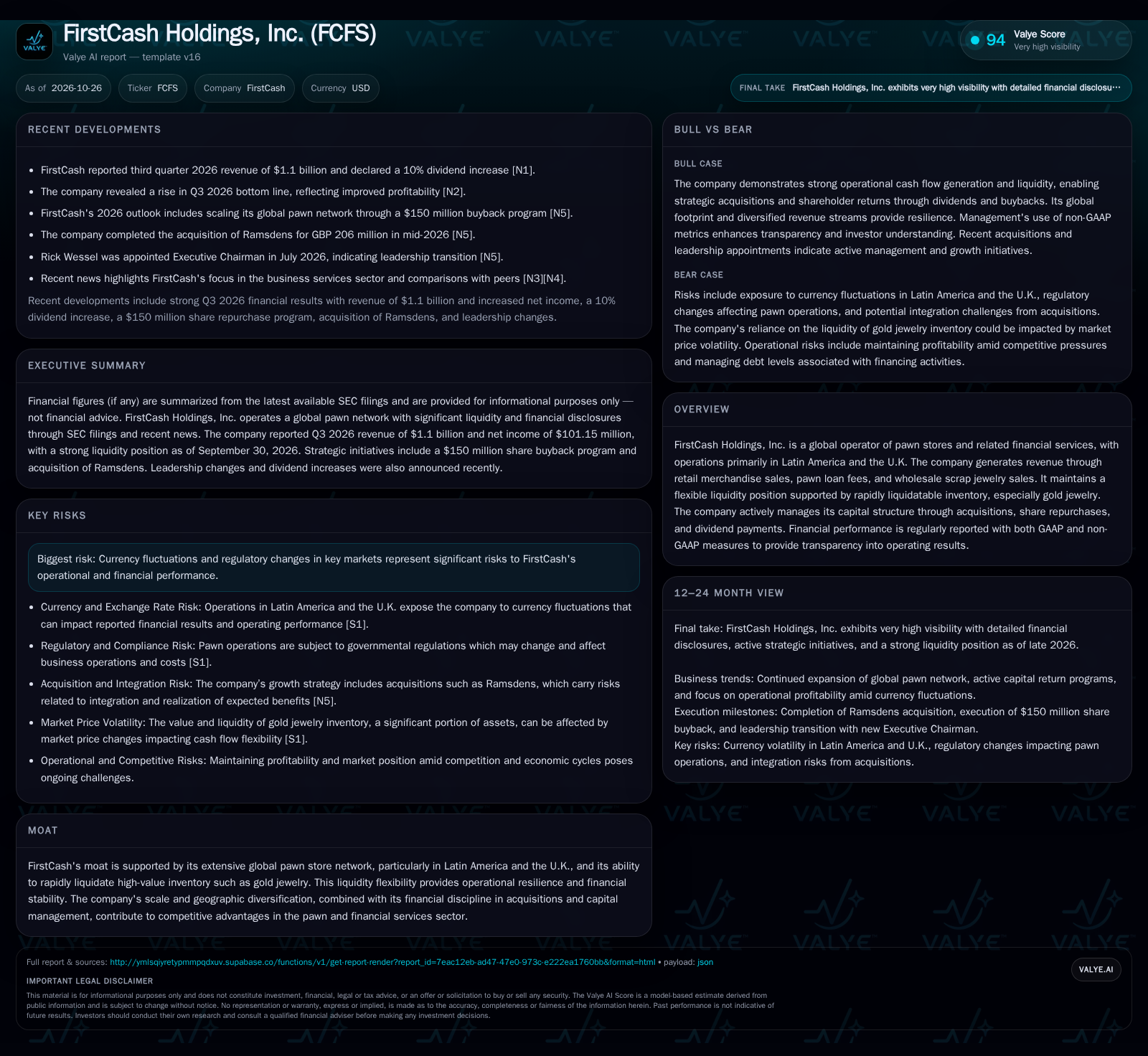
Its business model leverages rapidly liquidatable gold inventory and a growing Latin American presence. The company’s capital return strategy includes share repurchases and dividend hikes, but faces risks from currency swings, regulatory changes, and gold price volatility. Future performance will hinge on continued operational execution, integration of acquisitions, and external market conditions. [S1] [S2] [N1]
FirstCash Holdings, Inc. stands at the crossroads of traditional retail, alternative lending, and global expansion. With a Q3 2026 revenue run rate topping $1.1 billion and a growing presence in Latin America and the U.K., the company leverages a unique business model built on high-turnover gold inventory and diversified revenue streams. Its capital discipline—evidenced by aggressive buybacks and dividend growth—contrasts with the persistent operational challenges of currency volatility, regulatory shifts, and commodity price exposure. The question is whether FirstCash’s potential financial flexibility and scale can continue to offset these structural risks as it seeks further expansion.
Latest Results Highlight Growth and Shareholder Return Plans
FirstCash reported third quarter 2026 revenue of $1.1 billion and net income of $101.15 million, with basic EPS at $2.35 and a 10% dividend increase, underscoring both profitability and a shareholder-friendly capital return posture [N1] [S2]. As of September 30, 2026, the company’s balance sheet reflected $203.16 million in cash and cash equivalents, current assets of $2.07 billion, and current liabilities of $429.79 million, translating to a current ratio of 4.81 [S2]. The company reported cash and liquidity metrics for the period; these figures do not by themselves establish operating runway, investment capacity, financial flexibility, or financing capacity. [S1] The Latin American pawn segment remains a growth driver, contributing approximately $929 million in 2025 revenue [S1]. Recent share repurchase activity and a larger buyback authorization highlight ongoing capital allocation discipline [S1] [N5].
Pawn Business Fundamentals and Inventory Turnover Support Cash Flow
FirstCash’s economic engine combines retail merchandise sales, pawn loan fees, and wholesale scrap jewelry sales. Pawn lending is typically high-margin, short duration, and self-collateralizing—loans are secured by physical assets, with unredeemed items converted to inventory for retail or scrap sale. This dynamic enables rapid inventory turnover and cash conversion, especially for gold, which can be liquidated quickly during stress or to fund growth. The 62% gold share of inventory is a strategic lever, providing both margin stability and a natural hedge against economic downturns, as gold demand and prices often rise in uncertain times [S1].
The business exhibits moderate fixed costs (store leases, labor) but substantial operating leverage as incremental revenue from loan fees or retail sales flows through at high margins. Capital needs arise mainly from funding new pawn loans, inventory acquisition, and store expansion—these are typically funded by operating cash flow, supplemented by credit facilities if needed [S1]. Share repurchases and growing dividends, as seen in 2025 and 2026, are funded from this robust cash flow base [S1].
The interplay between pawn loan origination and inventory management is critical in FirstCash’s model, as it directly affects liquidity and risk exposure. When pawn loans are originated, the company effectively converts cash into secured receivables backed by physical collateral, which if redeemed, returns cash plus interest. However, unredeemed collateral transitions into inventory, necessitating efficient pricing and disposition strategies to avoid inventory obsolescence or markdowns. This cycle requires precise forecasting of redemption rates and market demand for retail and scrap sales. Additionally, the company’s ability to adjust loan terms and inventory pricing dynamically in response to gold price fluctuations can mitigate margin compression and optimize cash conversion timing.
Competitive Advantages Rooted in Scale, Gold Access, and Geographic Reach
FirstCash’s competitive position rests on its global pawn store network, especially its scale and density in Latin America and the U.K. This footprint enables local brand recognition and operational resilience, as regional economic cycles and regulatory regimes can be offset by geographic diversification. The company’s ability to rapidly liquidate gold inventory provides a liquidity advantage over smaller or less-diversified pawn operators, especially in stressed environments [S1].
Competition includes independent pawn shops, regional chains, fintech lenders, and alternative financial services firms. Fintech entrants may offer digital lending alternatives, but lack the physical collateralization and instant liquidity of pawn transactions. Regulatory complexity and local relationship-building also limit the threat from new entrants, while FirstCash’s scale supports procurement, marketing, and technology investments that smaller competitors cannot easily match. However, the company is not immune to margin compression or market share erosion if regulatory or macroeconomic conditions shift unfavorably.
Geographic diversification not only mitigates localized economic downturns but also introduces complexity in managing currency risk and regulatory compliance across jurisdictions. FirstCash’s scale enables investment in technology platforms that enhance inventory tracking, customer relationship management, and compliance monitoring, which smaller competitors may lack. Moreover, the company's procurement scale can secure more favorable gold purchase prices and terms, creating a cost advantage. However, this scale advantage depends on maintaining operational agility to respond to regional market nuances and regulatory shifts, which if neglected, could erode competitive positioning despite size.
Potential Upside from Combined Expansion and Gold Price Strength
The most favorable scenario emerges if FirstCash continues to scale its Latin American and U.K. networks, maintaining or improving same-store growth while integrating acquisitions smoothly. A stable or rising gold price environment would enhance inventory value and margin, amplifying the company’s ability to generate cash flow from both pawn lending and scrap sales. Currency headwinds could be muted if local economies remain stable or if hedging strategies are effective.
Lower loan loss rates, higher pawn loan originations, and robust retail sales per store would also confirm operational momentum. If disclosed, a reduction in operating expense ratios and successful integration of new store acquisitions would be further positive signals.
Beyond expansion and gold price stability, operational improvements such as enhanced credit risk management and digital customer engagement could further strengthen FirstCash’s growth trajectory. For example, leveraging data analytics to optimize loan underwriting and inventory turnover could reduce defaults and increase loan volumes without proportionally increasing risk. Similarly, integrating digital tools for customer acquisition and retention could expand the addressable market and improve same-store sales. These operational enhancements would compound benefits from geographic and commodity factors, potentially allowing the company to sustain higher margins and cash flow growth even in moderately challenging external environments.
Core Outlook Centers on Controlled Growth and Operational Efficiency
The most plausible path is one of continued moderate growth, underpinned by FirstCash’s established store network and capital discipline. Revenue and earnings expansion are likely to track store openings, incremental acquisition synergies, and stable pawn loan demand. Gold price volatility and currency fluctuations will introduce quarter-to-quarter noise but are unlikely to derail the core business unless extreme.
This scenario would be confirmed by consistent mid-single-digit to low double-digit revenue growth, stable or slowly rising margins, and ongoing capital returns. Watch for steady pawn loan growth, manageable credit losses, and no major regulatory disruptions as signals that the base case is intact.
In this scenario, the company’s capital allocation strategy will be pivotal in balancing growth investments with shareholder returns. Maintaining disciplined buybacks and dividend increases requires stable free cash flow generation, which depends on consistent inventory turnover and prudent risk management. The company’s ability to adapt to incremental regulatory requirements and currency fluctuations through hedging or operational adjustments will influence financial predictability. Additionally, moderate store expansion and selective acquisitions that integrate smoothly without diluting margins will support steady earnings growth, preserving investor confidence and enabling continued access to capital at favorable terms.
Risks from Currency, Regulatory Changes, and Gold Price Declines
Adverse developments could arise from sharp devaluation in Latin American currencies, eroding reported revenue and margin in U.S. dollar terms. Regulatory tightening—such as stricter lending limits, higher compliance costs, or outright restrictions on pawn operations—would directly impact loan volume and profitability. A significant, sustained drop in gold prices would reduce inventory value and impair the company’s ability to generate liquidity from scrap sales, potentially forcing asset write-downs or limiting cash returned to shareholders.
Downside confirmation would include declining same-store revenue, rising operating costs as a percentage of sales, reduced operating cash flow, and cuts to the dividend or share repurchase program. Evidence of integration missteps or rising loan defaults would also indicate deteriorating fundamentals.
Key Developments That Could Shape FirstCash’s Future Performance
Quarterly pawn loan originations and outstanding loan balances, especially in Latin America and the U.K., to gauge demand and geographic momentum—if disclosed.
Gold price trends and the proportion of gold in inventory, as these drive both margin and liquidity flexibility.
Currency exchange rates for the Mexican peso, Guatemalan quetzal, and British pound versus the U.S. dollar, given the company’s exposure to local currencies.
Regulatory developments in key markets, particularly any announced or enacted changes to lending limits, licensing, or compliance requirements.
Store count changes, including new openings, closures, and acquired locations, to track network expansion and integration progress.
Adjusted EBITDA and free cash flow as reported, to assess underlying cash generation and capital allocation capacity.
If disclosed, same-store sales growth and operating expense ratios to monitor efficiency and margin trends.
Disclaimer: This is research-only, informational analysis and not investment advice. It may include AI-generated interpretation and general industry context. Always verify important details using primary sources.

Comments