
WD-40: Brand Strength, International Reach, and the Stakes of Inflation and Channel Shifts
WD-40’s global brand, disciplined financials, and broad international footprint provide resilience, but the company faces intensifying margin and volume headwinds from macro volatility, currency swings, and changing retail dynamics. The next phase will test whether premium branding and innovation can offset mature-market saturation and mounting competitive threats.
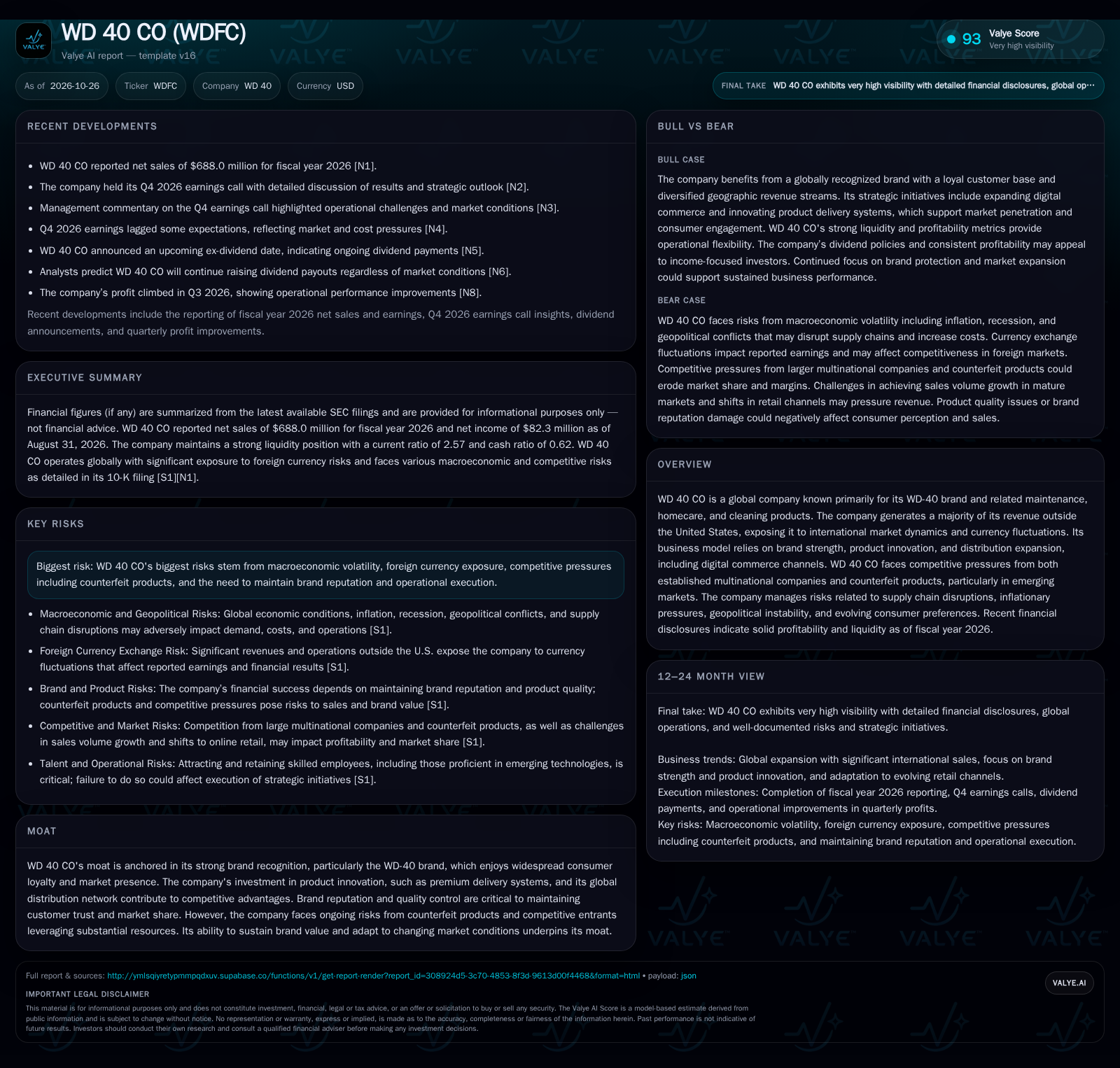
WD-40 delivered $688 million in net sales and $82.3 million in net income for fiscal 2026, with two-thirds of revenue generated abroad and a reported current ratio. However, the company is increasingly exposed to global macro and currency risks, and recent quarterly results lagged expectations amid cost and demand pressures. The core question is whether WD-40’s brand equity and innovation can sustain growth as mature markets saturate and new challenges arise overseas. [S1] [N4]
WD-40’s 2026 results reinforce its reputation as a disciplined, globally diversified consumer products company with deep brand equity and consistent financial management. Yet beneath the headline resilience, the company is increasingly exposed to macroeconomic, currency, and competitive pressures that are squeezing margins and challenging traditional volume growth strategies. With mature markets approaching saturation and competitive threats rising, WD-40’s ability to innovate and extend its brand into new channels and geographies will be critical in determining whether it can sustain its historical profitability and shareholder returns.
Recent Results Highlight International Exposure and Margin Pressures
WD-40 reported $688 million in net sales and $82.3 million in net income for fiscal 2026, ending August 31, 2026. The company’s reported liquidity position, with $70.6 million in cash and a current ratio of 2.57. Notably, 66% of consolidated net sales were generated outside the U.S., and 55% of revenues were in non-U.S. dollar currencies, underscoring the company’s international footprint and exposure to currency swings. The cited source reports dividend-related activity; that disclosure alone does not establish dividend-policy continuity, management confidence, or a material constraint on capital flexibility. These dynamics put a spotlight on WD-40’s ability to protect profitability in a more volatile global environment. [S1] [N4] [N5]
How WD-40 Makes Money: Brand Premium, Volume, and the Mix Challenge
WD-40’s core economic engine is the sale of branded maintenance, homecare, and cleaning products, with the iconic WD-40 lubricant at the center. The business model relies on a blend of premium pricing—justified by brand trust and perceived product efficacy—and high-volume turnover across global markets. Gross margins are typically supported by the company’s ability to command a price premium, but this is challenged by input cost inflation, currency devaluation in key markets, and channel shifts toward online and discount retail. Fixed costs are relatively modest compared to asset-intensive manufacturers, but WD-40 does invest in brand marketing, R&D for product innovation (such as improved delivery systems), and global distribution.
Operating leverage is present: incremental sales, especially in developed markets, generally flow through at higher margins once fixed overhead is covered. However, in practice, mature-market saturation and heightened price sensitivity limit the scope for volume-driven operating leverage. The international sales mix introduces both opportunity (growth in emerging markets) and risk (currency volatility and cost inflation). Capital needs are moderate, with excess cash historically returned to shareholders via dividends.
The company reported cash and liquidity metrics for the period; these figures do not by themselves establish operating runway, investment capacity, financial flexibility, or financing capacity.
Brand, Counterfeits, and the Evolving Competitive Battlefield
WD-40’s most durable advantage is its brand: the name is synonymous with multipurpose lubricants in many markets, engendering customer loyalty and shelf preference. This brand equity allows for premium pricing and helps defend against generic alternatives. However, the competitive landscape is shifting. Large multinational consumer and industrial chemical companies can outspend on distribution and marketing, while local and regional players compete aggressively on price.
A growing threat comes from counterfeit products, especially in emerging markets. Counterfeiting not only erodes legitimate sales and margins but also poses reputational risks if product quality fails to meet expectations. Moreover, as consumer purchasing patterns shift toward e-commerce and discount channels, WD-40 faces heightened price transparency and the risk of commoditization.
The company’s ability to maintain its competitive edge will depend on ongoing investment in brand protection, innovation in product formulation and delivery, and adaptation to digital sales environments. The risk is that, without continued differentiation, both market share and pricing power could erode in the face of aggressive competitors and changing consumer preferences.
Innovation and Brand Expansion Drive Renewed Growth
The most favorable scenario for WD-40 is that its investments in product innovation (such as new delivery systems or adjacent cleaning/maintenance solutions) and digital commerce expansion succeed in re-energizing growth. If new products or packaging formats resonate with both professional and consumer segments, the company could capture incremental share in established markets and accelerate penetration in underdeveloped regions.
A supportive macro environment—stabilizing inflation and FX rates—would allow WD-40 to maintain or even expand margins through selective pricing and supply chain optimization. Additionally, if brand protection efforts reduce the impact of counterfeit goods, especially in fast-growing emerging markets, legitimate sales could see a meaningful uplift.
Evidence that would confirm this scenario includes accelerating organic sales growth, margin expansion despite cost pressures, increased digital channel revenue, and share gains in international markets. Conversely, a lack of traction for new products or persistent margin compression would falsify this thesis.
Global Diversification Offsets Volume and Margin Headwinds—To a Point
The most plausible outcome is that WD-40 continues to deliver stable, modest growth, with international diversification cushioning the impact of mature-market saturation and periodic currency or cost shocks. Revenue growth may be incremental, with pricing actions offsetting some volume stagnation in developed markets. Margins are likely to remain under pressure from ongoing input cost inflation and FX volatility, but disciplined cost control and operational efficiency could limit the downside.
Dividend continuity and steady cash flows remain likely, given the company’s conservative balance sheet and historical capital allocation discipline. However, market share could erode slowly if competitive and counterfeit threats continue to intensify, and if online channel growth compresses price/mix advantages.
Material underperformance in any of these areas, or a significant reputational or quality issue, would challenge the base-case stability.
Brand Value Erodes Amid Intensified Competition and Macro Shocks
A negative scenario emerges if macroeconomic volatility—prolonged inflation, recession in key geographies, or persistent FX headwinds—compresses margins beyond management’s ability to offset via pricing or cost control. If counterfeit penetration accelerates and erodes consumer trust, WD-40 could face both volume and margin declines, particularly in emerging markets where enforcement is weak.
In developed markets, saturation and increased price competition could further limit growth, while a major product quality or reputation event would amplify the downside. If digital channel expansion leads to commoditization without compensating volume, the company’s ability to maintain premium pricing and brand attachment could weaken.
Conversely, resilience in reported margins and successful defense against counterfeits would lessen these risks.
Measuring WD-40’s Resilience: What Will Test the Brand and Growth Thesis
Organic sales growth rates by geography and channel—especially in emerging markets versus mature markets—would help assess the effectiveness of expansion and innovation strategies, if disclosed.
Gross margin trends relative to input cost inflation and FX movements are critical for detecting erosion of pricing power or operational efficiency.
Market share data in core lubricant categories and adjacent segments would provide insight into competitive dynamics and the impact of counterfeit goods, if available.
The proportion of sales generated from new products, delivery systems, or digital channels would signal the success of innovation and strategic pivots.
Reported incidence or estimated market impact of counterfeit product seizures or enforcement actions would help gauge the effectiveness of brand protection.
Employee retention and talent pipeline, particularly in R&D and digital marketing, would indicate the company’s ability to execute on innovation and channel adaptation, if disclosed.
Major product quality or reputational incidents—frequency, response, and impact—would test the durability of WD-40’s brand moat.
Disclaimer: This is research-only, informational analysis and not investment advice. It may include AI-generated interpretation and general industry context. Always verify important details using primary sources.

Comments