
Hestia Insight’s AI Fundraising Advisory: Can a Niche Platform Overcome Financial and Execution Hurdles?
Hestia Insight Inc. aims to carve out a differentiated position as an AI-driven capital markets advisor for emerging growth companies, focusing on healthcare and biotech. Yet, its zero revenue, acute liquidity shortfall, and reliance on a lean core team call into question not just scalability, but near-term viability.
Hestia Insight Inc. offers AI-powered fundraising advisory and fractional executive services for startups and growth-stage firms, targeting healthcare and biotech.Despite a differentiated platform approach and ambitions to build a comprehensive ecosystem, the company reported no revenue and an reported current ratio as of August 2026.
Hestia Insight Inc. is positioning itself as an AI-powered capital markets advisory and business consulting platform, specifically targeting the fundraising needs of emerging growth companies in healthcare and biotech. Its strategy blends proprietary technology, deep sector focus, and access to a global innovation network. However, as of August 2026, the company faces a stark disconnect between its ambitions and its financial reality: zero reported revenue, a current ratio of just 0.01, and a workforce of only three employees. The immediate challenge for Hestia Insight is not just scaling its differentiated approach, but demonstrating fundamental commercial viability and securing the resources needed to execute its vision.
Acute Liquidity Strain and No Revenue: The Present Operating Reality
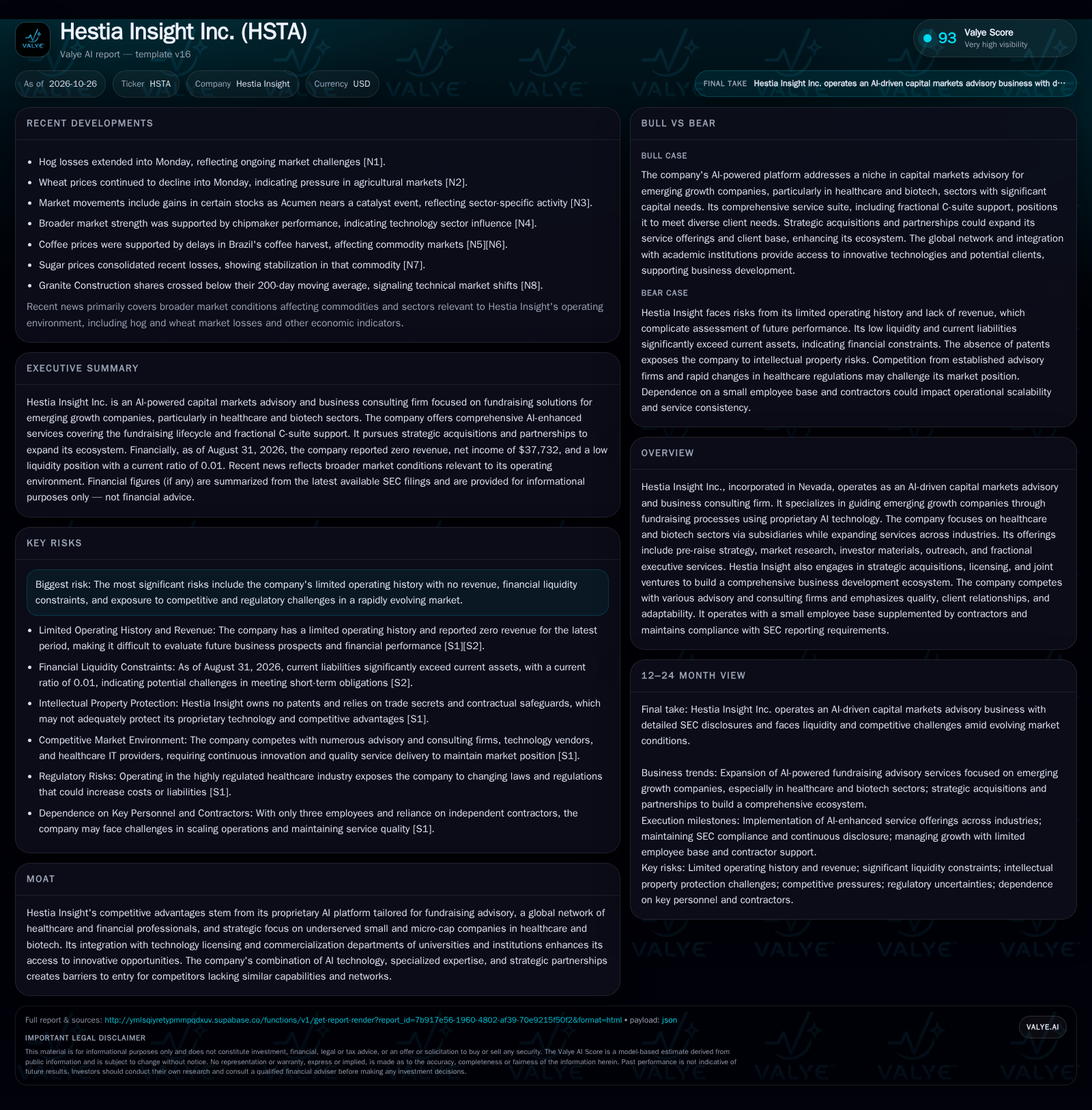
Hestia Insight reported zero revenue for the period ending August 31, 2026, with current assets of $3,852 and current liabilities of $343,703—yielding a current ratio of 0.01 and a matching cash ratio [S2]. Despite a net income of $37,732 in the same period, the absence of revenue and the extreme imbalance between assets and liabilities highlight severe liquidity pressure. The company’s small scale—just three employees—underscores both its early-stage status and its vulnerability to operational shocks [S1] [S2]. These facts are critical: Hestia Insight’s ability to deliver on its advisory and ecosystem ambitions now rests on its capacity to secure funding or rapidly generate revenue, as the present balance sheet cannot support sustained operations or growth.
How Hestia Insight’s Platform Could Generate Value—If Commercialized
Hestia Insight’s business model is built around AI-enhanced fundraising advisory, guiding clients through the full capital-raising lifecycle: from strategy and market research to investor outreach and ongoing relations [S1]. The platform approach, if executed, could allow for modular, repeatable service delivery, potentially supporting higher margins compared to traditional consulting—particularly if AI reduces manual labor in tasks like financial modeling and investor targeting. The addition of fractional C-suite offerings (e.g., on-demand CFO or CSO support) provides a route to recurring or retainer-style revenue, though the commercial structure—hourly, project-based, or subscription—is not disclosed. If the company can build a pipeline of clients and leverage technology to scale services with limited incremental cost, operating leverage could be substantial. However, the current absence of revenue suggests that either client acquisition has not yet materialized or that pricing/pipeline conversion is a major hurdle.
AI Differentiation in a Crowded Advisory Market: Durable Edge or Feature?
Hestia Insight’s core differentiation lies in its AI-powered approach and sectoral focus on healthcare and biotech, where capital needs are high and fundraising complexity is acute [S1]. Its global network—including ties to technology licensing offices and academic commercialization teams—could provide privileged access to innovative startups and deal flow. Yet, the broader advisory and consulting landscape is highly competitive, populated by established strategy firms, specialized fundraising consultants, market research providers, and a growing number of technology-enabled platforms. AI features are increasingly table stakes rather than a moat, unless proprietary models or data confer demonstrable client outcomes. Hestia’s lack of patents and reliance on trade secrets further weakens defensibility [S1]. In this environment, the company’s ability to develop sticky client relationships and deliver measurable fundraising results will be more important than technology branding alone. The question is whether its ecosystem strategy and sector relationships can outpace better-capitalized or more established peers.
Unlocking Commercial Traction: What a Breakout Would Look Like
A favorable scenario for Hestia Insight would see its AI-driven platform achieve product-market fit, driving a steady flow of emerging healthcare and biotech clients seeking fundraising support. If the company can convert its network relationships into paying engagements and demonstrate that its technology meaningfully accelerates capital raising or improves investor targeting, it could justify premium pricing or recurring contracts. Evidence of such a breakout would include: the announcement of multi-client engagements, the emergence of meaningful revenue in subsequent filings, and visible expansion of the core team or contractor pool to meet demand. Strategic partnerships, successful acquisitions, or integration with university commercialization offices could further accelerate ecosystem effects. Confirmation would come from a rising client roster, growing revenue, and improved balance-sheet metrics (especially a current ratio above 1.0). Falsification would occur if filings continue to show zero or negligible revenue and no progress on client wins, despite ongoing business development efforts.
Execution Strain and Funding Gaps Dominate Near-Term Prospects
The most plausible near-term trajectory is one of continued execution risk and resource scarcity. Hestia Insight’s ambitions are credible for a niche platform, but the current lack of revenue and acute liquidity pressure suggest that substantial commercial traction is not imminent. In this scenario, the company may secure a handful of pilot clients or small projects—potentially leveraging founder or network relationships—but growth is constrained by the need to obtain bridge funding or attract strategic partners. Operational bottlenecks from a tiny employee base and heavy contractor reliance could limit service consistency and scalability. Confirmation of this middle path would be moderate revenue growth, evidence of bridge financing or capital raises, and incremental staff or contractor additions. Falsification would be signaled by persistent zero revenue, worsening balance-sheet stress, or a cessation of regular SEC filings.
Liquidity Crisis or Strategic Retreat: What Failure Could Entail
If Hestia Insight cannot secure funding or land material client contracts in the near term, the risk of a liquidity crisis is pronounced. With current liabilities vastly exceeding assets, the company could face default on obligations, forced restructuring, or an abrupt wind-down of operations. In a less acute but still adverse scenario, Hestia may be compelled to scale back ambitions—focusing on advisory projects only when pre-funded by clients, or exploring asset sales, partnerships, or licensing of its AI platform to third parties. Evidence of a downside trajectory would include mounting short-term debt, delayed payments, staff attrition, or a shift in strategic communications toward “review of strategic alternatives.” Falsification of the downside would require clear evidence of new funding, revenue generation, or successful cost containment that stabilizes the balance sheet.
Metrics and Milestones That Would Validate or Challenge Hestia Insight’s Platform Thesis
The appearance of meaningful revenue (quarterly run-rate above zero), especially from repeat or multi-client engagements, would directly test the company’s ability to commercialize its platform.
A sustained improvement in the current ratio (ideally surpassing 1.0) would be necessary to demonstrate basic operating stability.
Disclosure of material client wins, especially in healthcare or biotech, would help confirm product-market fit and network leverage.
Hiring of additional employees, or a significant ramp-up in contractor utilization (if disclosed), would indicate operational scaling and growing demand.
Evidence of successful execution of strategic partnerships, acquisitions, or university integrations would support the ecosystem expansion thesis.
Any new funding rounds, bridge loans, or capital raises should be monitored as a test of external confidence and near-term solvency.
If disclosed, client satisfaction metrics, retention rates, or specific case studies demonstrating fundraising outcomes would help assess the efficacy and stickiness of Hestia’s services.
Ongoing SEC compliance and disclosure frequency remain important as a signal of continued operations and management’s commitment to transparency.
Disclaimer: This is research-only, informational analysis and not investment advice. It may include AI-generated interpretation and general industry context. Always verify important details using primary sources.

Comments