
PriceSmart’s Expansion Strategy: Assessing the Warehouse Club Model’s Traction Across Latin America
With a growing club footprint, rising Platinum Memberships, and ongoing digital investments, PriceSmart is betting on scale and operational efficiency to drive long-term value. The challenge: balancing execution risks and competitive threats in a diverse, often volatile, regional landscape.
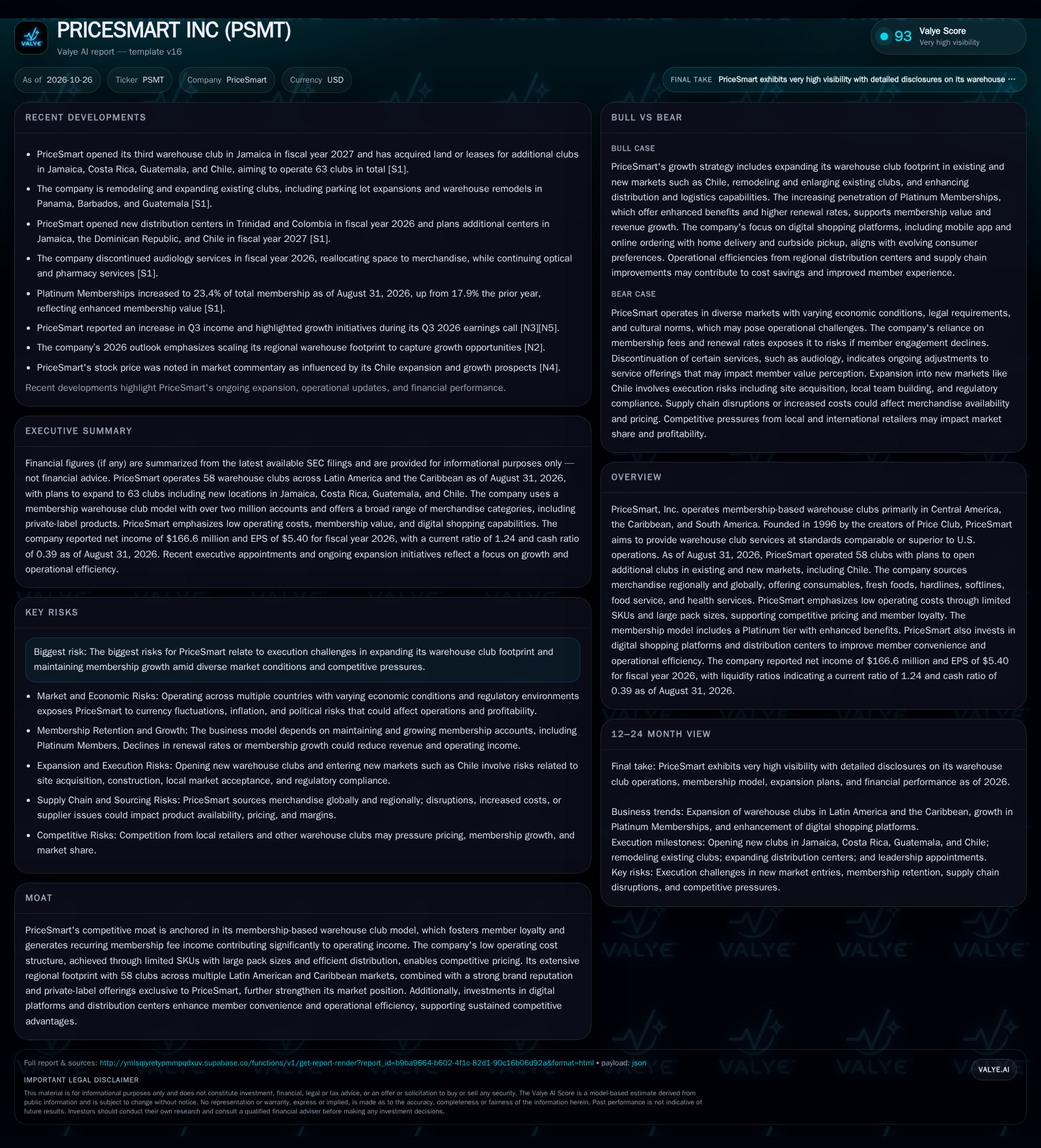
PriceSmart is actively expanding its warehouse club network in Latin America and the Caribbean, targeting 63 locations and investing in digital and logistics capabilities. Platinum Membership penetration is rising, supporting a key recurring revenue stream. The company’s model depends on operational efficiency, regional sourcing, and member loyalty, but faces execution risks in new markets like Chile and ongoing competitive and supply chain pressures. Future value hinges on successful club rollout, membership retention, and cost management amid regional volatility. [S1] [N2] [N3] [N4]
PriceSmart, the largest membership-based warehouse club operator in Latin America and the Caribbean, is doubling down on physical expansion and digital upgrades to capture a growing, value-seeking middle class. With 58 clubs open and five more on the way—including its first in Chile—the company is leveraging its low-cost, limited-SKU model and rising Platinum Memberships to drive recurring revenue and operational efficiency. Yet, the path forward is complex: regional volatility, execution risks in new markets, and intensifying competition from local and global retailers all threaten to test the resilience of PriceSmart’s business model and the durability of its competitive advantages. The next phase will reveal whether scale and efficiency can sustainably translate into superior returns.
PriceSmart’s Growth Drivers: Expansion, Membership, and Margin Dynamics
As of August 31, 2026, PriceSmart operated 58 warehouse clubs, with confirmed plans to expand to 63 clubs by entering new and existing markets, including Jamaica, Costa Rica, Guatemala, and Chile. This expansion strategy represents a material commitment to both organic growth and market diversification, with Chile marking the company’s first foray into South America beyond Colombia. [S1] [N2]
Platinum Memberships now comprise 23.4% of the total membership base, up significantly from 17.9% the prior year. This higher-tier membership is designed to boost renewal rates and deepen member engagement, and it contributed disproportionately to operating income, given that membership fees accounted for 38.6% of PriceSmart’s 2026 operating income despite representing only 1.8% of net merchandise sales. [S1]
Private-label products under the 'Member’s Selection®' brand made up 26.9% of merchandise sales in 2026, illustrating PriceSmart’s ability to drive margin improvement and member loyalty through exclusive offerings. [S1]
The company reported net income of $166.6 million and basic and diluted EPS of $5.40 for fiscal 2026. Its current ratio was 1.24 and cash ratio 0.39 at year-end, with $220.8 million in cash and equivalents. [S1]
Profitability Patterns and Constraints Within the Warehouse Club Framework
PriceSmart’s core business model is built on a membership-based warehouse format: annual membership fees provide a recurring, high-margin revenue stream, while merchandise sales drive volume and scale. The company’s focus on limited SKUs, large pack sizes, and private-label goods supports low operating costs and higher gross margins compared to traditional retailers. A substantial portion of the profit pool comes from membership fees, which, despite being a small percentage of total sales, deliver outsized operating income contribution due to minimal associated variable costs.
Merchandise sales economics hinge on efficient sourcing—about half of products are sourced regionally within Latin America and the Caribbean, which reduces logistics costs and supply chain complexity, while the rest are imported from the U.S. and globally. The expansion of private-label offerings under 'Member’s Selection®' further enhances margin potential, as these products typically carry higher gross margins and foster stickier customer relationships.
Operating leverage is central: fixed costs for club operations and distribution infrastructure are spread over a growing membership and sales base. This scale effect can improve profitability as new clubs ramp and digital channels expand. However, capital intensity is significant—new club construction, distribution center investments, and digital platform upgrades all require substantial up-front spending, with returns dependent on successful member acquisition and sustained sales growth.
Navigating Competitive Barriers and Pressures in Latin America’s Retail Sector
PriceSmart’s most durable advantage lies in its membership model, which creates recurring revenue, fosters loyalty, and could raise switching costs for core members. The limited-SKU, bulk-buying approach enables lower prices, while private-label exclusivity and regional sourcing help defend margins and differentiate the offering from both local grocers and international retailers.
However, the Latin American and Caribbean retail landscape is highly fragmented and competitive. Local supermarket chains, discount retailers, and informal markets remain formidable alternatives, especially in lower-income segments or regions where warehouse club penetration is nascent. Global players—such as Walmart and regional discounters—pose additional threats, particularly as e-commerce adoption accelerates and price transparency increases.
Digital integration offers a potential edge: PriceSmart’s investments in mobile apps, online ordering, and Click & Go® curbside/delivery may help defend share against digital-native and omnichannel competitors. Yet, digital convenience is rapidly being commoditized, and the company’s ability to maintain differentiated value will depend on execution in both physical and digital domains.
Potential Outcomes if Expansion and Membership Growth Gain Momentum
The most favorable scenario for PriceSmart sees rapid, successful rollout of new clubs—especially in high-growth, underpenetrated markets like Chile—combined with continued gains in Platinum Membership penetration. As club density increases, the company could benefit from stronger brand recognition, local scale economies, and enhanced supplier terms. Higher private-label penetration would further support gross margin expansion.
Digital adoption could accelerate, with more members shifting to online ordering and leveraging home delivery and curbside pickup, increasing both share of wallet and retention. If the company’s distribution center investments yield material logistics savings and in-stock improvements, operating margins could expand ahead of expectations.
Confirmation would come from above-trend membership growth, rising renewal rates (particularly for Platinum tiers), and evidence of strong same-club sales growth in new markets. Margin expansion, improved inventory turns, and robust cash flow generation would reinforce the thesis.
Forecasting the Most Probable Path: Moderate Club Growth Amid Execution Challenges
The central expectation is that PriceSmart continues to add clubs at a measured pace, with most new locations achieving ramping profitability but facing typical execution risks—site selection, local market adaptation, and regulatory compliance. Ongoing upgrades to digital and distribution infrastructure improve convenience and cost efficiency, but the benefits accrue gradually rather than transformationally.
Membership growth remains solid, with Platinum penetration increasing but at a slower rate as the base matures. Private-label sales mix edges up, supporting modest margin improvement. However, competitive pressures from local and global retailers—especially those investing heavily in e-commerce—limit PriceSmart’s ability to push through significant price increases or rapidly scale digital-only offerings.
Evidence for this scenario would include stable or slightly improving renewal rates, incremental margin gains, and consistent, if unspectacular, same-club sales growth. Execution setbacks or slower-than-expected adoption in new markets would be manageable rather than existential.
Risks of Overextension: When Expansion Challenges Execution Capacity
The bear case is defined by missteps in new market entries—especially in Chile or other unfamiliar territories—where regulatory hurdles, cultural mismatch, or poor site selection lead to underperforming clubs and stranded capital. Membership churn could rise if economic volatility, inflation, or competitive pricing erode the perceived value of the warehouse club model, particularly among price-sensitive segments.
Supply chain disruptions or cost inflation—whether from currency swings, regional instability, or global logistics shocks—could compress margins and lead to product shortages, undermining member trust. If digital investments fail to deliver a seamless experience, or if local competitors leapfrog PriceSmart in online convenience, member engagement and renewal rates could falter.
Falsification of this scenario would require evidence of successful new club ramp-up, stable or rising membership renewal rates, and no material erosion in merchandise margin or private-label mix.
Indicators of Progress in Validating PriceSmart’s Expansion Approach
Track the pace and profitability of new club openings, especially in Chile and other new markets, including time to breakeven and local membership uptake.
Monitor changes in overall membership accounts and, if disclosed, renewal rates—particularly for the Platinum tier, as this is a leading indicator of engagement and value perception.
Watch the proportion of private-label (‘Member’s Selection®’) sales as a percentage of total merchandise, as gains here could signal both margin enhancement and stronger member loyalty.
Follow the adoption and usage metrics of digital platforms (mobile app, online ordering, Click & Go®), as digital engagement may drive incremental sales and retention—if disclosed.
Assess developments in supply chain efficiency and distribution center utilization, especially in new facilities in Jamaica, the Dominican Republic, and Chile, as these are critical for cost control.
Observe local competitive dynamics and any pricing shifts by major supermarket or discount chains in PriceSmart’s core geographies, as increased price competition could pressure margins.
Evaluate the impact of regional macroeconomic volatility—currency moves, inflation, and regulatory changes—on reported margins and inventory costs.
Disclaimer: This is research-only, informational analysis and not investment advice. It may include AI-generated interpretation and general industry context. Always verify important details using primary sources.

Comments