
Lazard’s Q3 Disappointment: Fee Sensitivity, Business Mix, and the Stakes of Market Cycles
Lazard’s Q3 2026 results confirm the firm’s heavy exposure to market-driven fee income, as profit fell and revenue missed consensus despite a sizable liquidity cushion. The core question is whether Lazard can adapt its advisory and asset management business to volatile markets, defend margins against fierce competition, and deploy its resources to regain earnings momentum.
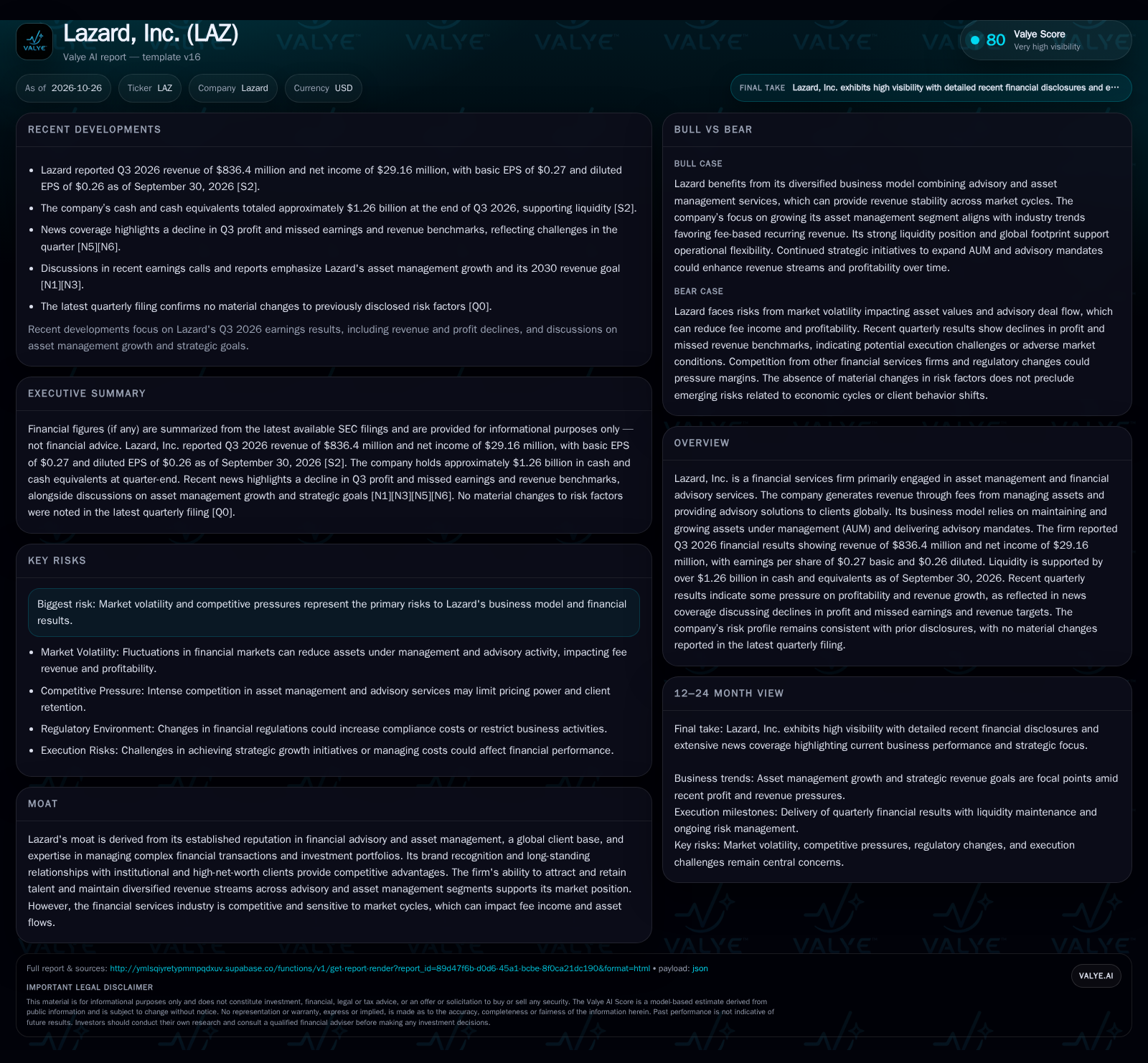
Lazard reported Q3 2026 revenue of $836.4 million and net income of $29.16 million, both below market expectations as profit declined and fee-generating activity softened. Despite a robust $1.26 billion cash balance, the firm’s sensitivity to market cycles—through both asset management and advisory—remains pronounced, raising questions about the durability of its business model and profit recovery timing. The competitive environment and uncertain deal flow will test Lazard’s ability to defend its franchise and capitalize on its global footprint. [S2] [N5] [N6]
Lazard’s Q3 2026 earnings miss and profit decline highlight the vulnerability of its business model to swings in financial markets and deal activity. With $836.4 million in revenue and $29.16 million in net income, the quarter underscored the firm’s ongoing struggle to grow fee income in a competitive and volatile environment. [S2] [N5] [N6]
Q3 2026 Results Reveal Fee Compression and Earnings Pressure
Lazard reported Q3 2026 revenue of $836.4 million and net income of $29.16 million, with basic EPS of $0.27 and diluted EPS of $0.26. This performance was below market expectations, as news reports highlighted both a decline in profit and a miss on revenue and earnings estimates. However, there were no material changes to previously disclosed risk factors, suggesting that the core threats—market volatility, competition, and regulatory risk—remain unchanged. These results reinforce Lazard’s sensitivity to the broader financial environment, with both its asset management and advisory businesses dependent on client activity and market sentiment. [S2] [N5] [N6]
How Lazard Earns: Fee-Driven Revenue and Operating Leverage Dynamics
Lazard’s business model is built around two main pillars: asset management and financial advisory. Both lines generate revenue primarily through fees—management and performance fees for AUM, and advisory/transaction fees for M&A, restructuring, and capital markets activity. The economics are attractive in periods of robust market activity: advisory fees are typically high-margin, and asset management benefits from scale, as incremental AUM adds revenue with relatively modest variable cost increases. However, the model is also inherently cyclical. Downturns in equity markets or reduced dealmaking can sharply curtail both AUM-based and transactional fee income, while much of the cost base (notably talent and infrastructure) is fixed or sticky downward. Operating leverage can thus work in both directions, amplifying profits in strong markets but compressing margins when revenue falls. Capital needs are generally modest for the core business, but the competitive labor market for top banking and asset management talent can drive up compensation ratios, especially when revenue growth stalls.
The interplay between fixed and variable costs in Lazard's model also warrants closer examination. While talent and infrastructure costs are largely fixed in the short term, the firm may have some limited ability to adjust discretionary expenses, such as marketing, technology investments, and travel, to partially offset revenue declines during downturns. However, these cuts can have long-term strategic consequences if they impair client service or innovation. Additionally, the timing mismatch between revenue recognition—often tied to deal closings or quarter-end asset valuations—and cost accruals can exacerbate earnings volatility. Understanding how Lazard manages this dynamic, including any use of deferred compensation or bonus smoothing, would provide insight into earnings quality and resilience.
Reputation, Relationships, and the Reality of Intense Industry Rivalry
Lazard has historically benefited from a strong global brand, deep client relationships, and a reputation for expertise in complex advisory assignments and institutional asset management. These intangible assets support pricing power and client loyalty, particularly for high-stakes advisory projects. However, the competitive landscape remains fierce, with a broad set of rivals ranging from global investment banks to boutique advisory shops and large-scale asset managers. Fee pressure is a persistent risk, as clients increasingly negotiate terms and shift mandates to lower-cost or more specialized providers. Furthermore, technology-driven platforms and passive investment vehicles continue to erode margins in asset management. While Lazard’s franchise and legacy relationships provide some moat, the firm must continually demonstrate value to retain and grow its client base—especially during periods of market stress when clients scrutinize costs and performance more closely.
Another dimension of Lazard's competitive positioning relates to its geographic footprint and sector specialization. While a global presence offers access to diverse markets and deal flow, it also introduces complexity and potential inefficiencies, especially if certain regions experience prolonged economic weakness. Sector expertise can create differentiation and pricing power, but concentration risk arises if key industries face structural headwinds. Moreover, evolving client expectations around digital capabilities, ESG integration, and customized solutions are reshaping the competitive landscape. Lazard's ability to invest in technology and talent aligned with these trends, without eroding margins, will be critical to maintaining its relevance and competitive edge.
If Markets Rebound: Fee Recovery and Mandate Expansion Drive Earnings Upside
A broad recovery in capital markets activity and asset prices would provide a powerful tailwind to both of Lazard’s core businesses. In such a scenario, advisory deal flow could accelerate as corporate confidence returns, boosting high-margin transaction fees. Simultaneously, rising asset values would expand AUM, lifting management fees and potentially triggering performance fee opportunities. Evidence that would confirm this upside scenario includes a sustained rebound in global M&A volumes, improved equity markets driving AUM growth, and a visible uptick in Lazard’s advisory pipeline or announced mandate wins. Margin expansion and a falling compensation ratio would further validate operating leverage in a recovery.
Navigating Through Volatility: Muted Fee Growth and Margin Pressure Persist
The most plausible near-term outlook is a continuation of market and dealmaking volatility, resulting in muted revenue growth and ongoing margin pressure for Lazard. Asset management fees may stabilize if markets avoid further declines, but significant growth would likely require a more robust rebound in risk assets. Advisory revenue could remain uneven, reflecting episodic bursts of activity rather than a sustained pipeline. Confirmation of this scenario would include flat or modestly rising AUM, lackluster advisory fee trends, and limited evidence of market-share gains. A persistently high compensation ratio and cautious management commentary about the deal environment would also support this view.
Prolonged Market Weakness and Competitive Attrition Threaten Franchise Value
A more adverse scenario would see Lazard facing an extended period of depressed capital markets and client risk aversion, leading to persistent declines in both advisory and asset management fee income. Under these conditions, the firm’s fixed cost base could drive a sharp contraction in operating margins, and talent retention could become challenging as compensation pools shrink. Intensified competition—especially from lower-cost or more digitally enabled rivals—could accelerate client attrition, further eroding revenue. Evidence for this outcome would include continued declines in AUM, a shrinking advisory pipeline, repeated earnings misses, and negative operating leverage (i.e., costs falling less than revenue). Any signs of major client departures, loss of key rainmakers, or forced cost-cutting programs would also signal risk to the business’s long-term franchise.
What Will Reveal If Lazard Can Regain Its Earnings Momentum?
Net new advisory mandates and announced deal pipeline: A useful metric would be the volume and value of new advisory assignments won each quarter.
AUM growth or contraction: Quarterly changes in assets under management, if disclosed, provide a direct read on asset management momentum.
Compensation ratio trends: Monitoring the proportion of revenue paid out in compensation will show if Lazard is able to manage costs amid fee pressure.
Client retention and mandate renewal rates: Any disclosures about repeat business or lost mandates would help test the durability of client relationships.
Operating margin movement: Sequential changes in operating margin will reveal the impact of cost controls and revenue mix.
Market share in core advisory categories: Evidence of share gains or losses relative to global and boutique competitors would clarify competitive positioning.
Management commentary on the outlook for deal activity and asset flows: Tone and specificity in quarterly calls or filings can signal confidence or caution.
Disclaimer: This is research-only, informational analysis and not investment advice. It may include AI-generated interpretation and general industry context. Always verify important details using primary sources.

Comments