
Big Tree Cloud Holdings: Liquidity, Governance Upheaval, and the Unanswered Business Model Question
Big Tree Cloud Holdings shows signs of active capital management and governance reform, but persistent losses, material control weaknesses, and a still-opaque business model leave fundamental uncertainties about its prospects and risk profile.
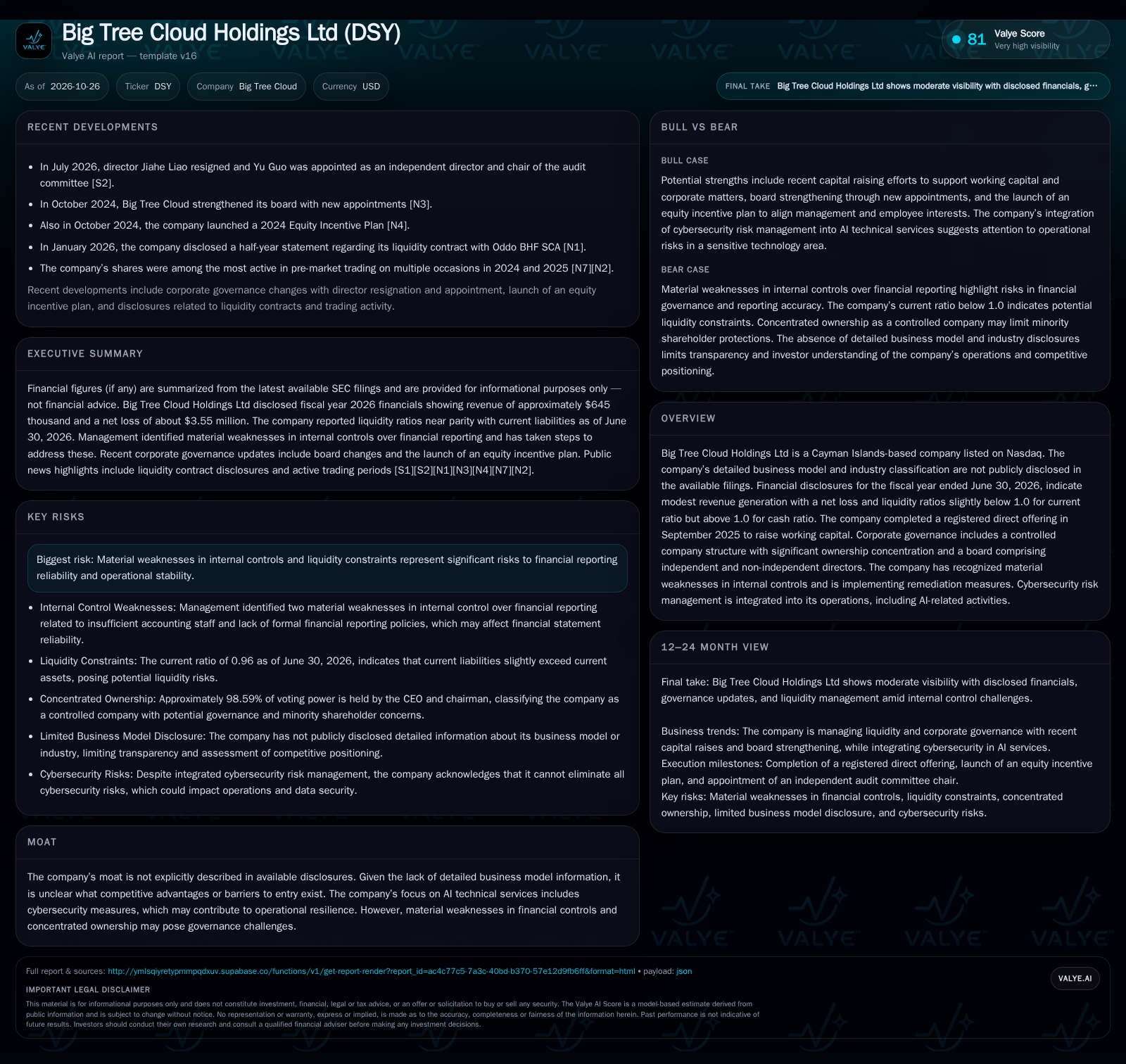
Big Tree Cloud Holdings Ltd, a Cayman Islands company listed on Nasdaq, reported $645,000 in revenue and a $3.55 million net loss for fiscal 2026. Liquidity remains tight: current assets are slightly below current liabilities. Material weaknesses in internal controls have been acknowledged, and recent capital raises and board changes aim to address governance and operational challenges. The company's lack of detailed business model disclosure complicates assessment of its economic potential and competitive standing. [S1] [S2]
Big Tree Cloud Holdings Ltd stands out for its combination of active financial maneuvering and persistent structural challenges. Despite raising $4.5 million in late 2025 and making visible board and governance changes, the company closes fiscal 2026 with only $645,000 in revenue and a net loss exceeding $3.5 million. Its current assets lag behind liabilities, and material weaknesses in internal controls remain unresolved. With the CEO controlling nearly all voting power and the underlying business model still largely undisclosed, investors face a landscape rich in uncertainty and potential volatility. The central question remains: can governance reform and capital infusions overcome weak operational transparency and fundamental economic ambiguity? [S1] [S2]
Material Weaknesses and Liquidity Constraints Shape the Immediate Outlook
As of June 30, 2026, Big Tree Cloud Holdings reported $3.11 million in cash and cash equivalents and $1.40 million in short-term investments, but current liabilities of $3.81 million exceeded current assets of $3.64 million, resulting in a current ratio of just 0.96. The company generated $645,000 in revenue and recorded a net loss of $3.55 million for the fiscal year, continuing a pattern of negative earnings. Management flagged two material weaknesses in internal controls—insufficient accounting staff and lack of formal financial reporting policies—raising concerns about reporting reliability. A $4.5 million direct offering in September 2025 provided a temporary working capital boost, but did not fundamentally alter the company’s liquidity or loss trajectory. [S1] [S2]
Unclear Revenue Drivers and Cost Structure Obscure Path to Profitability
The company’s lack of detailed business model and industry disclosure means its commercial mechanics are opaque. The $645,000 in annual revenue suggests either an early-stage business or one with limited product/market traction. With a net loss of $3.55 million, cost structure likely exceeds gross profit by a wide margin—potentially driven by fixed overhead, R&D, or SG&A, but the mix is undisclosed. If the company’s operations are software or AI technical services, as suggested by its reference to cybersecurity and AI, scalable margins could be possible if adoption grows, but the current cost base is out of proportion to revenue. The September 2025 capital raise signals a need for external funding to bridge operational deficits. The absence of recurring revenue disclosures, customer concentration data, or contract terms makes it difficult to assess revenue visibility or margin leverage. Without more granular detail, the economics imply a business in investment or turnaround mode, with negative operating leverage and dependency on capital markets to fund losses. [S1]
Opaque Competitive Positioning Hampers Assessment of Moat and Market Risks
Big Tree Cloud’s competitive standing is fundamentally unclear due to the absence of explicit business model, product, or market disclosures. References to AI technical services and cybersecurity risk management suggest participation in segments where barriers to entry can be high if intellectual property, data advantages, or sticky customer integrations exist. However, there is no evidence of proprietary technology, differentiated offerings, or network effects. The company’s inability or unwillingness to disclose its industry or commercial mechanics may indicate either nascent development, a pivoting business model, or a strategic desire to remain stealthy, but it also raises red flags about sustainable differentiation. In the absence of customer or contract disclosures, it is not possible to determine whether Big Tree Cloud faces competition from established SaaS, cybersecurity, or AI service firms—or whether it is even directly competing in those arenas. This lack of clarity means investors cannot reliably gauge the company’s moat, pricing power, or vulnerability to substitution.
What Would a Turnaround Look Like? Signs of Scalable Revenue and Control Remediation
A positive thesis would require evidence that recent governance reforms and capital infusions lead to operational discipline and revenue growth. If new board members and the audit committee chair drive successful remediation of internal control weaknesses, this would improve financial reporting reliability and potentially support investor confidence. Upside could materialize if the company discloses a credible, scalable business model—such as a SaaS platform or AI services suite—with increasing customer adoption, recurring revenue, and improving gross margins. Confirmation would include transparent reporting of revenue sources, customer wins, multi-year contracts, or backlog, alongside declining operating losses and reduced cash burn. Falsification would occur if, despite governance changes, losses remain elevated, controls are not remediated, and the business model remains opaque.
Stagnation Persists as Capital Buys Time but Not Traction
The most plausible scenario, given current evidence, is one of continued operational and financial struggle. The company may maintain operations through periodic capital raises and working capital management, but without significant business model disclosure or evident traction, revenue is likely to remain modest and losses persistent. Internal control remediation could take time, and concentrated ownership may limit external accountability or strategic change. Confirmation would come from flat or declining revenue, ongoing net losses, continued reliance on capital markets, and few, if any, new disclosures about customer acquisition or product differentiation. This path leaves the company exposed to external shocks, regulatory scrutiny, or investor fatigue.
Control Failures and Liquidity Stress Accelerate Value Erosion
In a negative scenario, failure to remediate material control weaknesses could result in unreliable financial reporting, regulatory penalties, or loss of market confidence. If revenue stagnates or declines further and operating losses persist, the company could exhaust its liquidity, especially given the current ratio below 1.0. Inability to secure additional financing, especially in a risk-off capital markets environment, would threaten operational continuity. Confirmation would be visible in worsening liquidity metrics, auditor resignations, delayed filings, or qualified audit opinions. A sharp deterioration in board stability or further resignations could compound governance risks, while continued opacity about the business model would erode any remaining investor trust.
Milestones That Could Clarify Big Tree Cloud’s Trajectory
Remediation status of identified material weaknesses in internal controls—progress reports or auditor statements would help test the governance turnaround thesis.
Disclosure of business model details: segment breakdowns, product lines, end-market focus, and revenue mechanics would clarify the company’s economic potential.
Revenue growth or customer acquisition updates—if disclosed—would signal whether operational reforms are translating to commercial traction.
Gross margin evolution—if provided—would lend insight into the scalability and efficiency of the underlying business.
Cash burn rate and operating expense trends: sustained negative cash flow without corresponding growth would signal ongoing dependency on external funding.
Board and management stability: further resignations or turnover, particularly in financial or audit functions, would be a red flag.
New capital raises, debt facilities, or evidence of constrained access to funding would highlight liquidity risk and market confidence.
Disclaimer: This is research-only, informational analysis and not investment advice. It may include AI-generated interpretation and general industry context. Always verify important details using primary sources.

Comments