
Celestica’s AI Data Center Momentum: Can End-to-End Integration Outpace Industry Cyclicality?
With net income surging and liquidity robust, Celestica is capitalizing on hyperscaler demand for data center and AI infrastructure. But as the contract manufacturing sector faces rapid technology shifts, geopolitical risk, and customer concentration, the company’s ability to sustain growth will hinge on managing operational complexity and diversifying its revenue base.
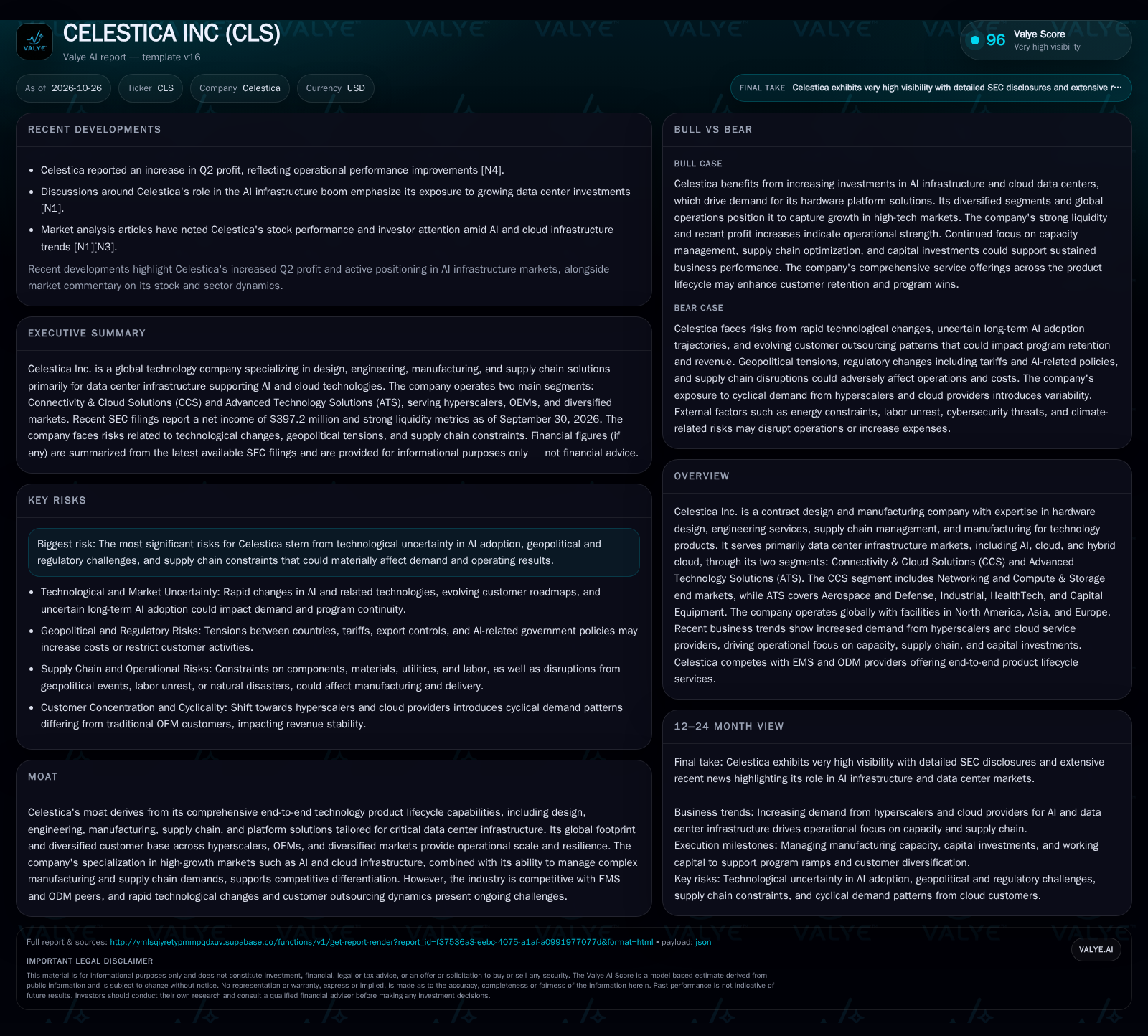
Celestica has reported strong profit growth and maintains reported liquidity position as hyperscaler and cloud investments in AI data centers accelerate demand for its hardware platform solutions. The company’s value proposition centers on end-to-end product lifecycle capabilities and global scale, but faces significant risks from technological change, supply chain challenges, and the cyclical nature of cloud infrastructure investment. Sustained outperformance will depend on Celestica’s execution in capacity, supply chain, and customer diversification.
The company’s end-to-end manufacturing and engineering capabilities are well aligned with the current surge in hardware demand for AI and cloud platforms. Yet as Celestica’s customer mix tilts further toward large-scale cloud clients, it faces heightened cyclicality, supply chain risk, and the challenge of staying ahead in a fast-moving technology landscape. The company’s next phase will be defined by how effectively it manages operational complexity and diversifies its customer base in the face of structural industry risks.
Recent Profit Growth and Liquidity Highlight AI Infrastructure Tailwinds
Celestica reported net income of $397.2 million and basic EPS of $3.30 for the quarter ended September 30, 2026, reflecting a period of significant profitability [S2]. The company’s cash and equivalents stood at $3.96 billion, with a current ratio of 1.61, suggesting a reported liquidity position relative to near-term liabilities [S2]. This financial strength comes as Celestica’s business mix continues shifting toward hyperscaler and cloud service providers, driven by accelerated investment in AI and data center infrastructure [S2]. These trends have led to increased deployments in the Connectivity & Cloud Solutions segment, particularly for hardware platform solutions supporting AI workloads [S2]. However, the company’s exposure to customer concentration and industry cyclicality is rising, as hyperscalers and cloud providers now represent a larger share of revenue [S2].
How Celestica Monetizes End-to-End Design and Manufacturing in High-Growth Markets
Celestica generates revenue through contract design, engineering, and manufacturing services for technology hardware, with particular strength in data center infrastructure for AI, cloud, and hybrid cloud applications. Its business model is built around two segments: Connectivity & Cloud Solutions (CCS), which encompasses Networking and Compute & Storage (including servers and storage hardware), and Advanced Technology Solutions (ATS), which serves diversified markets such as aerospace, industrial, and health tech [S2].
The company’s economics are shaped by high fixed costs for manufacturing capacity, engineering talent, and global supply chain management. Operating leverage can expand margins when utilization is high, especially during periods of strong demand from hyperscaler customers. However, the contract manufacturing sector is characterized by thin gross margins and price competition, so volume and efficiency are crucial. Celestica’s full product lifecycle offering—encompassing design, supply chain, assembly, testing, and asset management—may allow for higher average revenue per customer and potentially stickier relationships, but the durability of these economics depends on ongoing program wins and the ability to adapt to rapid shifts in customer technology roadmaps.
Capital needs are substantial, particularly given the scale of investment required to support new data center deployments and AI hardware platforms. Working capital requirements can spike during program ramps, and supply chain disruptions or component shortages can tie up cash. The company reported cash and liquidity metrics for the period; these figures do not by themselves establish operating runway, investment capacity, financial flexibility, or financing capacity.
Can Celestica’s Integration and Scale Withstand Intense EMS/ODM Competition?
Celestica operates in the highly competitive contract manufacturing and design sector, facing rivals among both Electronics Manufacturing Services (EMS) and Original Design Manufacturer (ODM) providers [S2]. Key competitor categories include global EMS firms with similar end-to-end service offerings, regional ODMs with specialized capabilities, and, increasingly, vertically integrated technology OEMs that may bring some manufacturing back in-house if scale or IP sensitivity demands it.
Celestica’s potential advantages lie in its comprehensive product lifecycle services and global operational footprint, which can appeal to customers seeking single-source solutions for complex, high-volume hardware programs. Its ability to manage supply chain complexity and provide flexible engineering support is particularly valuable as AI and cloud infrastructure requirements evolve rapidly. However, switching frictions in this space are moderate: while program transitions involve logistical and qualification hurdles, large customers can and do shift suppliers to optimize costs or technology access. Pricing power is limited by the commoditization of much of the hardware value chain, meaning Celestica must continually invest in capability and efficiency to defend margins.
The long-term question is whether Celestica can sustain differentiation in a market where technological requirements, customer preferences, and geopolitical realities are constantly shifting. Its current strength in AI infrastructure is a function of both capability and timing, but this advantage could erode if competitors match its integration or if customers consolidate their supplier base.
Sustained Hyperscaler Demand Could Drive Multi-Year Margin Expansion
In the most favorable scenario, global investment in AI and cloud data centers continues to accelerate, with hyperscaler and cloud provider customers deepening their reliance on Celestica for both design and manufacturing of next-generation hardware platforms. Under this outcome, Celestica leverages its end-to-end capabilities and global scale to win multi-year, high-value programs, achieving higher utilization across its facilities and driving operating leverage.
The positive causal chain would see Celestica increasing its share of wallet with existing customers, successfully cross-selling engineering and lifecycle management services, and expanding into adjacent verticals such as edge computing or specialized AI hardware. Confirmation of this scenario would include continued double-digit revenue growth in the CCS segment, evidence of multi-year program wins with major hyperscalers, and margin expansion despite ongoing industry price competition.
Falsification would come if revenue growth in AI/cloud infrastructure stalls, margin expansion proves fleeting due to price pressure or cost overruns, or if customers shift major programs to alternative suppliers.
Navigating Cycles: Stable Growth Tempered by Customer and Technology Risks
The most probable outcome is that Celestica continues to benefit from strong, if uneven, demand from cloud and AI infrastructure customers, but faces heightened volatility as customer concentration and technology cycles drive swings in order volumes. The company’s diversified ATS segment provides some buffer, but the CCS segment increasingly dominates growth and margin upside.
Under this scenario, Celestica’s revenue and profit growth moderate as the initial wave of AI/data center investment normalizes. The company manages capacity and working capital effectively, but supply chain disruptions, component shortages, or a pause in hyperscaler spending could lead to periodic earnings volatility. Its ability to adapt to customer technology shifts and maintain program wins will be critical.
Evidence supporting this scenario would include steady but decelerating revenue growth, continued program wins in both CCS and ATS, and stable margins. Contradictory evidence would be a sharp drop in CCS orders, major customer losses, or persistent supply chain and margin challenges.
Technology Shifts or Geopolitical Shocks Could Trigger Revenue and Margin Compression
Adverse outcomes could emerge from several vectors: a slowdown or reversal in AI/hyperscaler investment, disruptive technology shifts that favor new architectures or supply models, or geopolitical/regulatory actions that restrict Celestica’s ability to serve key customers or source critical components. In this scenario, demand for Celestica’s hardware solutions contracts sharply, resulting in underutilized capacity, margin compression, and potential write-downs of inventory or capital assets.
Further risk arises if major customers accelerate supplier consolidation, insource manufacturing, or shift to competitors with lower costs or better access to advanced technologies. Supply chain shocks—whether from regulatory changes, tariffs, or component shortages—could exacerbate the impact, tying up working capital and eroding profitability.
This scenario would be confirmed by a material decline in CCS segment revenue, a spike in inventory or receivables, margin contraction, and/or negative revisions to guidance. Falsification would require evidence of resilient demand and margin stability even in the face of macro or industry shocks.
Milestones and Metrics That Will Test Celestica’s AI Infrastructure Thesis
CCS segment revenue growth, particularly in Compute & Storage and Networking, to gauge the pace and durability of AI/cloud infrastructure demand [S2].
Customer concentration metrics—such as revenue share from top hyperscaler and cloud customers—if disclosed, to assess exposure to cyclical and program risk.
Gross and operating margin trends, especially in periods of high capacity utilization versus periods of order volatility.
Capital expenditure and working capital requirements in response to large program ramps or supply chain disruptions.
Evidence of multi-year program wins, contract renewals, or expansion into new verticals (e.g., edge computing, AI hardware adjacencies).
Supply chain resilience indicators, such as inventory turns, lead time management, and ability to secure critical components.
Geopolitical and regulatory developments, particularly those affecting cross-border supply chains or customer access in major end markets.
ATS segment performance as a buffer or offset to volatility in the CCS segment.
Disclaimer: This is research-only, informational analysis and not investment advice. It may include AI-generated interpretation and general industry context. Always verify important details using primary sources.

Comments