
AutoZone’s Growth Machine: Store Expansion, Margin Pressures, and the Next Phase of Aftermarket Competition
AutoZone’s decade-long expansion has delivered consistent revenue growth and a dominant store network, but margin compression and executive turnover highlight new vulnerabilities as the automotive parts landscape shifts toward digital and commercial channels.
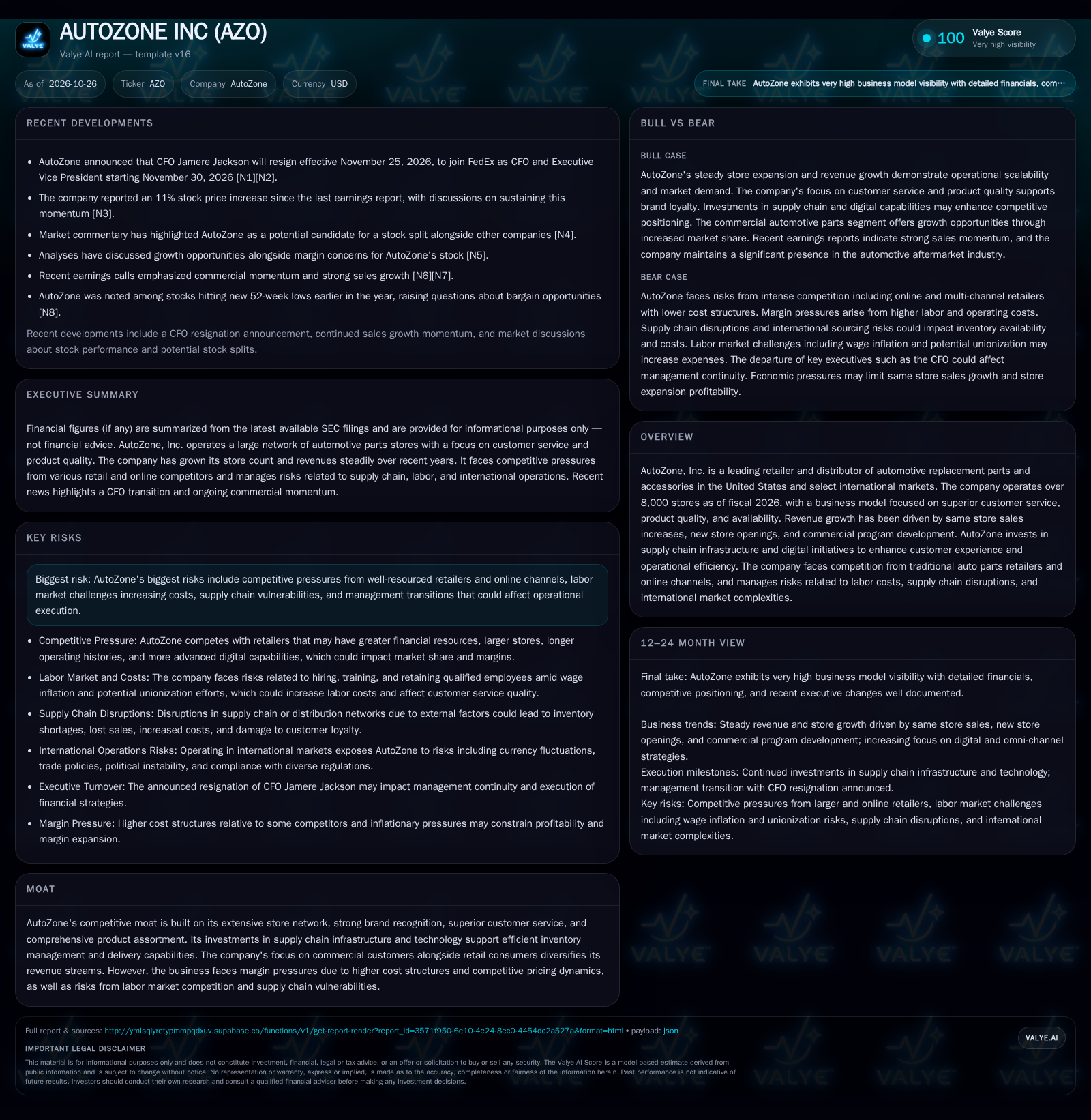
AutoZone has grown its store count to over 8,000 and annual revenue to $20.3 billion as of fiscal 2026, powered by same store sales, new locations, and expanded commercial programs. However, rising labor costs, margin pressures, and the announced CFO departure introduce new challenges. Sustaining growth will likely depend on supply chain efficiency, digital execution, and the ability to defend share against online and large-format competitors.[S1] [N1] [N6]
AutoZone’s long-term playbook—expanding its retail footprint, deepening commercial relationships, and investing in supply chain and digital infrastructure—has yielded robust top-line growth and a formidable presence in the North American auto parts market. Yet, the company now faces a confluence of emerging challenges: wage inflation, supply chain risks, executive turnover, and a more digitally-savvy set of competitors. The real test for AutoZone is no longer just growth, but sustaining margins and relevance as the industry’s competitive and technological landscape evolves.
Growth, Margins, and Management Change Define Today’s Landscape
AutoZone ended fiscal 2026 with $20.3 billion in revenue and $2.57 billion in net income, reflecting a compounded annual growth rate of approximately 7% since 2021 and a continued expansion of its store network to over 8,000 locations.[S1] This growth has been driven by a combination of same store sales increases, new store openings, and a strategic push in the commercial automotive parts segment. The company reported a current ratio of 0.9 for the period. [S1] [N5] [N1]
How AutoZone Converts Inventory and Scale into Profits
AutoZone’s business model is built on high inventory turnover, extensive product assortment, and rapid fulfillment, supported by significant investment in supply chain and technology. The company’s ability to stock a wide range of SKUs across 8,000+ stores enables it to capture urgent retail demand and serve commercial repair shops with just-in-time delivery. Revenue is driven by a mix of retail (DIY) and commercial (DIFM—do-it-for-me) sales, with commercial growth increasingly important for incremental volume and share. Same store sales and new store openings remain core levers, but both require ongoing capital and operational investment.
Operating leverage historically comes from spreading fixed distribution, IT, and merchandising costs over a growing revenue base, but this is now counterbalanced by rising labor costs, wage inflation, and supply chain disruptions. Labor is the largest operating expense, and any increase in wage rates or unionization risk could erode margins further. The company reported cash and liquidity metrics for the period; these figures do not by themselves establish operating runway, investment capacity, financial flexibility, or financing capacity. Pricing power is limited by intense competition, though AutoZone may command a premium on convenience and availability in certain segments. The company’s ability to grow profitably will likely hinge on maintaining high in-stock rates, optimizing assortment, and extracting productivity gains from ongoing digital and supply chain investments.
Defending Share in a Market Squeezed by Digital, Scale, and Service
AutoZone’s competitive position is anchored by its extensive North American store footprint, strong brand, and reputation for customer service and product availability. This enables rapid fulfillment for both retail and commercial customers, a critical differentiator in the aftermarket parts sector. However, the industry has seen an influx of competition from national chains, regional players, auto dealers, and especially online retailers who may operate at lower cost structures and can undercut prices or offer greater convenience for non-urgent purchases.[S1]
The risk is that as online channels improve inventory visibility, delivery speed, and price transparency, traditional advantages in brick-and-mortar convenience may erode. AutoZone’s investments in omni-channel digital capabilities are necessary to defend share, but these often require substantial upfront and ongoing investment, with uncertain ROI in a price-competitive market. Meanwhile, commercial customers—such as repair shops—may be less price sensitive but more demanding in terms of availability, delivery speed, and service, raising the stakes for execution. The company’s partial reliance on imports and exposure to supply chain shocks introduces further vulnerability relative to some competitors with more diversified sourcing or vertically integrated operations.
Supply Chain, Digital, and Commercial Execution Unlock Profit Expansion
If AutoZone can leverage its supply chain investments to further improve inventory turns, in-stock rates, and last-mile delivery for both retail and commercial customers, it could defend or even expand share despite increased competition. A successful digital transformation—integrating online ordering, in-store pickup, and seamless commercial account management—would help neutralize online-only threats and reinforce the company’s value proposition.
Margin expansion is plausible if automation, technology, or scale-driven efficiencies outpace wage inflation and cost pressures. The upside case would be confirmed by sustained or improving operating margins (despite cost headwinds), accelerating commercial segment growth, and evidence that omni-channel investments are driving higher sales per store or per employee. Falsification would come from persistent margin compression, weak returns on digital outlays, or a slowdown in commercial account wins.
Multi-Year Growth Continues—But Margin Headwinds Persist
The most likely scenario is continued top-line growth through additional store openings, steady same store sales, and incremental commercial program expansion, but with ongoing margin pressure from wage inflation, higher operating costs, and competitive pricing. AutoZone’s scale and brand should allow it to maintain a leading market position, but any margin improvement will be slow and hard-fought.
Evidence for this trajectory would include moderate revenue growth, stable or slightly declining gross and operating margins, and continued capital outlays for supply chain and digital upgrades. Confirmation would come from market share stability in both retail and commercial segments, as well as management’s ability to maintain execution despite executive turnover. Falsification would be a sharp drop in margins, loss of key commercial accounts, or a failure to keep pace with digital adoption relative to peers.
Margin Compression and Execution Risks Weigh as Competition Intensifies
In a negative scenario, AutoZone could see labor costs and inflation outstrip its ability to generate productivity or pricing gains, leading to sustained margin erosion. Supply chain disruptions, whether from geopolitical shocks, import restrictions, or logistics failures, could drive inventory shortages, lost sales, and damage to customer loyalty. The risk of unionization or a tightening labor market could further raise costs and operational complexity.
Competitive threats from online retailers and well-capitalized national chains could intensify, especially if digital investments fail to deliver the intended customer retention or new account wins. The announced CFO departure could exacerbate strategic or operational missteps if financial leadership continuity is disrupted. Confirmation of this scenario would be persistent margin declines, negative same store sales growth, and signs of commercial segment attrition or slowing store expansion.
What Will Determine AutoZone’s Staying Power in the Next Cycle?
Same store sales growth, particularly as a test of underlying demand and competitive resilience.
Gross and operating margin trends—whether inflation and wage pressures are being offset by productivity gains or eroding profitability.
Commercial segment revenue and account growth; a useful metric would be commercial sales as a percentage of total revenue, if disclosed.
Store expansion pace and capital spending on supply chain and technology—are investments driving efficiency and growth?
Digital engagement metrics, such as online order penetration or omni-channel sales mix, if disclosed, to assess digital strategy effectiveness.
Employee turnover, wage growth, and any developments related to unionization or labor disputes.
Inventory turnover and in-stock rates as indicators of supply chain health and execution.
Continuity and effectiveness of financial strategy following the CFO transition, including any changes in capital allocation or risk management.
Disclaimer: This is research-only, informational analysis and not investment advice. It may include AI-generated interpretation and general industry context. Always verify important details using primary sources.

Comments