
Maase Inc.: Strategic Bets in AI and Energy Solutions Under Regulatory Shadow
Maase Inc. is pivoting toward AI computing and energy management, but its path to profitability remains uncertain amid complex Chinese regulatory dynamics, recent executive turnover, and large contractual dependencies.
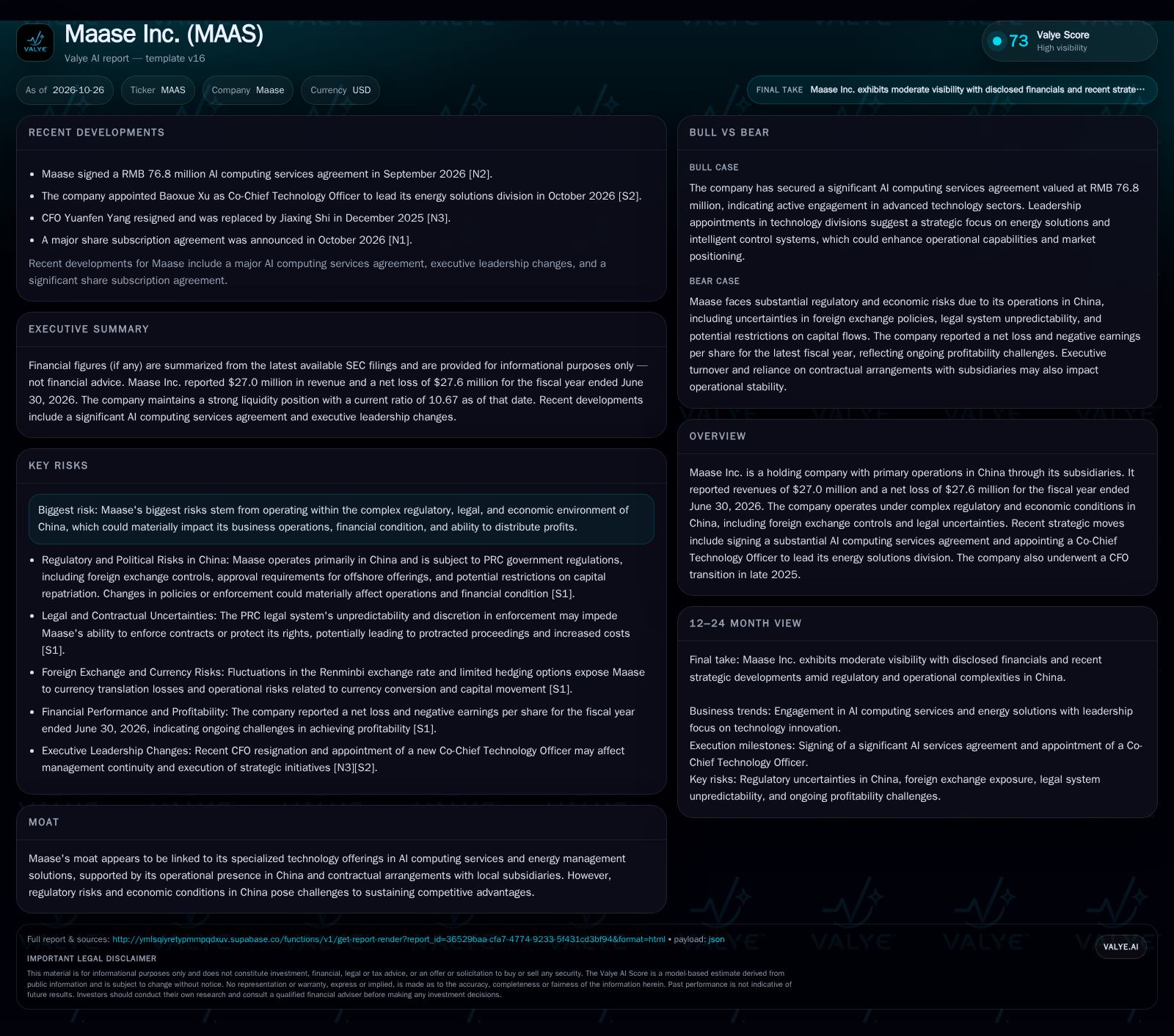
Maase Inc. is a China-focused holding company with $27 million in revenue and a net loss of $27.6 million for the year ended June 30, 2026. The company recently secured a major AI computing services contract and appointed a new Co-CTO for its energy solutions division, signaling a strategic push into advanced technology fields. However, persistent losses, significant regulatory risk, and management turnover highlight the need for operational and financial execution.
Maase Inc. stands at a strategic crossroads: on one hand, it is making bold moves into AI computing and energy management, evidenced by a recent multimillion-dollar contract and a targeted leadership hire. On the other, the company’s persistent net losses and exposure to China’s intricate regulatory landscape create material uncertainty around its long-term viability. For investors and partners, the central question is whether Maase’s technology bets and operational initiatives can overcome both structural losses and the external headwinds unique to its primary market.
Recent AI Contract and Leadership Moves Define Strategic Direction
Maase Inc. reported $27.0 million in revenue alongside a net loss of $27.6 million for the fiscal year ended June 30, 2026, with both basic and diluted EPS firmly negative [S1]. In September 2026, it announced a RMB 76.8 million AI computing services agreement, which is a substantial contract relative to its annual revenue base [N2]. Just a month later, Maase appointed Baoxue Xu as Co-Chief Technology Officer to head its energy solutions division, underscoring a clear intention to expand in intelligent control and energy management technologies [S2]. The company reported a current ratio of 10.67 for the period. [S1] Operating primarily in China, Maase faces heightened regulatory, legal, and currency risks, which remain central to its investment case [S1].
A critical factor in evaluating Maase’s strategic direction is the scalability and replicability of its AI computing services contract. The degree to which this contract can be expanded or serve as a template for future deals will influence revenue predictability and margin stability. Additionally, the appointment of a Co-CTO specifically for energy management suggests a dual-leadership approach potentially aimed at balancing innovation with operational execution. This structure may help mitigate risks associated with rapid technology shifts but also introduces complexity in decision-making and resource allocation. Understanding how these leadership roles coordinate and prioritize investments would provide insight into the company’s capacity to integrate AI and energy solutions effectively.
Revenue Mix, Cost Structure, and the Challenge of Scaling Profitably
Maase’s business model appears to center on technology-driven service agreements—exemplified by the recent AI computing contract and its targeted push into energy management. The economics of such contracts can be attractive if they are large, recurring, and high-margin, but the company’s ongoing net loss suggests either insufficient scale, high upfront costs, or both. Fixed costs in R&D, talent, and compliance are likely substantial, especially in regulated sectors like AI and energy in China. Variable costs may include hardware depreciation, cloud or data center fees, and project-specific labor, which can pressure margins if contract pricing is not sufficiently premium.
The company reported cash and liquidity metrics for the period; these figures do not by themselves establish operating runway, investment capacity, financial flexibility, or financing capacity. If Maase’s AI and energy solutions are delivered as multi-year service contracts, this could eventually provide revenue visibility and operating leverage, but the current evidence does not confirm recurring or subscription-based mechanics. Capital needs may rise if Maase pursues further technology development or must pre-fund hardware and infrastructure for large contracts, particularly under PRC capital controls and contractual arrangements with subsidiaries.
An important dimension of Maase’s cost structure is the interplay between fixed and variable expenses in a highly regulated environment. Fixed costs such as compliance, R&D, and talent acquisition are often sunk in the short term, which can exacerbate losses if revenue growth lags. Conversely, variable costs tied to project delivery and infrastructure usage may fluctuate with contract volume but can also introduce operational leverage if managed efficiently. The timing of these costs relative to contract milestones and payment schedules is crucial, especially under PRC capital controls that may restrict cash flow flexibility. A phased investment approach aligned with contract progress could help optimize cash burn and reduce financing dependency.
Positioning in China’s Crowded Technology and Energy Markets
Maase operates in two intensely competitive landscapes: AI computing and energy management. In China, both sectors attract significant domestic and international entrants, ranging from pure-play AI service providers to state-backed energy technology conglomerates. Maase’s potential differentiators could include specialized technology, customer relationships, or integration with local partners, but the supplied facts do not clarify its unique value proposition or pricing power.
Regulatory dynamics are a double-edged sword: while local presence and compliance may provide some moat against foreign entrants, frequent policy shifts and enforcement discretion introduce major risks. Substitution risk is high—customers can switch to alternative AI or energy management vendors if Maase’s offerings are not clearly superior in performance, integration, or cost.
Maase’s positioning also depends on its ability to differentiate through technology integration and customer intimacy within China’s fragmented AI and energy markets. If the company can leverage proprietary algorithms, data assets, or domain expertise to tailor solutions that address specific client pain points, it may build a defensible niche. However, the rapid pace of innovation and aggressive pricing by competitors, including state-backed entities, could compress margins and limit market share gains. Furthermore, regulatory compliance may confer some advantage but also adds operational complexity that competitors with deeper local ties or scale might manage more effectively. Strategic partnerships or alliances could be a pathway to enhance competitive positioning if Maase can secure complementary capabilities or distribution channels.
If AI and Energy Solutions Gain Traction, Margin Expansion Could Accelerate
The most favorable scenario for Maase hinges on its recent AI computing services contract and energy management focus catalyzing further customer wins and higher-margin deals. If the RMB 76.8 million contract reflects a scalable, replicable solution, Maase could leverage this reference to attract similar clients, potentially moving toward a recurring revenue model with better visibility and operating leverage.
Confirmation of this scenario would come from disclosures of multi-year contract backlogs, evidence of repeat business, or significant sequential revenue growth tied to technology solutions. Additional technology leadership hires, successful case studies, or new product launches in energy management would also support the upside. Falsification would occur if subsequent filings show stagnant or declining revenue, contract non-renewal, or lack of follow-through on the energy solutions strategy.
Incremental Progress, Persistent Losses, and Regulatory Overhang Remain Central
The most plausible near-term outcome is that Maase continues to execute on its AI and energy solutions initiatives, but at a pace insufficient to offset ongoing losses and external headwinds. While the recent contract and leadership hire may boost revenue or capabilities, the company’s structural challenges—high fixed costs, regulatory complexity, and uncertain contract renewal or expansion—persist.
Evidence confirming this base case would include modest revenue growth without a clear path to profitability, continued net losses, and no major new contracts or recurring revenue disclosures. If Maase is able to contain costs or renegotiate terms with subsidiaries to improve cash flow, it could stabilize, but regulatory and legal risks will likely continue to constrain upside and weigh on valuation.
Contract Dependency, Regulatory Shocks, and Liquidity Drain Could Drive Downturn
A negative scenario could unfold if Maase’s large contracts fail to renew, are delayed, or are not replicated, exposing the company to revenue volatility and accelerating cash burn. Regulatory shocks—such as new PRC restrictions on technology exports, capital flows, or contractual structures—could disrupt operations or limit access to cash generated by subsidiaries.
Evidence of downside would include a sharp drop in reported revenue, increased legal or regulatory expenses, or a significant reduction in cash and short-term investments without offsetting new business. Loss of key personnel or further executive turnover could also signal execution risk. If Maase is forced to seek emergency funding or faces restrictions on cash repatriation, the risk of financial distress would increase materially.
Milestones That Could Shift Maase’s AI and Energy Solutions Trajectory
Revenue growth specifically attributable to AI computing services and energy management contracts, if disclosed, would clarify the traction of these strategic bets.
Contract renewal rates and evidence of multi-year or recurring business would help test the sustainability of Maase’s revenue base.
Gross margin trends, particularly in the technology solutions segments, would indicate whether operating leverage is emerging.
Cash flow from operations and changes in cash/short-term investments will reveal whether Maase is moving toward self-sufficiency or burning through liquidity.
Any major new regulatory developments in China affecting technology or capital flows could materially alter the risk/reward profile.
Announcements of additional large contracts, partnerships, or public sector deals would signal momentum beyond the current contract win.
Turnover or additions in key management roles—especially in finance, technology, or China operations—could impact execution and strategic stability.
Disclaimer: This is research-only, informational analysis and not investment advice. It may include AI-generated interpretation and general industry context. Always verify important details using primary sources.

Comments