
Medifast’s Metabolic Health Pivot: Can a Coach-Driven Model Withstand Medical Weight Loss Disruption?
Despite a science-based transformation and reported liquidity position, Medifast faces a critical test: can its coach-first, holistic metabolic system maintain relevance and restore profitability as GLP-1 drugs and digital rivals redefine the weight loss market?
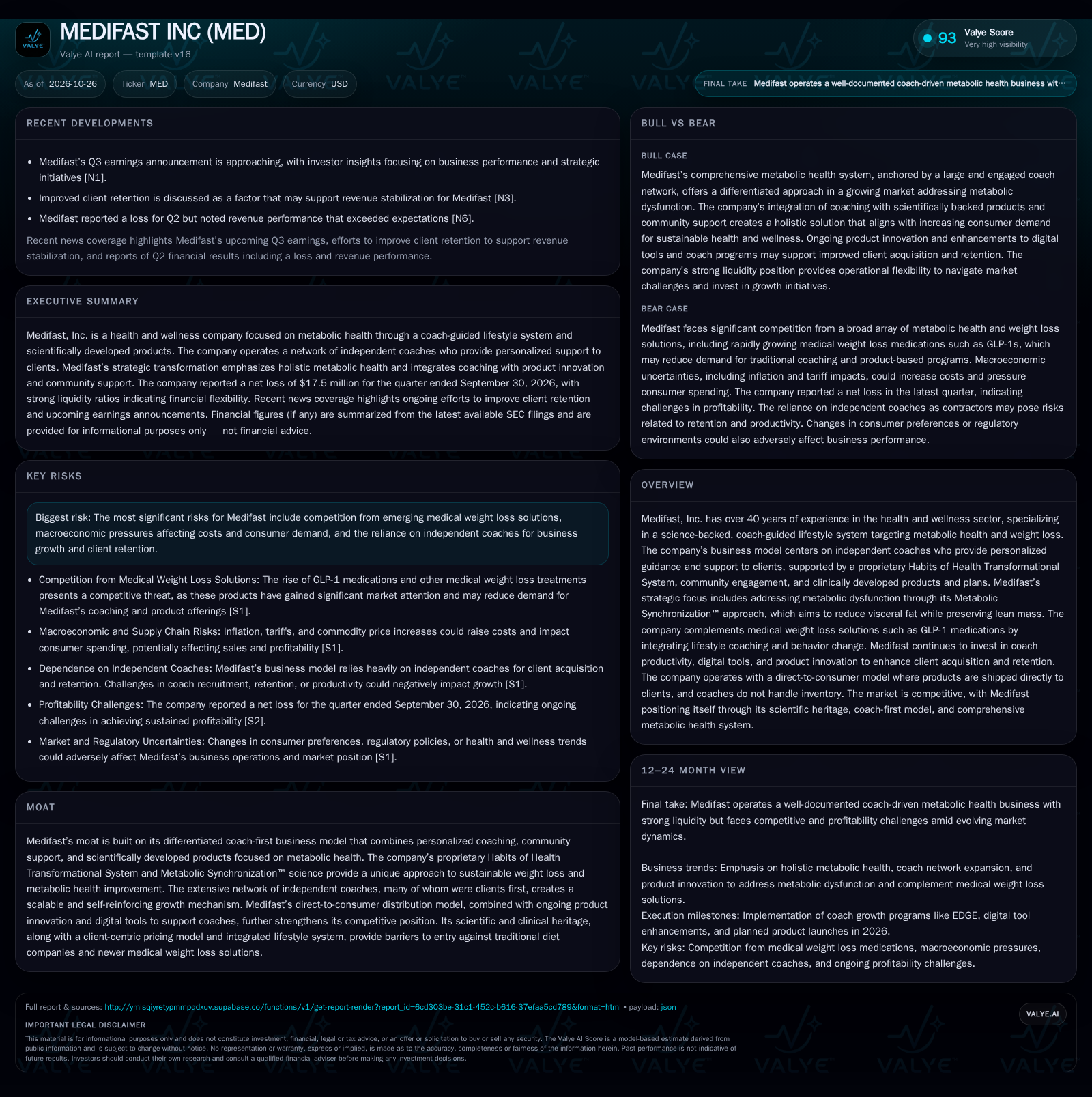
Medifast is in the midst of a strategic shift toward holistic metabolic health, relying on a large independent coach network and science-backed programs. The success of new programs, coach productivity tools, and product innovation will determine if Medifast can stabilize revenue and return to profitability in a rapidly evolving market landscape. [S1] [S2]
Medifast’s evolution from a product-based weight loss brand to a holistic metabolic health platform is being tested by one of the most disruptive shifts in the sector’s history: the rise of prescription GLP-1 medications and digital-first wellness solutions. The company’s future will likely hinge on its ability to leverage digital investments, next-generation product launches, and the unique engagement of its coach network to carve out a defensible niche amid intensifying competition and shifting consumer preferences. [S1] [S2]
Recent Financial Losses and Strategic Shifts Reshape Medifast’s Outlook
Medifast reported a net loss of $17.5 million for the quarter ended September 30, 2026, with basic and diluted EPS at -$1.57. The company reported cash and liquidity metrics for the period; these figures do not by themselves establish operating runway, investment capacity, financial flexibility, or financing capacity. The company’s most material recent move is its 2025 strategic pivot toward holistic metabolic health, emphasizing the Metabolic Synchronization™ approach and product innovation, including the integration of lifestyle solutions with the growing use of GLP-1 medications. Medifast continues to invest in digital tools and coach productivity programs, such as the EDGE initiative, to improve client acquisition and retention. Whether these efforts can reverse losses and stabilize revenue is now a central question for the business. [S1] [S2]
How Medifast’s Coach-Driven, Direct-to-Consumer Model Generates—and Risks—Value
Medifast’s economics are built around a direct-to-consumer model where independent coaches, compensated as contractors, provide personalized guidance and convert clients via digital and word-of-mouth channels. The company’s revenue comes from sales of proprietary meal replacements, supplements, and health programs shipped directly to consumers. Fixed costs include product development, digital infrastructure, and marketing, while variable costs are driven by product fulfillment and coach commissions.
In theory, the model offers operating leverage: once a coach is acquired and digital tools are built, incremental clients add revenue with modest marginal cost. However, the system is sensitive to coach productivity and retention—if coach engagement lags, both client acquisition and downstream revenue fall. Medifast’s EDGE and Premier+ programs are designed to boost coach output and retention, but the true elasticity of coach-driven growth is unproven in a landscape where prescription drugs and digital apps may offer perceived faster or simpler results.
Future economics hinge on whether new product lines and digital enhancements can drive higher client lifetime value, offsetting potential declines in traditional product volume as GLP-1 use grows. The absence of tiered pricing suggests Medifast is pursuing volume over margin expansion, which could limit pricing power but may help retain cost-sensitive clients.
Competitive Structure: Clinical Heritage vs. Medical and Digital Disruptors
Medifast competes in a highly fragmented metabolic health and weight loss market, facing traditional commercial programs, digital coaching apps, surgical interventions, and, most disruptively, prescription GLP-1 medications. The coach-first model, proprietary behavioral system, and direct-to-consumer logistics are designed to differentiate Medifast from both legacy diet firms and pure software challengers.
However, the rapid adoption of GLP-1 drugs for weight loss has shifted consumer expectations toward medicalized, fast-acting solutions. Digital-native platforms—often leveraging AI-driven personalization and lower fixed costs—compete for the same health-conscious demographic and may scale faster with lower client acquisition costs. Medifast’s reliance on human coaches and bundled products could remain attractive to clients seeking community and behavioral change, but the risk is that a growing share of the market will gravitate to either prescription drugs (for efficacy) or digital apps (for convenience and price).
Medifast’s edge may lie in its integrated approach—coaching, community, and product—plus its scientific claims around metabolic health and lean mass preservation. The question is whether these advantages are sufficiently valued in an era where pharmaceuticals and tech-first solutions dominate the narrative.
If Behavioral Integration Wins: Medifast as the Essential Complement to Medical Weight Loss
In a favorable scenario, Medifast’s coach-centric model and science-based programs become the preferred complement to GLP-1 medications and other medical interventions. As consumers and healthcare providers recognize that long-term weight management and metabolic health require behavioral change—not just pharmacology—Medifast’s programs are prescribed or recommended alongside medical treatments.
This would drive increased client acquisition, as the company’s Metabolic Synchronization™ approach and new product lines are seen as essential for sustaining weight loss, preserving lean mass, and mitigating the side effects of medical therapies. Improved digital tools and coach productivity programs (EDGE, Premier+) could enable each coach to manage more clients, amplifying operating leverage and restoring profitability even with competitive pricing.
Evidence that would confirm this scenario includes: rising client conversion rates from medical channels, partnerships with healthcare providers, increased average revenue per client, and margin stabilization or expansion despite GLP-1 adoption.
Navigating a Squeezed Middle: Medifast’s Likely Reality in a Hybrid Market
The most plausible outcome is that Medifast maintains a defensible but pressured niche, serving clients who value behavioral support and community but are increasingly exposed to medical and digital alternatives. Revenue and client counts may stabilize but not return to former growth rates, as product innovation and digital enhancements offset some—but not all—of the share lost to GLP-1s and software-based rivals.
Profitability could remain volatile, with periodic losses as fixed digital investments and marketing costs rise to retain relevance. Coach retention and productivity become the main operational levers, with the EDGE program and digital upgrades helping to slow, but not reverse, competitive attrition. Medifast’s liquidity provides time to refine its model, but sustained positive earnings may remain elusive unless it can tap new referral channels or prove that its science-based approach drives superior outcomes.
Confirmation would come from flat or slowly growing revenue, stable coach counts, and muted margin improvement. Falsification would be persistent client or coach attrition and continued quarterly losses despite new program rollouts.
Coach Attrition and Medical Displacement: How the Model Could Unravel
In a negative scenario, accelerating adoption of GLP-1 medications and digital-first platforms sharply erode Medifast’s client base, with coaches struggling to recruit or retain clients who increasingly view medical or app-based solutions as superior. Fixed costs related to digital investments and product development outstrip revenue, leading to sustained losses that force retrenchment or restructuring.
If coach productivity and retention decline—either because of dwindling client interest or more attractive alternatives for side-hustle income—the network effect that underpins Medifast’s model could break down. The company may be forced to cut back on product innovation or marketing, further weakening its competitive position and brand relevance.
Indicators of this scenario would include rapidly declining coach counts, shrinking revenue per client, mounting quarterly losses, and negative operating cash flow despite cost-cutting efforts.
Signals That Will Determine Medifast’s Strategic Trajectory
Trends in active earning independent coach numbers: sustained growth or decline will reveal the health of the core acquisition engine.
Client retention and new client acquisition rates, if disclosed, to gauge the effectiveness of EDGE and digital tool investments.
Revenue per client and average order value: improvement would suggest successful product innovation or higher engagement.
Margins and operating leverage as new products and digital programs scale: are fixed investments yielding improved profitability?
Partnerships or referral arrangements with healthcare providers or GLP-1 prescribers, which would validate Medifast’s integration into the medical value chain.
Digital engagement metrics—such as active users of Premier+ or other proprietary tools—if disclosed, to test whether digital investments are driving coach and client productivity.
Evidence of product pipeline launches and adoption rates for new metabolic health solutions planned for 2026.
Disclaimer: This is research-only, informational analysis and not investment advice. It may include AI-generated interpretation and general industry context. Always verify important details using primary sources.

Comments