
Teledyne Technologies: Acquisition-Driven Growth and Defense Tailwinds Meet the Challenge of Integration and Demand Cycles
Teledyne’s latest quarter reflects robust revenue and profit growth, driven by defense sector exposure and a disciplined acquisition strategy.
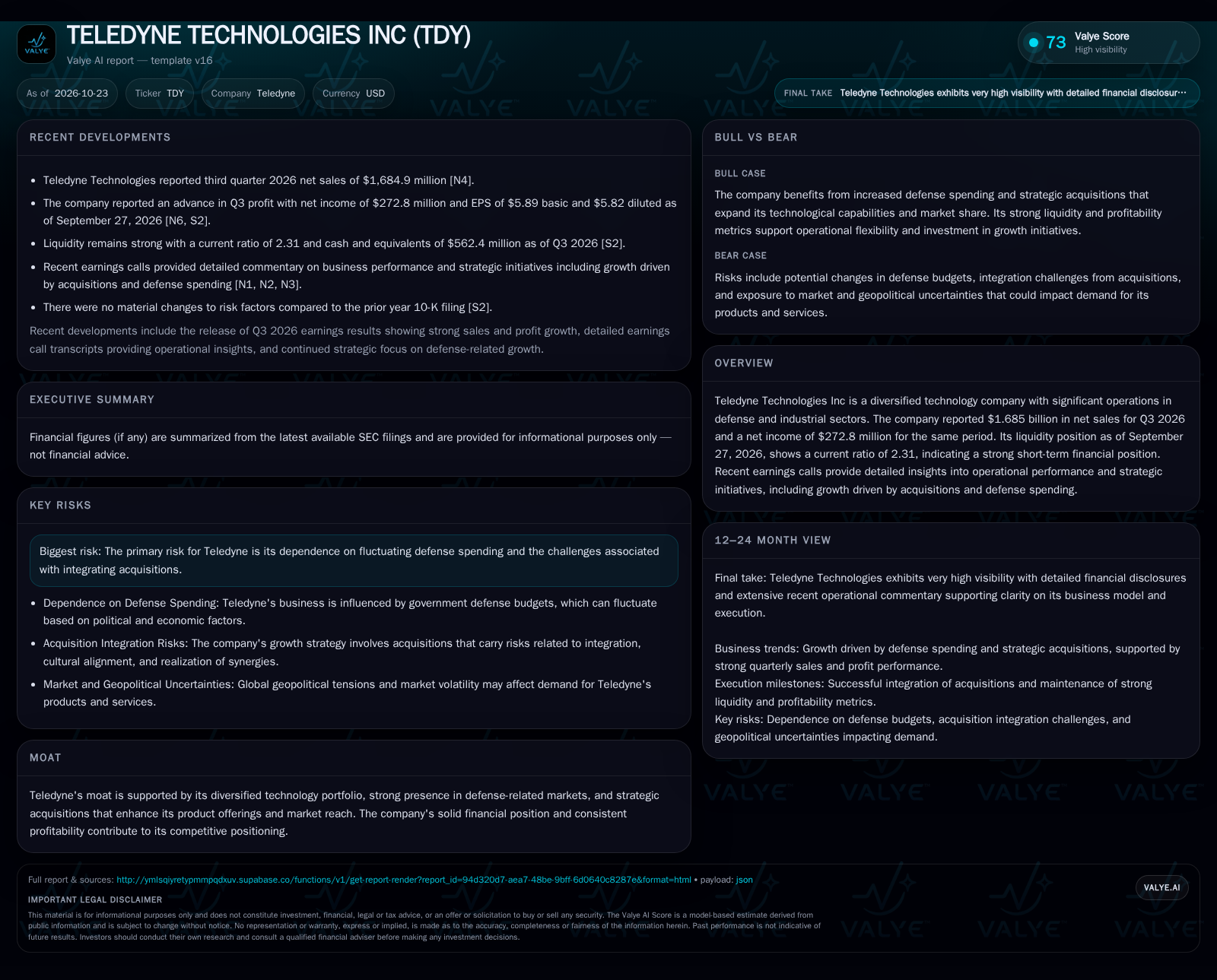
Teledyne Technologies posted strong Q3 2026 results, with $1.685 billion in net sales and $272.8 million in net income. The company’s diversified technology portfolio and operational execution are strengths, but dependence on defense budgets and acquisition integration are persistent risks. Watch for sustained margin performance, acquisition outcomes, and shifts in government funding.
Teledyne Technologies’ third quarter 2026 results underscore the company’s ability to capitalize on rising defense spending and execute on a focused acquisition strategy. With $1.685 billion in sales and a strong profit showing, the company is demonstrating both operational discipline and potential financial flexibility. However, the durability of this trajectory will depend on Teledyne’s ability to integrate acquired businesses, maintain innovation, and adapt to potential volatility in government defense budgets. The next phase will test whether Teledyne can convert its current momentum into longer-term, defensible growth.
Recent Financial Performance and Strategic Positioning: What’s Changed in 2026
Teledyne Technologies reported Q3 2026 net sales of $1,684.9 million and net income of $272.8 million, translating to basic EPS of $5.89 and diluted EPS of $5.82 [N4] [S2]. These figures reflect ongoing revenue and profit expansion, attributed in part to strong demand in defense-related markets and contributions from recent acquisitions [N1] [N2] [N6]. As of September 27, 2026, the company held $562.4 million in cash and cash equivalents, with a current ratio of 2.31 and a cash ratio of 0.37, indicating a reported liquidity position [S2]. Importantly, there were no material changes to previously disclosed risk factors, suggesting operational continuity and no new major threats in the immediate term [S2].
Additionally, the absence of new risk factors does not preclude emerging operational challenges, such as supply chain disruptions or geopolitical shifts, which could subtly influence near-term performance and require ongoing monitoring.
How Teledyne Converts Innovation and Scale into Profits
Teledyne’s business model is anchored in providing high-value technology solutions to defense, aerospace, and industrial clients. Revenue is generated through a mix of product sales, systems integration, and (where applicable) service contracts—often with government entities or prime contractors. Given the nature of defense and critical infrastructure projects, pricing typically reflects both technological differentiation and regulatory requirements, supporting higher average margins than commodity manufacturers.
Operating leverage is a key feature: fixed costs are significant due to R&D, advanced manufacturing, and regulatory compliance, but incremental sales can drive outsized profit gains once the cost base is covered. This effect is visible in the company’s recent profit advance alongside revenue growth. Teledyne’s acquisition strategy is designed to augment capabilities and expand addressable markets, but it also introduces integration costs and risks. Capital needs are moderate for ongoing operations but can spike with large acquisitions or technology investments.
The company’s reliance on fixed-cost structures, particularly in R&D and manufacturing, creates a natural threshold effect where incremental sales beyond breakeven can disproportionately enhance profitability. However, this leverage also introduces risk during demand downturns or integration phases when fixed costs remain elevated but revenue growth slows. Moreover, the acquisition strategy, while accretive in expanding technological capabilities and market access, demands rigorous post-merger integration discipline to prevent dilution of margins and to realize anticipated operational synergies. Capital allocation decisions must balance the pursuit of growth through acquisitions with sustaining organic innovation investments to safeguard long-term competitiveness.
Defensible Niches and the Pressures of a Fragmented Technology Landscape
Teledyne’s competitive position rests on its diversified technology portfolio and entrenched relationships in defense and industrial sectors. Its advantage lies in engineering depth, regulatory expertise, and the ability to deliver mission-critical solutions that are difficult to commoditize. However, the landscape is fragmented: Teledyne competes with both large diversified peers and specialized technology firms across its segments.
Barriers to entry in defense and high-reliability industrial markets are substantial, given regulatory hurdles and the need for long-term customer trust. Yet, switching costs for customers may not be absolute—especially as governments and contractors seek to diversify supply chains for resilience. Technology substitution risk is also present; advances in AI, sensor fusion, or alternative materials could disrupt established product lines. Teledyne’s acquisition-driven growth can help pre-empt some of these shifts, but integration execution and innovation pace will determine whether its competitive position strengthens or erodes over time.
Teledyne’s position in fragmented markets affords both opportunities and vulnerabilities. Fragmentation can enable niche leadership and tailored solutions that command premium pricing, but it also invites competitive encroachment from agile startups and larger diversified firms seeking to consolidate market share. The dynamic nature of technology adoption, especially with rapid advancements in AI and sensor technologies, necessitates a proactive innovation pipeline and strategic partnerships to preempt obsolescence. Additionally, customer diversification strategies by governments and contractors, while risk-mitigating, may compress margins and intensify competition, underscoring the importance of maintaining differentiated value propositions and operational excellence.
Integration Synergies and Defense Upswings Drive Durable Outperformance
A favorable outcome for Teledyne would see sustained increases in defense budgets—domestically and with allied governments—fueling strong demand for advanced sensing, imaging, and electronics solutions. If Teledyne successfully integrates acquired businesses, realizes operational synergies, and leverages cross-selling opportunities, it could achieve above-industry growth and margin expansion.
Confirmation would come from continued revenue and profit growth outpacing sector averages, improving operating margins, and evidence of synergies in earnings call commentary or segment disclosures. Additional signs include successful launches of new technology platforms, customer wins in adjacent markets, and rising backlog (if disclosed). Falsification would be indicated by integration delays, cost overruns, or a stall in margin expansion despite rising sales.
Sustained Growth with Periodic Shocks and Integration Hurdles
The most plausible trajectory is for Teledyne to maintain moderate revenue and profit growth, supported by ongoing defense sector demand and incremental contributions from acquisitions. Margins could remain healthy, but with periodic pressure from integration costs, R&D investment, and potential competitive pricing in select segments. Occasional project delays or budget adjustments are likely, reflecting the cyclical nature of government spending.
This scenario would be confirmed by stable or gradually improving financial metrics, continued liquidity strength, and steady commentary on operational execution in future filings and calls. Evidence of manageable integration costs and no material new risk disclosures would reinforce the base case. If margin degradation accelerates, or if liquidity comes under pressure from acquisition spending or working capital needs, this would challenge the base scenario.
Acquisition Missteps and Defense Spending Cuts Undermine Momentum
A negative scenario could unfold if there is an unexpected contraction in defense budgets—whether due to political shifts, fiscal tightening, or geopolitical détente—leading to order delays or cancellations. Simultaneously, if Teledyne faces significant challenges integrating new acquisitions (cultural mismatch, operational disruption, or failure to realize synergies), both costs and management distraction could rise sharply.
Downside confirmation would include declining sales or profits, margin compression, increased one-time or recurring integration charges, and negative revisions to guidance. Additional warning signs would be a deterioration in liquidity metrics (e.g.
What Will Test Teledyne’s Defense-Driven Growth and Integration Strategy Next?
Sustained or rising operating margin, particularly at the segment level, would provide evidence of successful integration and pricing discipline.
Revenue growth relative to broader defense and technology sector benchmarks will indicate whether Teledyne is capturing outsized share or simply riding industry tides.
Acquisition-related cost disclosures (if detailed) and commentary on synergy realization will clarify whether dealmaking is value-accretive or dilutive.
Backlog trends (if disclosed) or forward order commentary can provide early signals of demand resilience or vulnerability.
Changes in government defense budgets or procurement policy—especially in the U.S. and allied markets—are critical external watchpoints.
R&D expenditure as a percentage of sales, and the cadence of new product launches, will help test the company’s ability to defend against technological disruption.
Disclaimer: This is research-only, informational analysis and not investment advice. It may include AI-generated interpretation and general industry context. Always verify important details using primary sources.

Comments