
Las Vegas Sands: Margin Sensitivity, Asia Exposure, and the Stakes of Premium Gaming Volatility
Las Vegas Sands faces a complex operating landscape, with recent softness in premium gaming and persistent cost pressures challenging its Asian resort model.
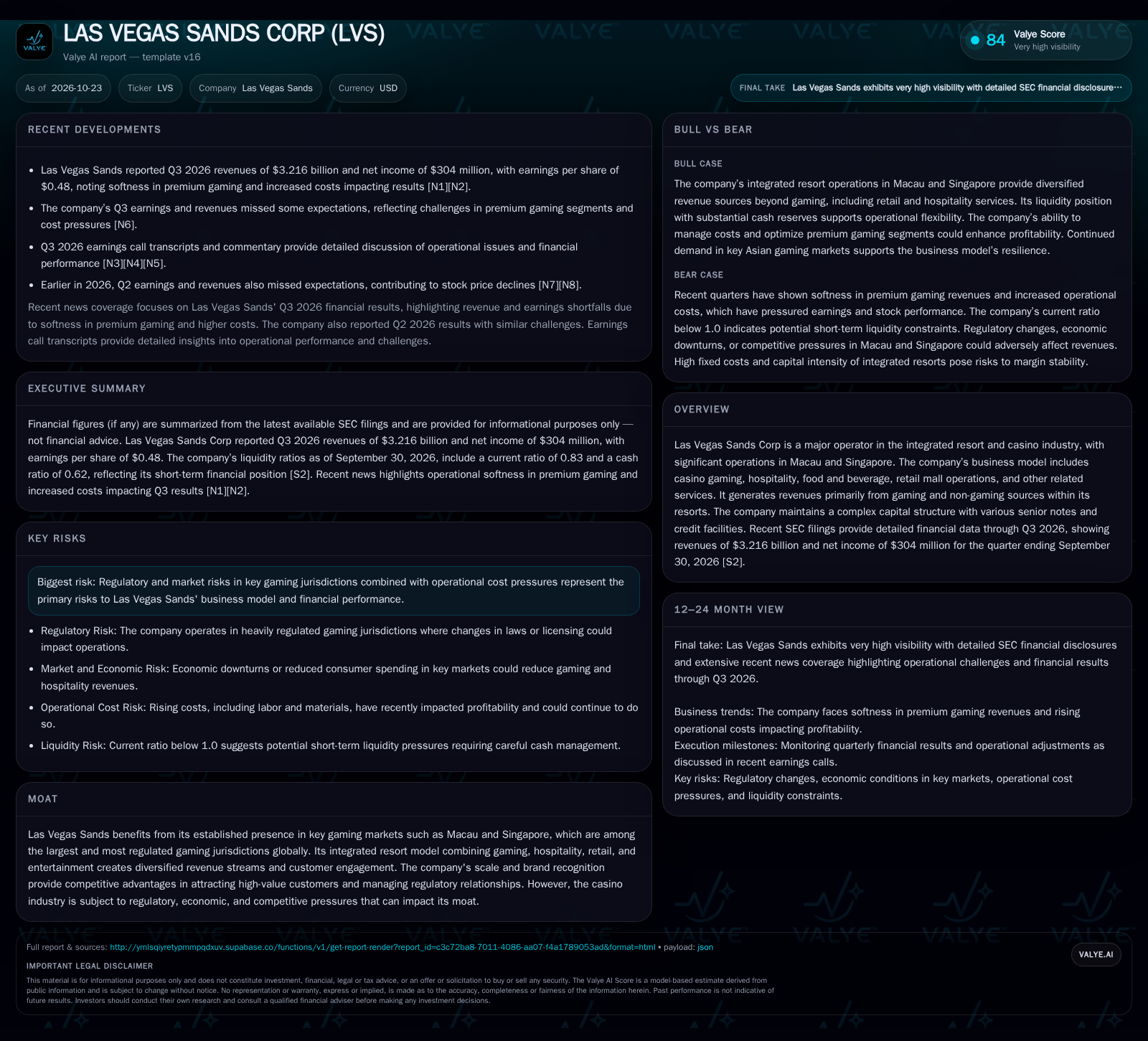
Las Vegas Sands reported Q3 2026 revenues of $3.216 billion and net income of $304 million but missed expectations due to weakness in premium gaming and higher costs. Regulatory risk and cost inflation remain key variables for future performance. [S2] [N6]
Las Vegas Sands’ latest quarter underscores how sensitive the integrated resort model is to both demand volatility and cost inflation, particularly in its core Asian markets. Despite generating over $3.2 billion in revenue for Q3 2026, the company missed expectations on both the top and bottom line, with softness in premium gaming and rising operational expenses compressing margins. With high fixed costs and a capital-intensive asset base, Las Vegas Sands’ future performance will be closely tied to its ability to reignite premium gaming demand and contain cost pressures in an increasingly competitive and regulated landscape. [S2] [N6]
Recent Earnings Misses Reveal Margin and Liquidity Stress Points
Las Vegas Sands reported Q3 2026 revenues of $3.216 billion and net income of $304 million, with both figures falling short of analyst expectations due to soft premium gaming revenues and higher operational costs. Basic and diluted EPS came in at $0.48. The company ended the quarter with $2.858 billion in cash and cash equivalents, current assets of $3.819 billion, and current liabilities of $4.621 billion—resulting in a current ratio of 0.83 and a cash ratio of 0.62. These figures point to short-term liquidity constraints and underline the importance of operational discipline and market recovery for near-term financial stability. [S2] [N6]
Fixed-Cost Leverage and Volume Sensitivity in the Integrated Resort Model
Las Vegas Sands’ economics are defined by a mix of high fixed costs, significant operating leverage, and substantial capital requirements. The integrated resort model—encompassing casino gaming, hotel occupancy, F&B, and retail—generates revenues from both gaming and non-gaming sources, but profitability is especially sensitive to shifts in high-margin premium gaming. Fixed costs such as labor, maintenance, and debt service on senior notes and credit facilities mean that even modest revenue shortfalls can compress margins disproportionately. Conversely, incremental recovery in gaming volumes, especially in premium segments, can rapidly restore profitability due to high operating leverage.
The company reported cash and liquidity metrics for the period; these figures do not by themselves establish operating runway, investment capacity, financial flexibility, or financing capacity. This amplifies the need for stable revenue streams and prudent cash management, particularly when current liabilities exceed current assets. Cost inflation—especially in labor and materials—further magnifies margin risk, making cost containment as critical as topline growth.
The inherent volatility of premium gaming revenue also introduces a nonlinear risk profile to Las Vegas Sands’ earnings. Because a large portion of EBITDA is generated from a relatively small cohort of high-value players, fluctuations in their betting behavior or visitation patterns can cause outsized swings in profitability. This concentration risk necessitates sophisticated customer relationship management and targeted marketing strategies to sustain engagement with these premium customers. Furthermore, the capital intensity of integrated resorts means that fixed overheads remain largely invariant in the short term, amplifying the impact of any revenue volatility on margins. Thus, the company’s financial health is highly contingent on maintaining both volume and spend per visitor in the premium segment.
Another critical dimension is the interplay between fixed cost structure and the company’s ability to flex costs in response to demand fluctuations. While some operating expenses, such as variable labor or utilities, can be adjusted with relative agility, many costs—like property taxes, debt servicing, and long-term maintenance—are rigid. This cost stickiness constrains the company’s margin resilience during downturns, making proactive cost management and operational efficiency initiatives vital. Additionally, the timing mismatch between capital expenditures and revenue cycles can strain cash flow, underscoring the importance of prudent capital allocation and contingency planning to navigate periods of demand softness.
Market Concentration and Regulatory Exposure Define Competitive Dynamics
Las Vegas Sands’ competitive position is anchored in its scale and entrenched presence in Macau and Singapore, both of which are highly regulated and premium-oriented gaming markets. These jurisdictions offer high barriers to entry—through licensing and capital requirements—favoring established incumbents and limiting direct new competition. However, this concentration also exposes the company to region-specific regulatory and economic shocks. Any tightening of gaming regulations, changes in license terms, or macroeconomic downturns in China or Southeast Asia could disproportionately impact revenues and margins.
The competitive set includes both global integrated resort operators and local/regional players, with non-gaming offerings (retail, entertainment, and hospitality) providing some differentiation but not fully insulating against gaming revenue swings. Technology-driven substitutes, such as online gaming, remain less relevant in these jurisdictions due to regulatory restrictions but could become more salient if local laws evolve.
Premium Gaming Recovery and Cost Control Could Reignite Margin Expansion
A favorable scenario for Las Vegas Sands would involve a robust rebound in premium gaming demand in Macau and Singapore, coupled with effective operational cost management. If premium segment visitation and spend recover to pre-softness levels—potentially driven by easing travel restrictions, macroeconomic improvement in China, or successful marketing to high-value players—incremental revenue could flow disproportionately to the bottom line due to high operating leverage. This would be further amplified if the company can contain labor and input costs, possibly through productivity initiatives or procurement efficiencies.
Evidence supporting this scenario would include sequential improvement in premium gaming volumes, positive commentary on booking trends or player activity from company disclosures, and margin expansion despite stable or rising revenues. Falsification would come from persistent softness in premium gaming metrics or further cost inflation outpacing revenue growth.
Revenue Stability Hinges on Gradual Market Recovery and Tight Cost Management
The most plausible outcome is a gradual normalization of gaming and non-gaming revenues, with the company managing through ongoing cost pressures. Premium segments may recover at a measured pace, but not enough to fully offset cost inflation or restore peak margins. In this scenario, Las Vegas Sands would likely maintain stable, but not accelerating, earnings and continue to prioritize cash flow preservation and disciplined capital spending. Regulatory status quo in Macau and Singapore would be assumed, with no major licensing shocks or new competitive entrants disrupting market share.
Confirmation would come from relatively stable quarterly revenue, modest improvements in profitability, and management commentary emphasizing cost control and operational discipline. Signs of further margin compression or regulatory headwinds would challenge this scenario.
Regulatory Tightening or Prolonged Premium Weakness Could Trigger Financial Strain
A negative scenario would be triggered by either adverse regulatory developments in Macau/Singapore (e.g., tax increases, license restrictions, or new compliance costs) or by a prolonged slump in premium gaming demand. Given the company’s current ratio below 1.0, a sustained revenue decline could force difficult decisions around capital expenditures, cost cuts, or even asset sales to shore up liquidity. Fixed costs and debt service obligations would magnify the impact of lost revenues, potentially leading to covenant pressures or the need for external financing.
This scenario would be confirmed by further declines in premium gaming volumes, negative regulatory news, or deterioration in liquidity metrics. Evidence against this outcome would include stabilization or improvement in both regulatory environment and premium segment performance.
In a scenario of prolonged premium gaming weakness or regulatory tightening, the company’s capital structure and liquidity management would come under heightened scrutiny. Given the fixed nature of debt servicing obligations, sustained revenue declines could erode cash flows to levels insufficient to cover interest and principal repayments without asset disposals or refinancing. This financial strain might necessitate renegotiations with creditors or the pursuit of alternative financing sources, potentially at higher costs or with restrictive covenants. Additionally, cost-cutting measures in such an environment could impair service quality or marketing effectiveness, further depressing demand and creating a negative feedback loop. Hence, the downside risks are not solely revenue-driven but also encompass financial and operational dimensions that could compound challenges.
Testing the Sands Thesis: Areas for Near-Term Validation or Concern
Sequential trends in premium gaming volumes and win rates, especially in Macau and Singapore, would help test the resilience of the company’s core revenue engine.
Quarterly margin evolution and cost-per-employee metrics (if disclosed) would clarify whether operational discipline is offsetting inflationary pressures.
Regulatory developments—such as license renewals, tax changes, or policy shifts—should be closely tracked for signals of potential disruption or stability.
Updates on capital spending plans or project deferrals could reveal management’s appetite for risk and balance-sheet flexibility.
Management commentary on customer mix, marketing effectiveness, or premium player engagement (if disclosed) would provide leading indicators of demand recovery.
Competitive actions—such as new resort openings or promotional activity in Macau/Singapore—could affect share of wallet and pricing power.
External macro signals, including Chinese consumer confidence and outbound travel trends, would offer context for regional gaming demand.
Disclaimer: This is research-only, informational analysis and not investment advice. It may include AI-generated interpretation and general industry context. Always verify important details using primary sources.

Comments