
Quest Diagnostics: Payer Diversification, Billing Complexity, and the Stakes of Scale in Clinical Testing
Quest Diagnostics’ raised 2026 guidance and strong Diagnostic Information Services growth underscore the importance of payer mix, billing efficiency, and operational scale—but rising interest costs, cybersecurity vulnerabilities, and regulatory uncertainty complicate the outlook for margin stability and risk management.
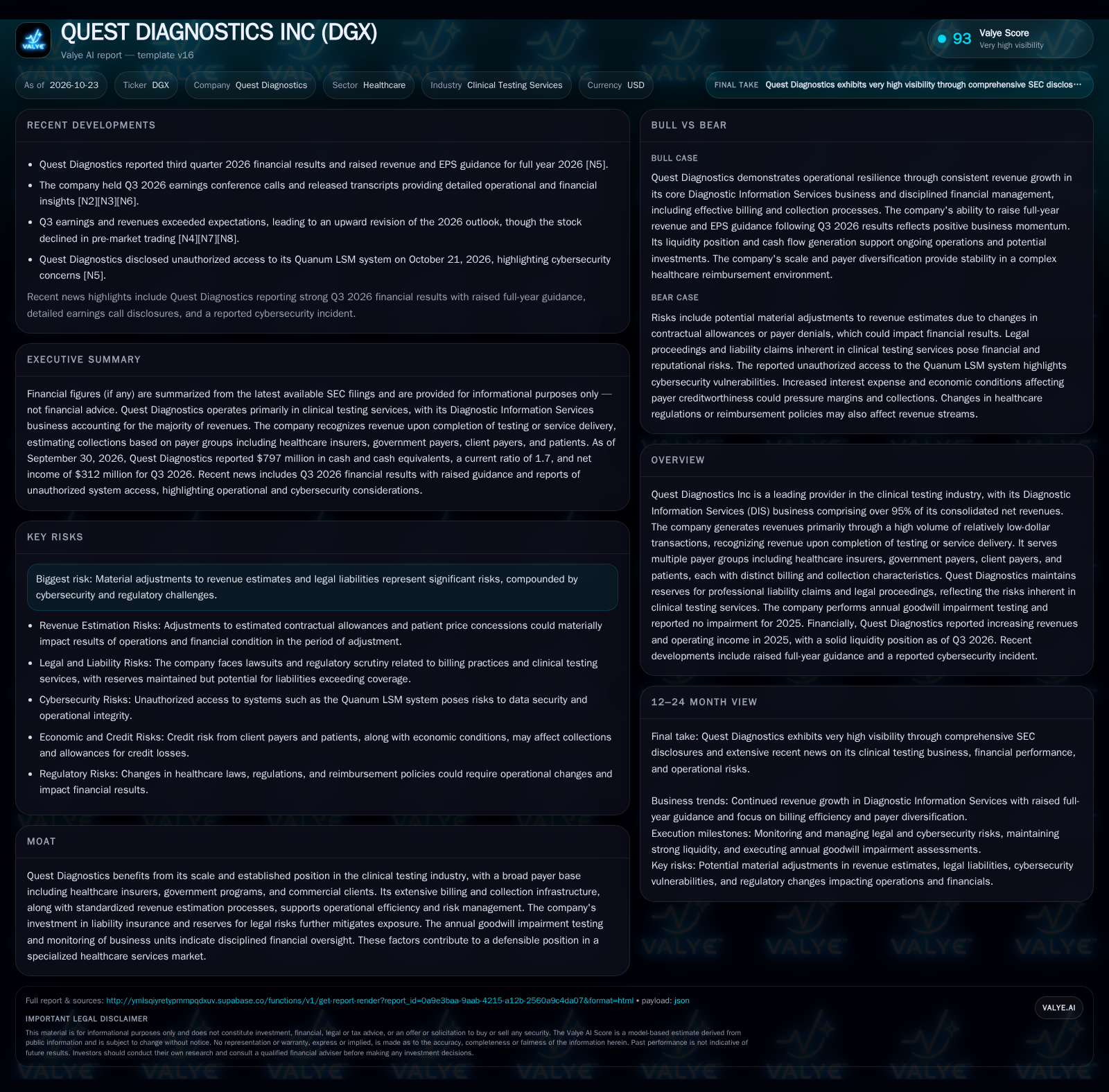
Quest Diagnostics’ Diagnostic Information Services business drove double-digit revenue and operating income growth in 2025, prompting raised guidance for 2026. The company’s performance highlights the advantages of scale, payer diversification, and billing process improvements in a complex, high-volume clinical testing market. However, rising interest expenses, a recent cybersecurity breach, and persistent regulatory and credit risk expose the limits of operating leverage and the challenge of managing multiple risk vectors going forward. [S2] [N5]
Quest Diagnostics’ latest results illustrate the power—and complexity—of scale in the clinical testing industry. With its Diagnostic Information Services (DIS) business representing the overwhelming majority of revenues and a double-digit growth rate in 2025, Quest has raised its full-year 2026 guidance. This momentum reflects not only the company’s broad payer mix and billing process improvements but also the persistent challenges posed by payer credit risk, regulatory uncertainty, and a rising interest expense burden. Meanwhile, a recent cybersecurity incident underscores growing operational risks as the company digitizes its workflows. The question for investors is whether operational leverage and payer diversification will offset these emerging headwinds or whether the limits of scale will become more apparent as the business environment shifts. [S2] [N5]
Recent Results Spotlight Growth and Operational Challenges
Quest Diagnostics’ Diagnostic Information Services (DIS) business delivered $10.785 billion in revenue for 2025, up 12.2% from the prior year, and accounted for more than 95% of total consolidated revenue. Operating income increased by 15.6% to $1.556 billion, providing the basis for raised full-year 2026 revenue and EPS guidance after Q3 2026 results. [S2] [N5]
Despite the robust top-line and operating income growth, interest expense rose 31.5% in 2025, narrowing the net margin expansion and emphasizing the company’s exposure to capital costs. [S2]
As of September 30, 2026, Quest reported $797 million in cash and a current ratio of 1.7. [S2]
A cybersecurity breach involving unauthorized access to the Quanum LSM system was reported on October 21, 2026, signaling heightened risk around data integrity and operational continuity. [N5]
How Scale, Payer Mix, and Billing Complexity Shape Economics
Quest Diagnostics’ economics are defined by high transaction volume, low average price points, and a complex payer landscape. The majority of revenue is recognized upon completion of testing, but actual collection depends on contractual terms and the creditworthiness of diverse payer groups: healthcare insurers (fee-for-service and some capitated arrangements), government payers (fixed schedules), client payers (hospitals, physicians, employers), and patients. [S2]
Roughly half of the company’s costs relate to employee compensation and benefits—a largely fixed structure at scale—while materials, logistics, and IT are variable or semi-variable. This means incremental volume, if matched by effective billing and collection, should yield operating leverage, but only if payer mix and reimbursement rates remain stable.
Accounts receivable are distributed across client payers (43%), healthcare insurers (27%), patients (20%), and government payers (8%), each with distinct collection cycles and risk profiles. Client payers and patients introduce higher credit risk and longer collection periods, which can increase working capital needs and require more aggressive allowances for doubtful accounts. [S2]
The increase in interest expense underscores the importance of capital structure discipline, as greater leverage can erode the benefits of scale if rates rise or cash flows are disrupted.
Defensible Scale, but Not Immune to Substitution and Margin Pressure
Quest Diagnostics’ primary competitive advantage is its national scale, broad payer relationships, and established billing infrastructure. Large-scale laboratories benefit from purchasing power, route density, and data-driven process improvements that are difficult for smaller regional labs to replicate cost-effectively.
However, scale alone does not eliminate risk. Hospital-based labs, specialty testing providers, and new entrants leveraging automation or direct-to-consumer models can compete on niche expertise, local responsiveness, or lower price points. Payer consolidation and regulatory changes can also pressure reimbursement rates, eroding margins even for market leaders.
Switching friction exists for major institutional clients due to integration with electronic health records and workflow processes, but this is less pronounced for price-sensitive smaller clients or patient self-pay segments. There is no evidence of network-effect lock-in; instead, recurring volume depends on service reliability, payer contracts, and regulatory compliance.
If automation and AI-driven diagnostics accelerate, they could shift the margin structure of the industry, potentially favoring even larger players—or allowing new tech-enabled entrants to erode incumbent share.
Sustained Volume Growth and Billing Efficiency Unlock Further Operating Leverage
If Quest Diagnostics continues to grow its DIS volumes—driven by expanded test menus, value-based care partnerships, and successful client and payer negotiations—incremental revenue could flow through at higher margins due to fixed-cost leverage. Improvements in electronic ordering, billing automation, and payer-specific collection strategies could reduce denial rates and speed up cash conversion, further enhancing profitability.
A favorable payer mix shift toward insurers and government programs with faster payment cycles and lower credit risk would free up working capital and reduce bad debt expense. If regulatory changes support preventive testing or expand reimbursement for advanced diagnostics, Quest could capture additional market share from less-capitalized competitors.
Confirmation would come from continued double-digit DIS revenue growth, declining days sales outstanding, and margin expansion outpacing revenue growth. Evidence of major new payer contracts, successful integration of new testing technologies, or improved patient collection rates would also support the bullish thesis.
Volume Momentum Offsets Margin Headwinds, but Risks Cap Further Expansion
The most plausible outcome is that Quest Diagnostics sustains moderate volume and revenue growth in its DIS business, with incremental improvements in billing efficiency and payer mix offset by periodic margin pressure from reimbursement changes, client payer defaults, and rising operating costs.
Interest expense may remain elevated, limiting net income growth even as operating income rises. Cybersecurity and compliance costs are likely to increase as digitalization accelerates, partially offsetting gains from workflow automation.
Evidence for this scenario would include steady, single-digit revenue growth, stable gross and operating margins, and manageable increases in bad debt and compliance expense. Any significant deterioration in the credit quality of client or patient payers, or a major regulatory change impacting reimbursement rates, would challenge this middle path.
Credit, Cyber, or Regulatory Shocks Disrupt Collections and Margin Structure
A sharp deterioration in client or patient payer credit quality—potentially triggered by economic downturns or healthcare cost shifts—could drive up bad debt expense and force more aggressive revenue write-downs, materially impacting operating results. A significant cyberattack or data breach could disrupt billing operations, erode client trust, and trigger legal liabilities or regulatory penalties.
If regulatory changes reduce reimbursement rates, restrict certain test categories, or impose new compliance costs, Quest could face a squeeze on both revenue and margins, particularly if rivals respond with aggressive pricing or innovation. Sustained increases in interest expense or a loss of access to cost-effective funding would amplify the downside.
This scenario would be confirmed by a spike in accounts receivable days, a surge in bad debt reserves, margin compression despite stable volumes, or major legal and compliance costs tied to cybersecurity or billing practices.
Factors That Will Test the Durability of Quest’s Scale and Margin Structure
Tracking the ratio of client and patient payer receivables to total accounts receivable—if disclosed—would reveal shifts in credit risk exposure.
Monitoring days sales outstanding (DSO) and bad debt expense trends would help assess billing efficiency and collection risk.
Observing the revenue contribution and growth rate of the Diagnostic Information Services segment, especially relative to industry volume trends, would clarify Quest’s ability to sustain share gains.
Watching for changes in interest expense and net debt levels would indicate sensitivity to capital structure and funding conditions.
Reviewing updates on cybersecurity incidents and associated legal/regulatory costs would test operational resilience.
Assessing any changes in payer mix, particularly shifts toward or away from higher-risk client/patient segments, would signal revenue quality trends.
Following regulatory developments around reimbursement rates, test coverage, and compliance requirements would highlight external pressures on economics.
Noting any major contract wins, technology integrations, or payer partnership announcements would help confirm the upside scenario.
Disclaimer: This is research-only, informational analysis and not investment advice. It may include AI-generated interpretation and general industry context. Always verify important details using primary sources.

Comments