
Hoops Scouting USA: Dual-Platform Ambitions Collide with Acute Financial and Execution Hurdles
Hoops Scouting USA aims to unify basketball scouting and digital training for aspiring athletes, but severe capital constraints, operational fragility, and intense competition threaten its ability to scale and survive. The next phase will hinge on successful app deployment, user uptake, and material progress toward monetization—none of which are assured without external funding.
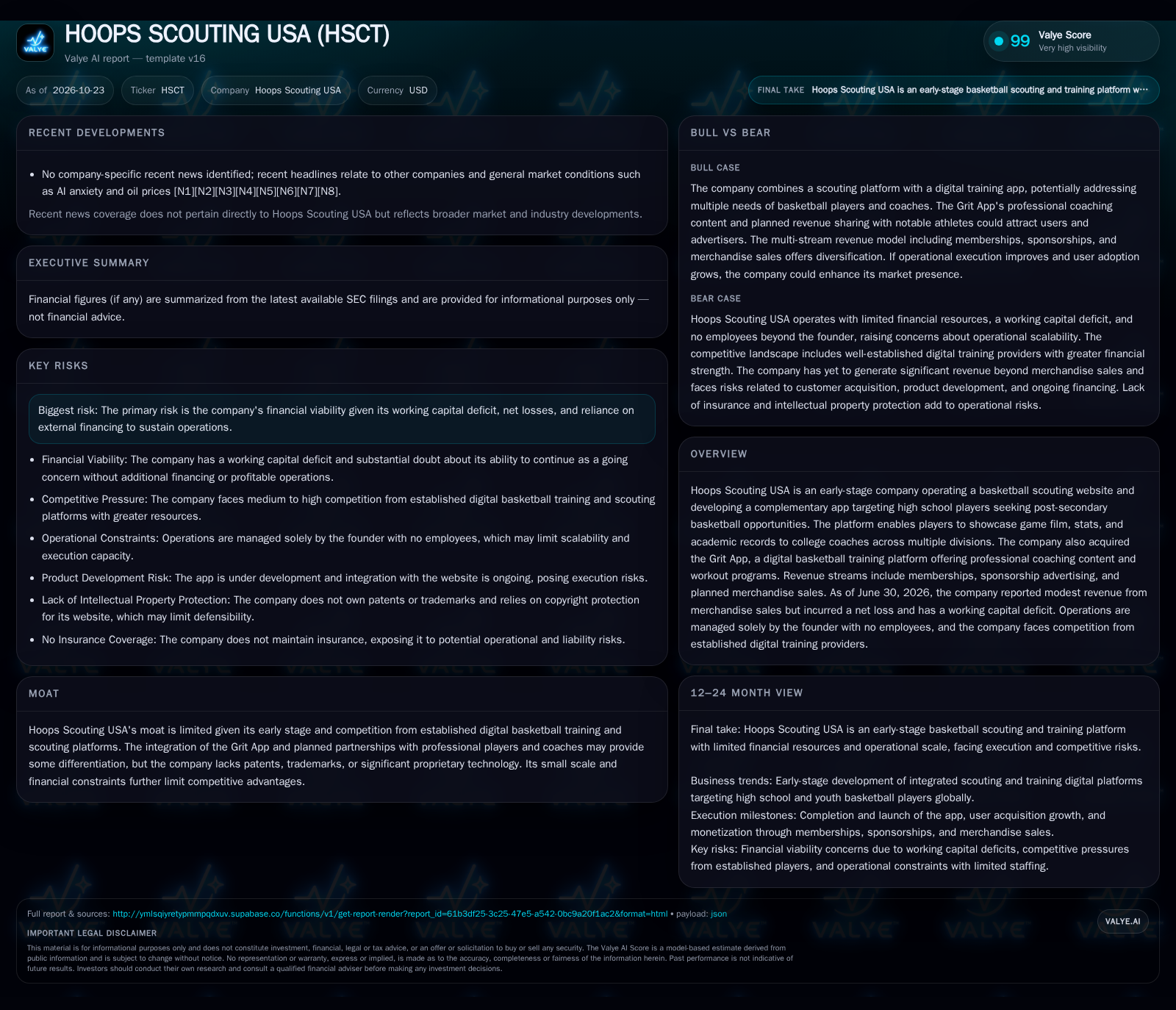
Hoops Scouting USA operates a digital platform for high school basketball scouting and has acquired a training app, but as of mid-2026 faces a severe working capital deficit, minimal revenue, and is run solely by its founder. The business model aspires to unite memberships, advertising, and merchandise, yet execution, funding, and competitive risks are acute. The company’s future depends on successful product launches and user growth, both of which are highly uncertain without substantial new capital or partnerships. [S1] [S2]
Hoops Scouting USA is attempting to carve out a niche at the intersection of high school basketball scouting and digital athletic training. Its recent acquisition of the Grit App signals a bid to address both player exposure and skill development. However, as of mid-2026, the company is confronting existential challenges: it has minimal revenue, a significant working capital deficit, no staff beyond its founder, and faces entrenched competition. The next twelve months will likely determine whether Hoops Scouting can transition from a single-operator project to a viable digital sports platform—or become another casualty of undercapitalized ambition in a crowded field. [S1] [S2]
Acute Capital Shortfall and Solo Operation Define the Current State
As of June 30, 2026, Hoops Scouting USA reported $20,000 in merchandise revenue but a net loss of $71,064. The company’s current assets stood at $69,127 against current liabilities of $316,978, yielding a current ratio of just 0.22 and a cash balance of $28. The entire business is operated by its sole founder with no employees or insurance coverage. These facts point to immediate financial fragility and operational risk: without near-term external funding or a sudden inflection in profitable revenue, the company’s ability to continue as a going concern is in serious doubt. [S1]
The Grit App acquisition in February 2023, valued at $100,000 and paid in restricted stock, brought a digital training platform into the fold. However, integration with the main scouting website and any meaningful monetization remain works in progress. [S1]
The company’s stated revenue streams—memberships, sponsorships, and merchandise—have yet to deliver scale or sustainability. Its business model is not yet validated in the market, and execution risk is heightened by the lack of staff, insurance, and tangible intellectual property protection. [S1]
Monetization Aspirations Confront Fixed Cost Pressure and Scaling Limits
Hoops Scouting USA’s intended revenue stack is diversified in theory: player and coach memberships, advertising/sponsorship, and merchandise. In practice, only merchandise has generated any meaningful revenue to date. Memberships and sponsorships, which typically offer higher margins and recurring cash flow in digital platforms, remain potential rather than realized income streams.
The economics of such a platform depend on scale: fixed costs for development, infrastructure, and marketing must be spread across a large user base to reach profitability. With only the founder at the helm and no employees, operating leverage is limited; the platform cannot easily scale operations or customer support without capital for hiring and marketing. The Grit App’s digital content could, if widely adopted, provide high-margin incremental revenue, but this hinges on both successful integration and user acquisition.
Without significant recurring revenue or a large installed user base, the company remains stuck in the high-fixed/low-variable cost phase common to early-stage digital platforms. The lack of insurance and intellectual property protection further exposes any value created to exogenous shocks and imitation. Access to capital is now the gating factor for both continued operations and any prospect of scaling.
Entrenched Rivals and Low Switching Costs Hamper Competitive Edge
Hoops Scouting USA faces a market crowded with established digital basketball training and scouting platforms. Larger competitors benefit from brand recognition, established user networks, deeper content libraries, and larger marketing budgets. Switching costs for users—players and coaches—are low, as uploading film and stats or accessing training content is relatively frictionless across platforms.
The acquisition of the Grit App and plans to partner with NBA/NCAA figures could provide some differentiation, particularly if exclusive or high-profile content emerges. However, without meaningful proprietary technology, patents, or trademarks, and with only copyright protection for its website, defensibility is minimal.
Customer acquisition costs in this sector can be high due to the need for ongoing content production, platform development, and aggressive marketing. With limited resources, Hoops Scouting USA may struggle to break through the noise. The lack of insurance and a single-person operation also mean that any operational disruption could quickly erode whatever competitive foothold the company manages to establish.
If User Flywheel Ignites: Pathways to Monetization and Survival
A favorable scenario would see the company successfully launch and integrate the Grit App with the core scouting website, driving user adoption among high school players and their coaches. Strategic partnerships with NBA or NCAA players and trainers could generate buzz and provide marketing leverage. As the user base grows, memberships and sponsorships could begin to generate recurring revenue, while merchandise sales benefit from network effects.
In this scenario, evidence of rapid user growth, increased engagement metrics (e.g., active users, uploads, or session times), and the signing of high-profile promotional partners would help confirm the flywheel is turning. A meaningful uptick in non-merchandise revenue—particularly from memberships or advertising—would further validate the model.
External financing or a strategic partnership could extend runway, allowing the company to invest in marketing, customer support, and content creation. If these elements align, Hoops Scouting USA could carve out a defensible niche despite its late start and resource disadvantage.
Incremental Progress but Ongoing Financial Strain Likely to Persist
The most plausible trajectory is one of slow, incremental progress: the company may complete app integration and attract a modest number of users, but faces ongoing challenges translating engagement into sustainable revenue. Merchandise sales may continue at low levels, while memberships and sponsorships ramp only gradually, if at all.
Without significant new capital, operational constraints (single operator, no insurance, no employees) will limit marketing reach and product development. The company may experiment with partnerships or influencer marketing on a small scale, but lacks the resources for sustained campaigns.
Confirmation of this scenario would include continued low revenue growth, persistent working capital deficits, and little progress in user adoption or revenue diversification. The absence of external financing or a major commercial breakthrough would reinforce the view that Hoops Scouting USA remains in a precarious holding pattern, unable to scale meaningfully.
Failure to Secure Capital or Traction Could Force Wind-Down
In the adverse scenario, the company fails to raise new capital or achieve a substantial uptick in revenue. Ongoing net losses and a working capital deficit would exhaust the reported cash balance, forcing the founder to reduce or cease operations.
Product development milestones—such as full app integration—may be missed or indefinitely delayed due to resource constraints. Without staff or insurance, any operational setback or legal issue could prove existential.
Evidence confirming this scenario would include missed payroll (if any staff are hired), cessation of development or marketing activity, or a formal disclosure of intent to wind down operations. Lack of any material revenue growth or partnership announcements over the next several quarters would further point toward this outcome.
Milestones That Will Determine Whether Hoops Scouting USA Survives and Scales
User adoption metrics for both the scouting website and Grit App—such as registered accounts, active users, and engagement rates—if disclosed, would provide early signals of market traction.
Growth in non-merchandise revenue streams, especially memberships and sponsorships, would help validate the company's business model and path to recurring income.
Evidence of successful integration between the Grit App and the core scouting platform (e.g., seamless data sharing, joint marketing campaigns) would indicate technical and operational execution.
Announcements of partnerships or revenue-sharing agreements with NBA/NCAA players or other high-profile figures would test the company's ability to build brand and drive user acquisition.
Updates on fundraising, strategic investments, or new credit facilities would directly impact the company's financial runway and ability to execute its business plan.
Any hiring activity or addition of employees would mark a shift from single-operator risk toward greater organizational resilience.
Disclosure of insurance procurement or steps toward intellectual property protection would reduce operational risk and indicate maturing governance.
Material changes in working capital deficit or current ratio, if improved, would signal progress toward financial sustainability.
Disclaimer: This is research-only, informational analysis and not investment advice. It may include AI-generated interpretation and general industry context. Always verify important details using primary sources.

Comments