
Star Fashion Culture: Marketing Integration Ambitions Confront Profitability
Star Fashion Culture Holdings is pursuing growth by blending offline event marketing with digital precision campaigns across major Chinese platforms, backed by recent equity raises. Yet persistent net losses, reported cash balance, and execution demands highlight the tension between expansion aspirations and near-term financial realities.
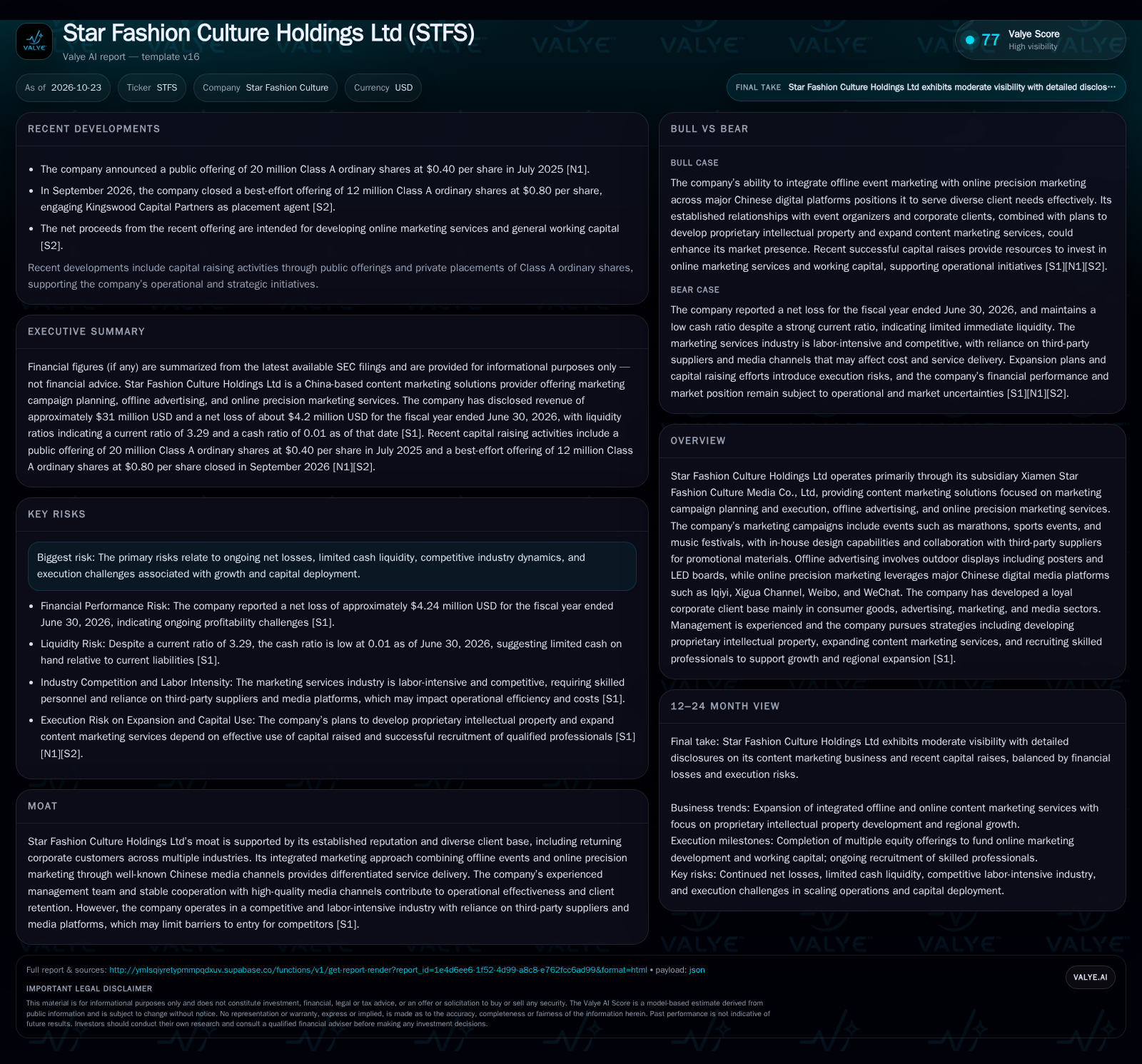
Star Fashion Culture Holdings, a China-based content marketing provider, has raised capital to expand its integrated offline and online marketing services. Despite a diverse client base and experienced management, the company faces ongoing net losses and limited cash liquidity. Its ability to leverage capital for growth while managing execution and industry competition will be critical to its prospects. [S1] [S2] [N1]
Star Fashion Culture Holdings sits at the intersection of traditional and digital marketing in China, offering brands integrated campaigns that span live events, outdoor advertising, and precision-targeted online placements. After recent capital infusions, the company aims to scale its offerings and develop proprietary content assets. The coming quarters will test its ability to translate capital and client relationships into a resilient, scalable business model.
Recent Equity Raises Fuel Growth Initiatives Amid Mounting Losses
Star Fashion Culture Holdings reported $30.98 million in revenue but a net loss of $4.24 million for the fiscal year ended June 30, 2026. The company reported cash and liquidity metrics for the period; these figures do not by themselves establish operating runway, investment capacity, financial flexibility, or financing capacity. [S1]
To support its expansion, the company executed two equity offerings: a public offering of 20 million Class A shares at $0.40 per share in July 2025, and a best-effort offering of 12 million Class A shares at $0.80 per share in September 2026. The proceeds are earmarked for developing online marketing services and general working capital. [N1] [S2]
Client retention is notable: 12 out of 18 corporate clients over two years have returned, suggesting some degree of satisfaction or switching friction. [S1]
How Integrated Marketing Revenue Models Shape Profit Potential
Star Fashion generates revenue by providing a mix of campaign planning, offline advertising (e.g., posters, LED displays), and online precision marketing placements through major Chinese platforms. Pricing in this sector is typically project-based for campaigns and events, with variable margins depending on the mix of in-house execution versus third-party supplier reliance. Digital placements may offer more scalable, recurring revenue opportunities if retainer or performance-based contracts are adopted, but the current report does not specify contract mechanics.
The business is labor-intensive: creative design, campaign management, and content integration require skilled professionals, while event execution and offline advertising depend on coordination with external vendors. This creates a high fixed-cost base in personnel, with variable costs tied to campaign scale and supplier fees.
Operating leverage could emerge as digital and proprietary IP-driven services grow, potentially raising margins if recurring, higher-value contracts are secured and in-house content assets are monetized. [S1] [S2]
Capital requirements are substantial for a company pursuing both regional expansion and IP development, especially when event production and media buying require upfront investment. Without a shift to higher-margin, recurring revenue streams, the company’s economics may stay structurally challenged.
Where Star Fashion Stands in China’s Crowded Marketing Landscape
The Chinese marketing services sector is highly fragmented and fiercely competitive, with established agencies, digital marketing firms, and in-house client teams all vying for brand budgets. Star Fashion’s integrated offering—blending live events, offline advertising, and digital precision marketing—may provide differentiation for clients seeking unified campaigns, especially across both physical and digital channels.
Its client base in consumer goods, advertising, and media, along with a record of returning clients, signals some competitive traction and stickiness. The company’s relationships with major digital platforms (e.g., Iqiyi, Weibo, WeChat) are critical, but these are not exclusive and do not by themselves guarantee defensibility unless underpinned by proprietary content or analytics.
A potential advantage lies in developing proprietary IP and content assets, which could increase switching costs and more defensible margins if clients come to rely on unique assets or data. However, barriers to entry remain moderate: established incumbents can bundle similar services, and smaller agencies can undercut on price or specialize in niche segments.
Reliance on third-party suppliers and labor intensity also limit the company’s ability to lock in superior margins or create a durable moat. The question is whether Star Fashion can leverage its experience and client relationships into a scalable, differentiated platform before competitors erode any early gains.
If Capital Deployment Yields Scalable Digital and IP-Driven Growth
A favorable outcome would see Star Fashion using recent capital to accelerate the development of proprietary content and digital marketing offerings, shifting the business mix toward higher-margin, recurring revenue streams. Success would require retaining and expanding key client relationships—especially in sectors with large, repeat marketing budgets—and demonstrating the ability to sell integrated campaigns that leverage both offline and digital assets.
Confirmation of this scenario would include: a rising share of revenue from digital/IP-driven services; improving gross and operating margins; new or expanded multi-campaign client relationships; and evidence of proprietary content assets being monetized (e.g., branded events, original media formats).
Evidence that would falsify this scenario would include continued reliance on one-off project revenue, persistent operating losses despite capital deployment, or client churn indicating lack of differentiation.
Incremental Improvements but Profitability Remains a Distant Goal
The most plausible trajectory is that Star Fashion achieves moderate revenue growth by leveraging new capital to expand digital offerings and maintain its existing client base, but struggles to meaningfully improve profitability in the near term. The industry’s labor intensity and reliance on third-party suppliers constrain margin expansion, while competitive pressures keep pricing in check.
The company may gradually increase its roster of recurring clients and develop some proprietary content, but operating losses persist as investment outpaces margin gains. Cash management remains tight, with periodic capital raises required to sustain the business.
This scenario would be confirmed by steady but modest revenue growth, a slow reduction in net losses, and a relatively stable client mix, without a major shift in revenue composition or margin profile. Falsification would come from either a sudden swing to profitability (suggesting a more scalable model) or a sharp drop in client retention or revenue (indicating competitive displacement or operational missteps).
Liquidity Stress and Competitive Squeeze Threaten Continuity
On the downside, Star Fashion could exhaust its available cash before reaching sustainable scale, forcing further dilutive capital raises or operational cutbacks. If the company fails to convert capital into differentiated, higher-margin offerings, it may face intensified price competition and margin compression from larger agencies or digital-native firms.
Execution missteps—such as failing to deliver on high-profile campaigns, losing key clients, or delays in developing proprietary IP—could accelerate client churn and revenue declines. In this scenario, the company’s reported cash balance becomes a critical vulnerability, and creditor or supplier relationships may become strained.
This adverse path would be confirmed by a shrinking client roster, stagnant or declining revenue, deepening operating losses, and further equity dilution or asset sales to maintain operations. Falsification would require evidence of liquidity improvement, cost discipline, or a sudden, profitable client win.
Signals That Will Reveal Whether Star Fashion’s Strategy Can Deliver Sustainable Growth
Progression in the share of revenue from digital and proprietary content/IP-driven services, if disclosed, would help test whether the business model is shifting toward higher-margin, recurring revenue streams.
Gross and operating margin trends in upcoming financials will reveal whether scale efficiencies or pricing power are emerging.
Client retention and expansion rates, especially among top customers, will indicate the degree of stickiness and competitive differentiation.
Cash burn rate and frequency of capital raises will be critical to monitoring near-term solvency risk and the company’s ability to self-fund growth.
Evidence of successful recruitment and retention of qualified professionals—such as disclosed headcount growth or named hires—would support execution capability.
New or expanded relationships with major media platforms or exclusive content partnerships would signal progress toward building defensible assets.
Any disclosures of contract structure—such as the length, value, or renewal rates of marketing agreements—would clarify revenue visibility and potential for recurring income.
Announcements of monetized proprietary IP—such as branded events, original media properties, or licensing deals—would confirm movement toward differentiated, scalable revenue sources.
Disclaimer: This is research-only, informational analysis and not investment advice. It may include AI-generated interpretation and general industry context. Always verify important details using primary sources.

Comments