
Balchem’s Regulatory Moat: Emissions Compliance, Cash Allocation, and the Stakes for Specialty Ingredients
Balchem’s Q3 2026 results highlight solid profitability and a robust balance sheet, but regulatory tightening around ethylene oxide emissions and shifting capital allocation priorities could reshape its economic profile. The company’s ability to adapt to evolving compliance demands, maintain operational resilience, and deploy capital effectively will determine whether its specialized market position remains a lasting advantage.
Balchem’s strong Q3 2026 earnings and liquidity are set against growing regulatory scrutiny of ethylene oxide sterilization. The company’s future value will hinge on both its ability to absorb compliance costs and sustain innovation in specialty ingredients, while capital allocation decisions—recently including share buybacks, debt paydown, and ongoing investments—signal an evolving approach to growth and risk. Watch for regulatory developments, customer adaptation, and margin trends as indicators of the company’s ability to defend its economic moat.
Balchem enters late 2026 with a profile that combines consistent profitability and a reported balance sheet position with mounting external pressures. The company’s reliance on ethylene oxide (EtO) for sterilization and microbial reduction—a process under intensifying regulatory scrutiny—creates both a barrier to entry and a source of potential disruption. As Balchem continues to invest in productivity and pursue acquisitions, its ability to navigate compliance costs and shifting customer needs will be decisive. The stakes: whether its specialized regulatory moat translates into sustainable economic advantage, or whether compliance costs and operational friction begin to erode returns.
Q3 2026 Results Signal Profitability Amid Regulatory and Capital Allocation Shifts
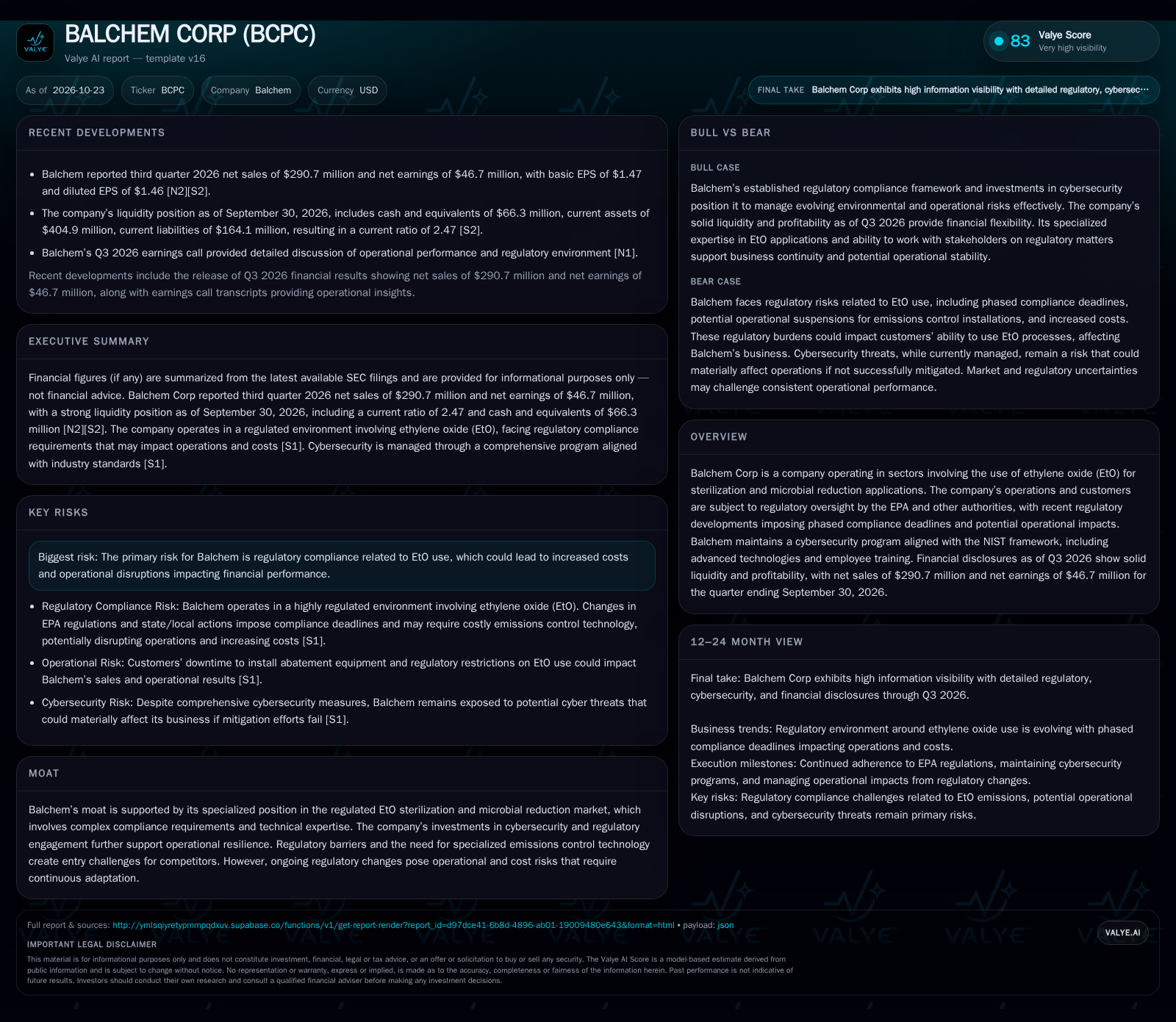
Balchem reported Q3 2026 net sales of $290.7 million and net earnings of $46.7 million, with basic EPS of $1.47 and diluted EPS of $1.46 [N2] [S2]. The company reported a current ratio of 2.47 for the period. Over the first nine months of 2026, significant cash outflows included $71.9 million for share repurchases, $40 million in net debt payments, $38.6 million in income taxes, $30.8 million in dividends, and $29.6 million for capex and intangibles [S2].
Regulatory developments remain front and center: Balchem’s EtO business faces phased EPA and state/local emissions deadlines, with potential for increased costs as customers install abatement equipment or adapt processes [S1]. These dynamics are not only shaping operational priorities for Balchem but may also affect demand patterns and margin structures in its specialty product lines.
How Compliance, Pricing, and Product Mix Drive Balchem’s Economic Engine
Balchem’s revenue model spans specialty ingredients and performance products, with a significant exposure to EtO-based sterilization for the food, pharma, and medical-device sectors. The company’s cost structure combines high fixed costs (plant, R&D, regulatory compliance) with variable costs tied to raw materials and logistics. EtO compliance requirements could increase both fixed and variable costs, depending on the scale and nature of emissions control investments and process adaptations mandated across its customer base [S1].
Pricing power may be partially supported by regulatory complexity and customer need for compliant, reliable sterilization solutions, but the degree to which increased compliance costs can be passed through to customers remains uncertain. If customers face downtime or are compelled to reduce EtO use, Balchem could face volume headwinds or be forced to absorb more of the compliance burden. Operating leverage is likely positive but could be blunted by rising compliance costs or shifts in product mix toward lower-margin or less-regulated segments.
Capital allocation choices—recently emphasizing buybacks, debt paydown, and selective investment—suggest a focus on shareholder returns and balance sheet strength over aggressive expansion. Continued M&A activity remains a lever, but future investments may require careful calibration against regulatory and customer risk [S2].
Regulatory Barriers and Technical Know-how as Moat—But Not an Impregnable Fortress
Balchem’s core advantage lies in its specialized expertise in EtO sterilization and compliance—a field where regulatory hurdles serve as both a moat and a source of operational risk. The need for advanced emissions control, documentation, and risk management creates high switching costs for customers and entry barriers for would-be competitors. However, this moat is vulnerable to two counterforces: the potential for regulatory changes that render EtO less economically viable, and the emergence of alternative sterilization technologies that could substitute away demand.
Peer competition includes both large specialty chemical conglomerates and smaller, niche ingredient providers. While Balchem’s diversified product portfolio across human and animal nutrition provides some insulation, its EtO-related business remains exposed to top-down regulatory shocks and customer adaptation. If regulatory burdens or customer costs become prohibitive, even a strong compliance track record may not fully protect market share or margins.
If Balchem’s Customers Adapt Smoothly, Margin Resilience and Growth Could Follow
The most favorable path is one where customers successfully install emissions controls and maintain EtO usage, allowing Balchem to pass through compliance-driven costs via price increases. In this scenario, regulatory barriers would reinforce the company’s moat, limiting new entrants while deepening customer reliance on compliant, value-added solutions.
Evidence for this scenario would include minimal decline in EtO-related sales volumes, visible pricing adjustments correlating with compliance cost increases, and stable or expanding segment-level margins despite regulatory headwinds. Confirmation would also come from new customer wins or contract renewals tied to Balchem’s compliance leadership, as well as continued investment in product innovation that leverages the company’s regulatory expertise.
Ongoing Compliance Costs and Customer Friction Temper Growth, But Core Profitability Holds
The most plausible outcome is a middle path: Balchem absorbs some incremental compliance costs, with partial pass-through to customers. Some customers may face downtime or reduced EtO usage, leading to modest volume or margin pressure in affected business lines, but not a wholesale erosion of the company’s economic base.
Confirmation would be found in stable—but not accelerating—top-line growth, modestly compressed margins in EtO-related segments, and continued but cautious capital allocation toward operational improvements and selective M&A. Falsification would come from a sharp, sustained decline in EtO-driven sales or a step-function increase in compliance-related SG&A or capex that outpaces revenue growth.
Escalating Regulatory Burden Triggers Customer Attrition and Margin Compression
In an adverse scenario, regulatory deadlines and compliance costs prove more disruptive than anticipated, leading to significant customer downtime, reduced EtO adoption, or outright loss of business as customers seek alternatives. Balchem could be forced to absorb a larger share of compliance investment, eroding margins and exposing fixed-cost leverage on the downside.
This scenario would be confirmed by sharp, sequential declines in EtO-related revenues, significant write-downs or impairments tied to compliance investments, and a spike in customer churn or contract non-renewals. A sustained rise in SG&A or capex as a percentage of sales, coupled with declining returns on invested capital, would further validate downside risk.
Testing Balchem’s Moat: What Will Reveal Adaptation or Erosion Over the Next Year?
Quarterly trends in EtO-related sales volumes and segment margins would help determine the impact of regulatory compliance on both top-line and profitability—especially if broken out by customer segment or product line.
If disclosed, the pace and scale of customer installations of emissions abatement technology would illuminate adaptation speed and the risk of customer downtime or attrition.
Capital expenditure breakout between regulatory-driven investments and growth/innovation initiatives would clarify whether compliance is crowding out other value creation.
Updates on new or renewed contracts that cite compliance capabilities as a differentiator would support the thesis of a defensible moat.
Evidence of pricing power—such as documented price increases tied to compliance costs—would show whether Balchem can defend margins.
Any material customer loss or shift to substitute sterilization technologies would signal potential erosion of market position.
Changes in working capital or inventory levels could provide early signals of demand disruption or operational bottlenecks.
Disclosures regarding regulatory developments—such as new EPA or state-level mandates—would help gauge the future intensity of compliance pressure.
Disclaimer: This is research-only, informational analysis and not investment advice. It may include AI-generated interpretation and general industry context. Always verify important details using primary sources.

Comments