
Five Point Holdings: Navigating California’s Real Estate Cycles Amid Regulatory and Legal Complexity
Despite a strong cash reserve and recent capital structure moves, Five Point Holdings faces operational volatility from regulatory delays, legal proceedings, and a slow housing market. The company’s ability to convert its land bank into profitable development hinges on execution, market conditions, and resolving litigation tied to its San Francisco projects.
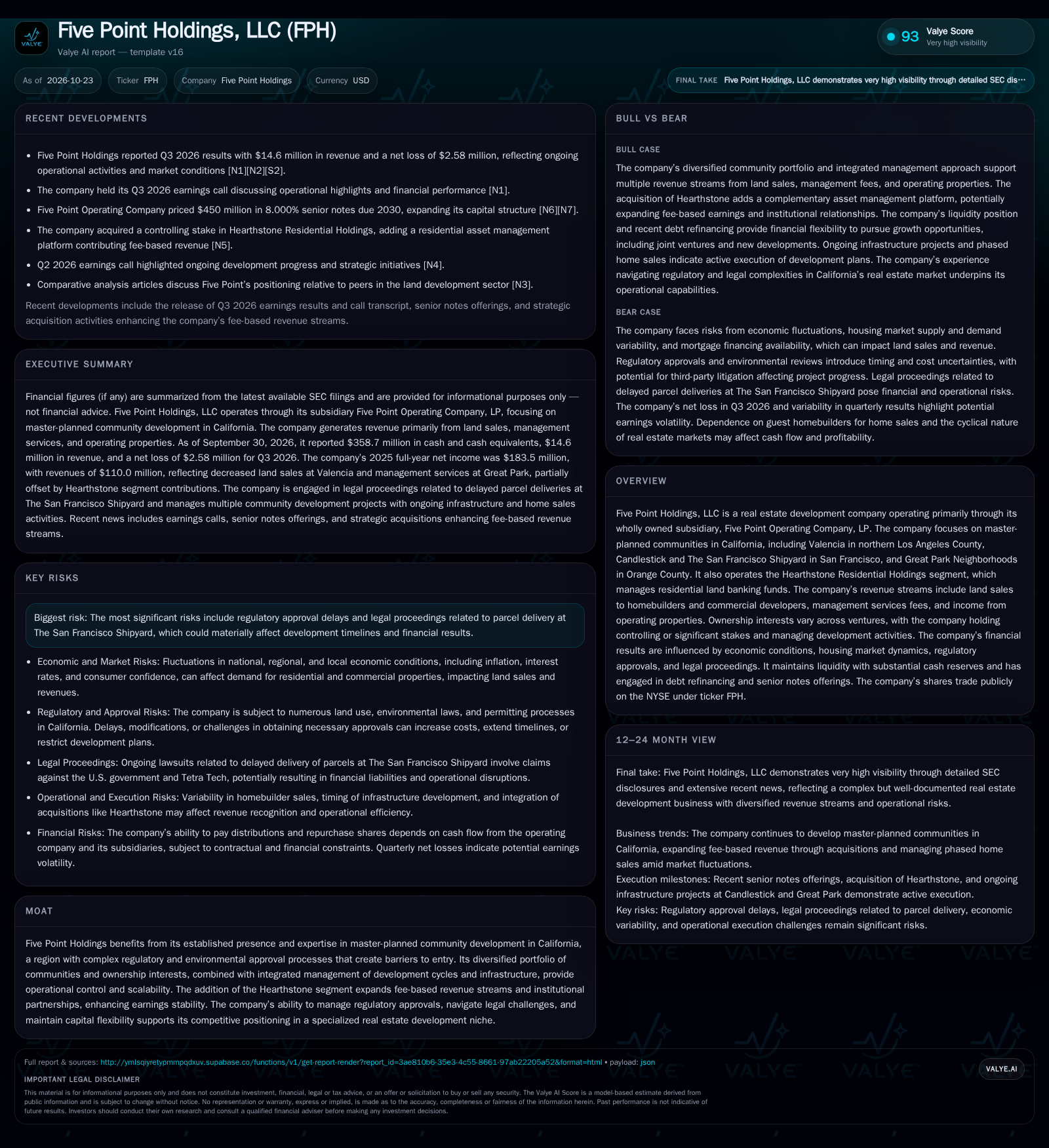
Five Point Holdings closed Q3 2026 with $358.7 million in cash, $14.6 million in revenue, and a net loss of $2.58 million, as it continues to develop master-planned communities across California. Recent refinancing and expanded credit provide potential financial flexibility, but the pace of land sales and ongoing legal disputes at The San Francisco Shipyard remain central risks. The company’s future value will depend on regulatory approvals, timing of asset monetization, and California housing demand. [S2] [N1] [N2]
Five Point Holdings operates at the intersection of real estate ambition and California’s formidable regulatory environment. The company’s Q3 2026 results highlight both its financial resources—$358.7 million in cash and an expanded capital structure—and the downside of land development: earnings volatility, net losses, and project delays. With ongoing legal disputes at The San Francisco Shipyard and a reliance on regulatory approvals for future phases, Five Point’s ability to convert its land holdings into profitable communities depends on market cycles, execution, and navigating a thicket of legal and governmental hurdles. The next phase in value creation will be defined by how effectively it manages these intertwined challenges. [S2] [N1] [N2]
Recent Results Reveal Both Financial Cushion and Operating Pressure
The company reported cash and liquidity metrics for the period; these figures do not by themselves establish operating runway, investment capacity, financial flexibility, or financing capacity. However, the company reported just $14.6 million in revenue and a net loss of $2.58 million for the quarter, reflecting the inherent lumpiness and risk in its business model. Recent refinancing—including a $450 million senior notes offering and a $75 million debt reduction—has expanded the company’s potential financial flexibility, but also extends its exposure to interest expense and capital market cycles. Legal proceedings regarding delayed parcel delivery at The San Francisco Shipyard add further uncertainty to both timing and potential cash outflows. These factors combine to create a business with strong resources, but meaningful execution and external risks. [S2] [N1] [N2] [N6] [N7]
Master-Planned Community Development: Capital Intensity and Revenue Volatility
Five Point’s core business revolves around the acquisition, entitlement, and phased development of large-scale, master-planned communities in California. The economics of this model are defined by high upfront capital investment in land, infrastructure, and regulatory approvals, followed by episodic revenue recognition as parcels are sold to homebuilders or commercial developers. Margins can be attractive on fully entitled, infrastructure-ready land, but the cadence of sales is highly sensitive to external factors: housing demand, mortgage rates, and the pace of regulatory approvals.
The company’s expanded revolving credit facility adds flexibility for opportunistic land investment or accelerated development, but also increases the stakes if market conditions deteriorate before asset monetization occurs.
California’s Barriers to Entry and the Realities of Entitlement Risk
Five Point operates in a region where the complexity of land use regulation, environmental review, and infrastructure requirements creates substantial barriers to entry for new competitors. Its established presence in northern Los Angeles County, San Francisco, and Orange County offers both a strategic advantage and a source of risk: the long development timelines and regulatory hurdles can lock in value but also tie up capital for years.
The company’s diversified portfolio—spanning Valencia, Great Park, Candlestick, and The San Francisco Shipyard—provides some insulation against local market shocks, but also exposes it to the unique challenges of each jurisdiction. Five Point’s experience navigating California’s regulatory maze is an operational asset, yet the threat of adverse legal outcomes, shifting political priorities, and rising construction costs can offset these advantages. Peers in the land development sector may face similar constraints, but success in this niche is often determined by the ability to secure entitlements and manage relationships with local stakeholders.
Unlocking Value Through Accelerated Entitlements and Favorable Market Conditions
A favorable scenario for Five Point would see accelerated regulatory approvals for new development phases—especially at high-profile projects like Candlestick and The San Francisco Shipyard—coinciding with a robust recovery in California housing demand. In this environment, the company could rapidly monetize its land bank through parcel sales to homebuilders, potentially at premium prices if supply remains constrained. The company’s ample cash and expanded credit capacity would allow it to invest in infrastructure and pursue new joint ventures, compounding growth.
Confirmation of this scenario would come from a pronounced uptick in land sale closings and homebuilder activity, public announcements of regulatory milestones (such as key permits or environmental clearances), and evidence of strong absorption rates at active communities. A reduction or resolution of legal proceedings at The San Francisco Shipyard would further enhance visibility and reduce risk. Conversely, delays in approvals, tepid homebuilder demand, or ongoing litigation would undermine this trajectory.
Managing Through Cyclicality: Slow Monetization and Steady Execution
The most plausible outcome is continued moderate progress on entitlements and infrastructure, with land sales paced to match cautious homebuilder demand and incremental regulatory approvals. Five Point is likely to experience ongoing revenue and earnings volatility, as seen in Q3 2026, with periods of net losses offset by sporadic gains from large parcel transactions.
The base case would be confirmed by steady, if unspectacular, home sales at Valencia and Great Park, gradual movement through the regulatory process at Candlestick and The San Francisco Shipyard, and no major adverse developments in ongoing litigation. Evidence refuting this view would include a sharp deterioration in California housing demand, significant regulatory setbacks, or escalation of legal liabilities that materially impair cash flow.
Legal and Regulatory Gridlock: Capital Locked and Value Erosion
In a negative scenario, Five Point could face prolonged delays in regulatory approvals or adverse legal outcomes, particularly at The San Francisco Shipyard. This would prevent the company from monetizing its land bank, while fixed costs and interest expense continue to accrue. A downturn in housing demand or a spike in mortgage rates could further erode the market value of its development parcels, compressing margins and increasing the risk of asset impairments.
Confirmation of this scenario would include extended periods with no new land sales or regulatory milestones, adverse court rulings or settlements requiring significant cash outflows, and persistent net losses eroding the company’s cash reserves. Improvement would require visible progress in litigation, successful regulatory breakthroughs, or a notable rebound in demand for California housing.
Milestones and Metrics That Will Shape Five Point’s Value Trajectory
Quarterly and annual land sale volumes at Valencia, Great Park, and future phases at Candlestick and The San Francisco Shipyard—if disclosed—will provide direct evidence of monetization progress.
Regulatory approval milestones, such as entitlements, permits, and environmental clearances for new development phases, will be critical for unlocking the next wave of value.
Resolution or escalation of legal proceedings related to The San Francisco Shipyard, including public disclosure of settlements, court rulings, or revised delivery timelines.
Homebuilder absorption rates and pricing trends in Five Point’s active communities, which would signal the underlying health of local housing demand.
Updates on infrastructure completion and construction progress at major projects, as delays here can bottleneck revenue recognition.
Market indicators such as California mortgage rates, new home sales data, and local inventory levels, which will shape the external demand environment for Five Point’s products.
Disclaimer: This is research-only, informational analysis and not investment advice. It may include AI-generated interpretation and general industry context. Always verify important details using primary sources.

Comments