
IP Strategy Holdings: Digital Asset Yield Ambitions Confront Acute Liquidity and Regulatory Pressures
IP Strategy Holdings, Inc. is pursuing a dual-track business built on digital asset staking and validator operations alongside a legacy spirits segment.
The company’s ability to monetize its digital assets is under pressure, and its spirits business provides limited diversification. Near-term survival hinges on liquidity management and adaptation to evolving blockchain and regulatory environments. [S1] [S2]
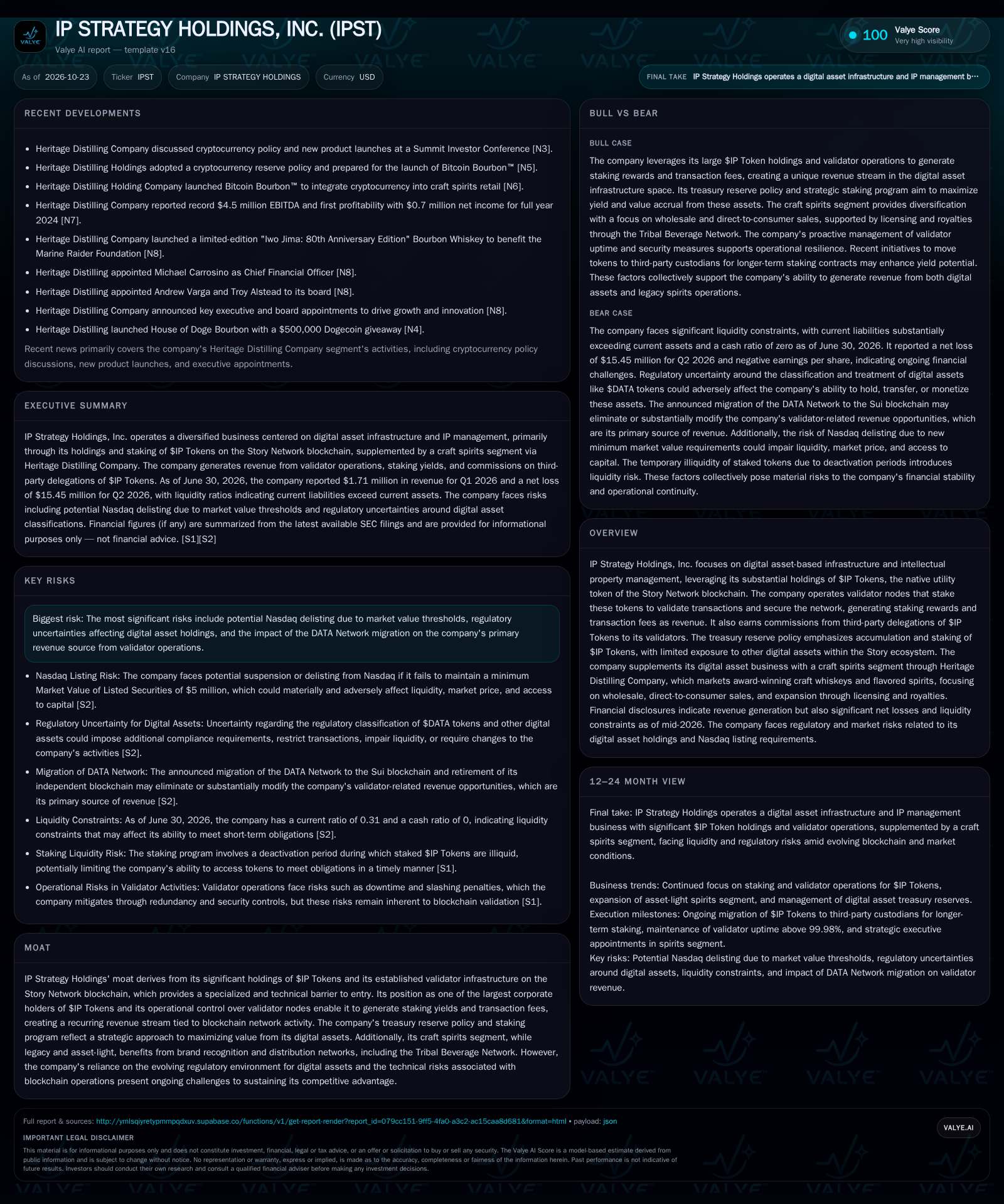
IP Strategy Holdings, Inc. represents a rare hybrid: a company straddling the vanguard of blockchain infrastructure and the traditional craft spirits industry. Its business model is fundamentally anchored in the accrual and staking of $IP Tokens on the Story Network, earning validator rewards, commissions, and option premiums. However, this digital asset-centric approach is under immediate threat from both structural liquidity shortfalls and external shocks—regulatory shifts and blockchain network migrations—that could undermine or even eliminate its primary revenue engines. The next phase for IP Strategy Holdings will be determined by its ability to adapt its treasury strategy, secure new capital or commercial partners, and manage the volatility inherent in both the digital asset and legacy spirits domains.
Liquidity Shortfall and Revenue Model at a Crossroads
As of June 30, 2026, IP Strategy Holdings reported current assets of $3.06 million and current liabilities of $9.81 million, resulting in a current ratio of 0.31 and a cash ratio of zero—clear evidence of acute liquidity stress [S2]. The company generated $1.71 million in revenue for the quarter ended March 31, 2026, but posted a substantial net loss of $15.45 million for the quarter ended June 30, 2026 [S2]. Its core economic engine is the staking of $IP Tokens: 81.8% of its token treasury was staked as of year-end 2025, with additional yield generated via covered call options and commissions from third-party delegations [S1]. However, a major risk has emerged: the DATA Network, which underpins a portion of validator-related revenue, is set to migrate to the Sui blockchain and retire its independent chain. This could eliminate or fundamentally alter the company’s validator revenue opportunities [S2]. These facts together frame a business at a pivotal juncture, where its digital asset strategy and immediate liquidity needs are in direct tension.
Staking, Validator Yield, and the Fragility of Token-Driven Economics
IP Strategy Holdings' primary business leverages the yield-generating mechanics of blockchain staking: by operating validator nodes on the Story Network and staking its sizable $IP Token treasury, the company earns transaction validation rewards and commissions on delegated tokens [S1]. This model is inherently volume-dependent—revenues scale with network usage, total tokens staked, and the prevailing yield rates. Ancillary yield comes from selling covered calls on $IP Tokens, which can boost returns but introduces exposure to token price volatility. The capital structure is highly concentrated: at least 95% of treasury reserves are in $IP Tokens, with minimal diversification [S1].
A critical challenge is the illiquidity of staked tokens, due to a 14-day deactivation period, which constrains the ability to meet short-term obligations [S1]. This risk is compounded by the company’s reported cash balance and the absence of a clear capital-raising roadmap [S1] [S2]. The legacy craft spirits segment, while providing some revenue diversification, appears subscale and unlikely to offset the digital business’s losses or cash needs in the near term. Operating leverage is significant: validator operations and token management have high fixed costs (technology, security, compliance) but low marginal costs, which could amplify losses if revenue opportunities shrink.
Blockchain Validator Scale vs. Regulatory and Ecosystem Headwinds
The company’s competitive position in the Story Network ecosystem is anchored by its large $IP Token holdings and established validator infrastructure—a technical and capital-intensive barrier to entry for smaller or new entrants [S1]. This scale advantage allows IP Strategy Holdings to capture a meaningful share of staking rewards and to attract third-party delegations, enhancing commission income. However, this advantage is tightly coupled to the health and growth of the Story Network itself; should network activity or token economics deteriorate, the company’s revenue base would erode.
The competitive landscape is also shaped by regulatory uncertainty. Competitors in digital asset management, staking infrastructure, and validator services all face the risk of adverse regulatory reclassification—particularly if tokens like $DATA or $IP are deemed securities or subject to new restrictions [S2]. The announced migration of the DATA Network to Sui introduces a new competitive dynamic: validator rewards may shrink or disappear, and the company could lose its technical edge if Sui’s ecosystem favors new or larger validators. In the spirits segment, competition from larger, established beverage companies and craft distillers limits pricing power and scale benefits.
Yield Maximization and Ecosystem Growth as a Path to Recovery
A favorable trajectory for IP Strategy Holdings would see the Story Network’s transaction volume and staking participation rise, thereby increasing validator rewards and commission income. If the migration of the DATA Network to Sui results in new or expanded validator opportunities (rather than outright elimination), the company could transition its infrastructure and maintain or even grow its yield streams. Greater adoption of the Story Network or integration with other blockchain ecosystems could drive up $IP Token demand and price, enhancing both staking rewards and option premium income.
Operationally, moving more tokens to third-party custodians for longer-term staking contracts (as the company is pursuing) could increase yield and reduce counterparty risk [S1]. If the company secures new capital—either via equity, debt, or strategic partnerships—it could address its liquidity gap, preserve its validator operations, and potentially expand its digital asset holdings. Confirmation of this scenario would come from rising reported staking rewards, new validator partnerships on Sui, and evidence of successful liquidity management or capital inflows.
Digital Asset Revenue Under Pressure, Spirits Segment Remains Subscale
The most plausible near-term scenario is that IP Strategy Holdings faces ongoing pressure on its digital asset revenue model. The migration of the DATA Network to Sui is likely to result in at least a temporary reduction in validator rewards, with uncertainty around whether the company can regain similar economics in the new ecosystem. Staking yields may stagnate if network activity does not increase, and the illiquidity of staked tokens continues to strain working capital. The company’s liquidity crunch may force asset sales or operational retrenchment unless new funding is secured.
The craft spirits business, while a source of some revenue diversification, is unlikely to materially change the overall financial profile given its limited scale and the capital intensity of expanding distribution. The company’s lack of disclosed capital-raising plans or new token acquisitions suggests a period of defensive treasury management, with potential cost-cutting or strategic reviews. Evidence for this scenario would include flat or declining staking income, continued net losses, and no major capital inflows or asset acquisitions.
Liquidity Crisis and Loss of Core Validator Revenue
The most adverse scenario would see the company’s liquidity position deteriorate further, forcing the liquidation of $IP Token holdings at depressed prices or the suspension of validator operations due to inability to cover costs or meet regulatory requirements. If the migration to Sui eliminates or drastically reduces the company’s validator revenue, and if regulatory authorities impose new restrictions on digital asset holdings or staking, IP Strategy Holdings could lose its core revenue engine.
The risk of Nasdaq delisting becomes acute if the company cannot quickly boost its market value of listed securities, which would further restrict access to capital and could trigger downward spiral dynamics for both the digital asset and spirits segments. Confirmation of this scenario would be signaled by distressed asset sales, suspended validator operations, missed debt or contractual payments, or public warnings regarding going-concern risks.
Milestones That Could Reshape the Digital Asset and Liquidity Thesis for IP Strategy Holdings
Quarterly trends in staking rewards and validator commission income—especially any material changes following the DATA Network migration—would help test the sustainability of the revenue model.
Disclosure of new capital-raising transactions, such as equity, debt, or strategic partnerships, would clarify the company’s ability to address its acute liquidity shortfall.
Updates on the percentage of $IP Tokens staked versus held for liquidity, and any changes in the deactivation period or staking contract terms, would provide insight into treasury flexibility.
Evidence of successful migration or expansion of validator operations to the Sui blockchain, including new node launches or partnerships, would be a meaningful sign of adaptation.
Material changes in the market value of listed securities—if disclosed—would indicate progress against Nasdaq listing requirements.
Revenue and operating margin trends in the Heritage Distilling Company segment, particularly from licensing and direct-to-consumer channels, would help assess the diversification thesis.
Any regulatory developments impacting the classification, custody, or transferability of $IP or $DATA tokens would be pivotal for the company’s digital asset strategy.
Disclaimer: This is research-only, informational analysis and not investment advice. It may include AI-generated interpretation and general industry context. Always verify important details using primary sources.

Comments