
Kilroy Realty’s Profitability Squeeze: Capital Recycling, Leasing Headwinds, and the Stakes of Urban Office Exposure
Kilroy Realty’s recent profit declines and active capital recycling spotlight the challenges of navigating high-value urban office markets amid shifting demand and operational risks. The company’s ability to manage leasing, development execution, and balance sheet strength will determine whether it can sustain value in a structurally evolving commercial real estate environment.
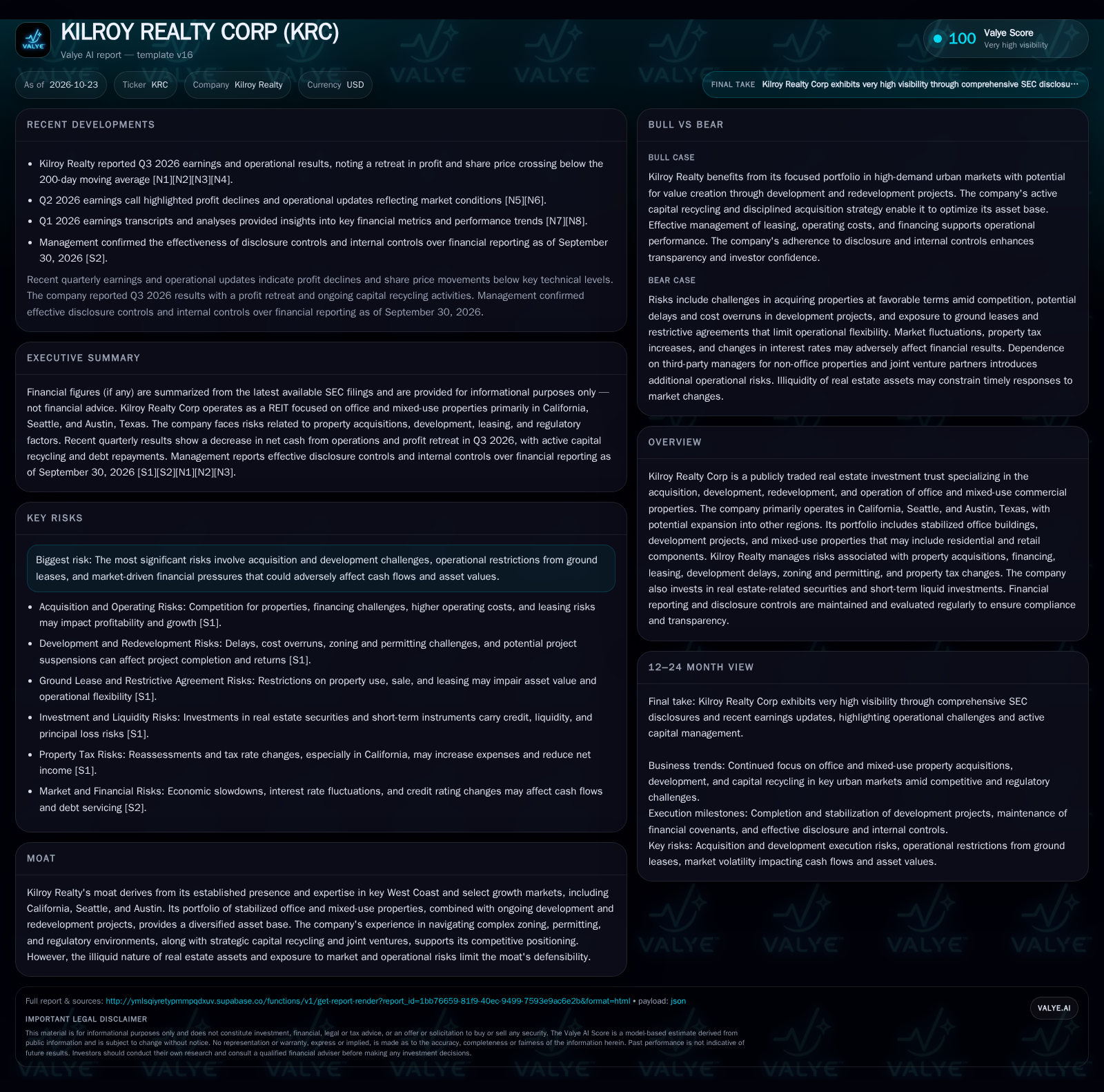
Kilroy Realty Corp faces mounting profitability pressures, with Q3 2026 earnings reflecting a profit retreat and a share price drop below technical support. Despite maintaining effective internal controls and engaging in capital recycling, the firm’s exposure to urban office markets, development risk, and restrictive property agreements underscore the importance of execution on leasing, project delivery, and asset management in an uncertain demand environment. Future performance hinges on stabilizing occupancy, managing costs, and executing asset sales or redevelopments for value creation. [S2] [N1] [N2] [N3] [N4]
Kilroy Realty Corp’s latest quarterly earnings underscore the mounting challenges for office-focused REITs operating in high-demand but structurally pressured urban markets. With profit retreating in Q3 2026 and cash flows from core operations declining, Kilroy’s strategy has pivoted toward active capital recycling and balance-sheet management, including major debt repayments and share repurchases. However, the company’s exposure to acquisition, development, and leasing risks—compounded by restrictive property agreements and rising property taxes—raises questions about the sustainability of its current business model. The stakes are now centered on Kilroy’s ability to stabilize occupancy, control costs, and unlock value from its prime urban portfolio amid evolving demand for office and mixed-use assets.
Profit Retreat, Cash Flow Pressures, and Active Capital Recycling Define 2026
Kilroy Realty’s Q3 2026 results revealed a retreat in profit and a share price drop below the 200-day moving average, signaling market concern about the company’s earnings trajectory and asset value resilience. Net cash provided by operating activities declined by 15.8% for the first nine months of 2026, reflecting reduced net cash operating income and decreased capitalized interest. Funds From Operations (FFO), a critical REIT performance metric, fell to $322.8 million, down from $388.8 million in the prior year, indicating eroding profitability. The company’s capital allocation was marked by $48.9 million in net cash from investing activities—primarily from asset sales—while net cash used in financing surged 116.5% due to significant debt repayments and share buybacks. These developments underscore a period of heightened financial and operational tension, as Kilroy juggles cash generation, debt management, and asset optimization. [S2] [N1] [N2] [N3] [N4]
Urban Office Model Under Strain: Revenue Streams, Cost Structures, and Capital Demands
Kilroy Realty generates revenue primarily through rental income from office and mixed-use properties, with some exposure to residential and retail tenants in its urban-focused portfolio. The company’s economics hinge on occupancy rates, rent spreads, and the ability to manage operating expenses—factors that are particularly sensitive in high-cost, supply-constrained markets like California and Seattle. Development and redevelopment activities offer upside through value creation but carry significant capital requirements, as well as risks of delays, cost overruns, and uncertain leasing outcomes.
Fixed costs, including property taxes (especially vulnerable to reassessment in California), interest on debt, and maintenance, create operating leverage that can magnify both gains and losses. Kilroy’s capital recycling strategy—selling mature or non-core assets to fund new investments—can help optimize returns but may become harder to execute in a market where office asset liquidity and pricing are under pressure. The company’s use of unsecured debt and share repurchases in 2026 increased financing outflows, highlighting the need for careful management of leverage and liquidity in a volatile environment. [S1] [S2]
Navigating Urban Gateways: Advantages and Structural Headwinds in Prime Office Markets
Kilroy’s competitive positioning is rooted in its established footprint in supply-constrained, high-value urban markets—principally California, Seattle, and Austin. These locations offer access to deep tenant pools (notably tech, professional services, and media) and have historically supported premium rents and higher asset values. The company’s expertise in navigating complex zoning and permitting processes, as well as its track record in development and redevelopment, provides a degree of local advantage over less experienced entrants.
However, the office sector faces structural headwinds: hybrid work adoption, rising vacancy rates, and shifting tenant preferences for flexible, amenity-rich space. Competitors include other public office REITs, private real estate funds, and institutional landlords, all contending with similar demand uncertainty and capital market pressures. The illiquidity of large-scale office assets, exposure to restrictive ground leases, and the risk of property tax hikes in California further constrain Kilroy’s strategic flexibility. While capital recycling and development expertise are relative strengths, their effectiveness may be blunted if market liquidity deteriorates or tenant demand fails to rebound. [S1] [S2]
Unlocking Value Through Successful Leasing and Redevelopment
The most constructive scenario for Kilroy would see a stabilization or recovery in urban office demand, enabling the company to lease up vacant space at attractive rates and achieve strong pre-leasing on new or redeveloped projects. Effective execution on development pipelines—delivering projects on time and on budget—could generate incremental NOI and support FFO growth. Asset recycling could yield proceeds above book value, allowing redeployment into higher-yielding opportunities or further debt reduction.
Signs that would confirm this scenario include rising occupancy rates, positive rent spreads on renewals and new leases, successful stabilization of development projects, and asset sales at premium valuations. A visible inflection in FFO and net cash from operations, alongside muted property tax increases and disciplined cost control, would reinforce the turnaround. If Kilroy can demonstrate resilience in tenant demand (particularly from tech and life sciences) and maintain access to attractively priced capital, upside could be realized even in a challenging macro environment.
Managing Through Prolonged Office Market Uncertainty
The most plausible near-term scenario is one of continued operational and financial headwinds for Kilroy. Urban office demand may remain tepid, with some improvement in select submarkets but persistent leasing friction and elevated vacancy in others. The company is likely to face ongoing margin pressure from static or declining rents, slower lease-up of new projects, and rising property taxes—especially in California.
In this environment, Kilroy can be expected to prioritize balance sheet discipline, execute selective asset sales (potentially at compressed valuations), and defer or phase new development starts. FFO and cash from operations may stabilize but not rebound meaningfully, and share price performance could lag broader real estate indices. Evidence confirming this scenario would include flat or modestly declining occupancy, muted lease spreads, continued capital recycling at neutral or slightly negative gains, and limited new development announcements. Any improvement in operating metrics would likely be incremental rather than transformational.
Cascading Impacts from Leasing Weakness and Asset Value Declines
A more adverse scenario would be triggered if office leasing markets weaken further, leading to rising vacancies, falling rental rates, and a deterioration in asset values. In such a case, Kilroy could experience further declines in FFO, diminished ability to service debt, and possible covenant pressures. Asset sales could become more challenging, with proceeds falling short of book value and impairments materializing on the balance sheet.
This scenario could be confirmed by a sharp drop in occupancy rates, negative leasing spreads, a spike in property tax expenses, and reductions in credit ratings or tightening of borrowing terms. Development projects might be delayed or suspended, and liquidity could become a concern if net cash from operations turns negative or refinancing options narrow. If ground lease restrictions or regulatory changes further constrain asset use or disposition, the downside could be amplified.
Milestones That Will Clarify Kilroy Realty’s Urban Office Thesis
Quarterly occupancy rates for office and mixed-use properties—if disclosed—will be a direct indicator of leasing traction and underlying tenant demand.
Net effective rent growth or leasing spreads on renewals and new leases would help test the company’s pricing power and market positioning.
Pre-leasing rates and cost-to-completion for development and redevelopment projects are critical for assessing future NOI growth and capital risk.
Net proceeds and book value multiples on asset sales will signal the effectiveness of the capital recycling strategy and the health of office asset markets.
Trends in property tax expense, particularly in California, could materially impact net operating income and should be monitored closely.
Debt maturity schedules, refinancing activity, and covenant compliance—if disclosed—will indicate balance sheet resilience and access to capital.
Any changes in ground lease terms, restrictive agreements, or regulatory environments that affect asset use or value would alter the risk profile.
Disclaimer: This is research-only, informational analysis and not investment advice. It may include AI-generated interpretation and general industry context. Always verify important details using primary sources.

Comments