
Kinder Morgan’s Expansion Backlog and Profit Growth: Infrastructure Strength Meets Short-Term Financial Constraints
Kinder Morgan delivered record third-quarter 2026 results, buoyed by strong natural gas pipeline operations and a $5.4 billion expansion backlog, signaling robust demand and continued investment.
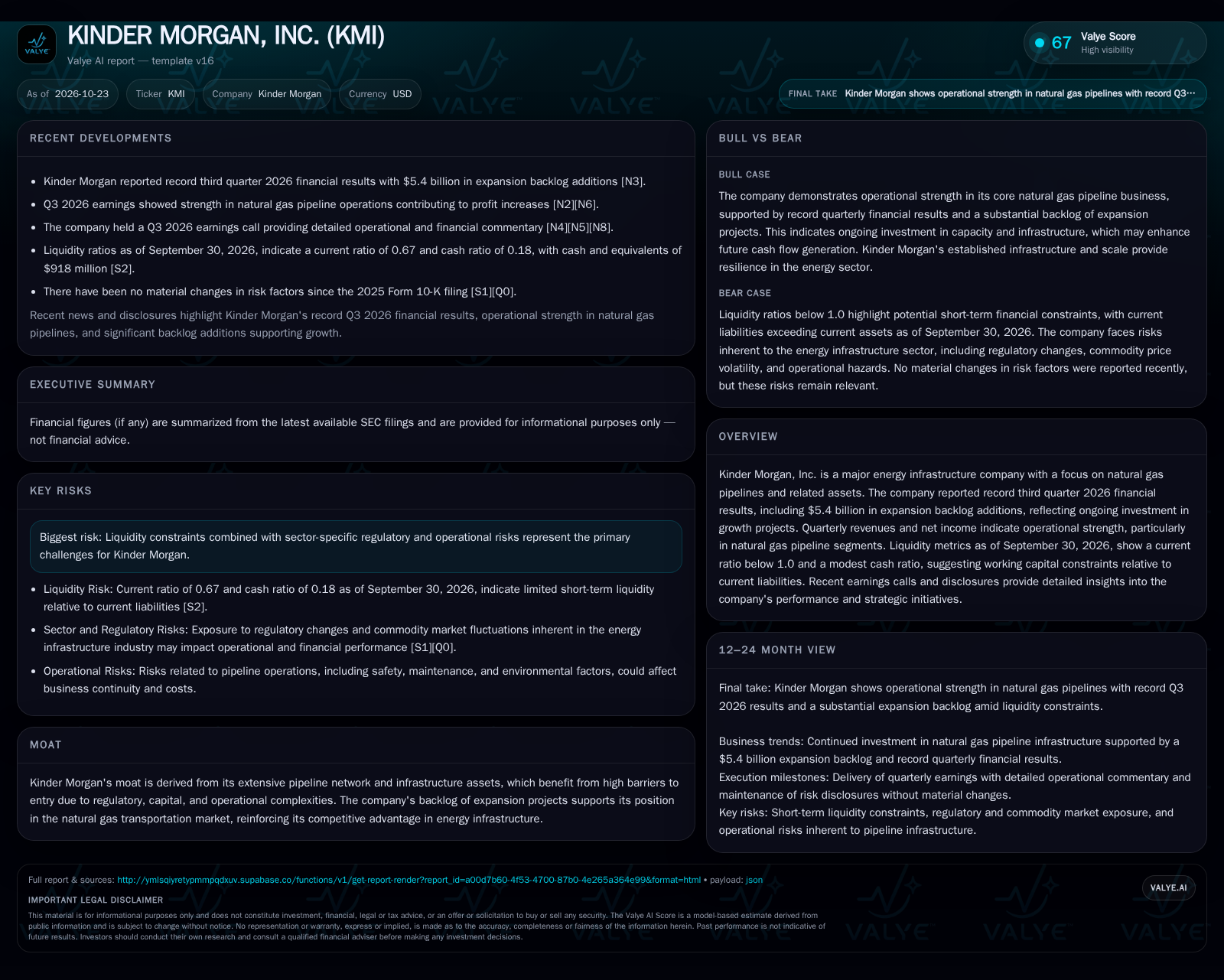
Kinder Morgan delivered record third-quarter 2026 results, buoyed by strong natural gas pipeline operations and a $5.4 billion expansion backlog, signaling robust demand and continued investment. The company's entrenched pipeline network remains a significant competitive moat, but future performance will hinge on translating backlog into cash-generating assets while managing potential financial flexibility and external uncertainties. [S2] [N3]
Kinder Morgan, Inc. (KMI) stands at a crossroads defined by record-breaking operational performance and a substantial pipeline of future projects, but also by visible short-term financial constraints. The company’s $5.4 billion in expansion backlog, coupled with strong Q3 2026 results driven by its natural gas pipeline segment, signals ongoing demand and the scale of its infrastructure ambitions. The central question: Can Kinder Morgan’s operational strength and competitive moat offset its immediate liquidity headwinds and sectoral uncertainties? [S2] [N3] [N2] [N6]
Kinder Morgan’s Latest Results: Strong Operations, Expansion Ambitions, and Liquidity Caution
Kinder Morgan reported record third-quarter 2026 financial results, including $4.53 billion in revenue and $764 million in net income, translating to $0.34 per share. The company’s natural gas pipeline operations were the primary driver of this profit increase, reinforcing the resilience of its core infrastructure business. Notably, Kinder Morgan added $5.4 billion in expansion backlog, reflecting substantial ongoing investment in new growth projects and signaling robust demand for its services. This juxtaposition of operational strength and short-term financial constraint sets the backdrop for Kinder Morgan’s next phase. [S2] [N3] [N2] [N6]
Pipeline Economics, Capital Needs, and the Leverage of Scale
Kinder Morgan’s core business—owning and operating natural gas pipelines—relies on scale-driven economics and long-lived infrastructure. Revenue is typically generated via transportation and storage fees, often under long-term agreements with utility, industrial, and power-generation customers. While such agreements can provide insulation from short-term commodity price swings, the actual degree of revenue stability depends on the mix and terms of these agreements, which are not fully detailed in the current report.
Expansion projects require substantial upfront capital, with returns realized over decades through regulated or negotiated tariff structures. The $5.4 billion expansion backlog highlights ongoing capital commitments; the economic value will depend on Kinder Morgan’s ability to bring these assets online on time and on budget. Operating leverage is a defining characteristic: once pipelines are built, incremental throughput generally incurs low variable costs, supporting margin expansion as utilization rises. However, the capital intensity of the sector also means that missteps—delays, cost overruns, or regulatory setbacks—can have amplified financial impacts.
Debt is typically used to finance large-scale projects, so Kinder Morgan’s ability to access capital markets at reasonable terms will remain a key determinant of its growth trajectory and risk profile. If cash flows from existing operations and new projects materialize as planned, the business model can generate attractive returns; if not, liquidity constraints could force project deferrals or repricing.
Entrenched Network, Regulatory Barriers, and Shifting Energy Dynamics
Kinder Morgan’s competitive moat is built on its extensive pipeline network, which spans critical energy corridors and benefits from high barriers to entry, including regulatory complexity, right-of-way acquisition, and capital requirements. This infrastructure footprint enables economies of scale, system integration, and customer stickiness, as rerouting or replicating such networks is prohibitively expensive for new entrants.
However, the energy infrastructure landscape is evolving. While natural gas remains a cornerstone of North American energy supply, long-term demand could be influenced by shifts toward electrification, renewables, and decarbonization policies. Competing pipeline operators, midstream master limited partnerships, and, in some regions, alternative energy transport modalities (such as hydrogen or CO2 pipelines) all represent potential sources of substitution or margin pressure.
Kinder Morgan’s backlog and operational scale provide a degree of resilience, but its future competitive position will depend on its ability to adapt network assets for new energy flows, maintain regulatory compliance, and continue securing long-term agreements in a changing demand environment.
Translating Backlog into Cash Flow: A Path to Margin Expansion and Reduced Leverage
The most favorable scenario for Kinder Morgan is one in which its $5.4 billion expansion backlog is executed efficiently, with new projects coming online as scheduled and generating contracted, fee-based revenues.
Evidence that would confirm this scenario includes rising cash from operations, declining net debt or leverage ratios, and steady or increasing dividend payouts. Timely project completions, minimal cost overruns, and new long-term transportation agreements would also be positive signs. Additionally, regulatory approvals for major projects and stable or growing throughput volumes would reinforce the case for sustainable value creation.
Falsifying evidence would include project delays, cost inflation, or an inability to secure new long-term agreements at attractive rates, as well as persistent or worsening liquidity metrics.
Sustained Operations with Growth Tempered by Capital Discipline
The most plausible near-term scenario is that Kinder Morgan continues to deliver stable operational performance in its core natural gas pipeline business while prioritizing disciplined capital allocation. Revenue and profit growth may be moderate, reflecting steady demand for gas transport and storage, but expansion projects could be selectively paced to match available internal and external financing.
In this case, Kinder Morgan maintains its competitive position and operational cash flows, but liquidity remains tight, requiring careful management of working capital and debt maturities.
Confirmation would come from quarterly results showing consistent EBITDA, manageable leverage, and no material negative surprises in project execution or regulatory compliance. Falsification would be signaled by deteriorating working capital, rising short-term borrowing, or operational disruptions that erode cash flow.
Liquidity Pinch and External Shocks: What Could Derail the Expansion Story?
If Kinder Morgan’s liquidity constraints intensify—due to project cost overruns, delayed cash inflows, or adverse credit market conditions—the company could be forced to defer or cancel portions of its expansion backlog. This would stall growth, reduce operating leverage, and potentially trigger asset sales or dividend cuts to preserve cash.
External factors such as unfavorable regulatory changes, pipeline incidents, or a sharp decline in natural gas demand (from commodity price shocks or accelerated energy transition policies) could further stress Kinder Morgan’s financials. In this scenario, the company’s competitive position would be weakened, and its ability to fund growth internally or externally would be compromised.
Downside confirmation would be seen in rising short-term debt, negative free cash flow, project delays, or a reduction in dividend. Early warning signs might include credit rating downgrades or management guidance that emphasizes capital preservation over growth.
Benchmarks for Testing Kinder Morgan’s Growth, Liquidity, and Execution Thesis
The pace at which Kinder Morgan converts its $5.4 billion expansion backlog into operational, cash-generating assets—measured by project completions and in-service dates—will be a direct test of its growth thesis. [N3]
Changes in current and cash ratios, if disclosed, will help track short-term liquidity risks and Kinder Morgan’s ability to meet obligations without resorting to expensive financing.
Debt levels, leverage ratios, and any shifts in credit ratings will serve as barometers for potential financial flexibility and resilience under different market conditions.
Throughput volumes across key pipeline assets, if disclosed, would provide insight into underlying demand and utilization trends.
Updates on regulatory approvals, permitting progress, and major contract wins or renewals will help assess the stability and visibility of future revenue streams.
Any material operational incidents, cost overruns, or project delays disclosed in future filings or earnings calls would directly challenge the company’s execution narrative.
Disclaimer: This is research-only, informational analysis and not investment advice. It may include AI-generated interpretation and general industry context. Always verify important details using primary sources.

Comments