
QuantumScape’s Path to Commercialization: Technology Milestones, Cost Discipline, and the Stakes of Scaling Solid-State Batteries
QuantumScape’s solid-state battery ambitions hinge on overcoming technical and manufacturing hurdles. Recent progress in operational efficiency and a new 100-MWh production line partnership underscore both the promise and the risks of a pre-revenue, high-valuation company seeking to deliver a step-change in electric vehicle battery technology.
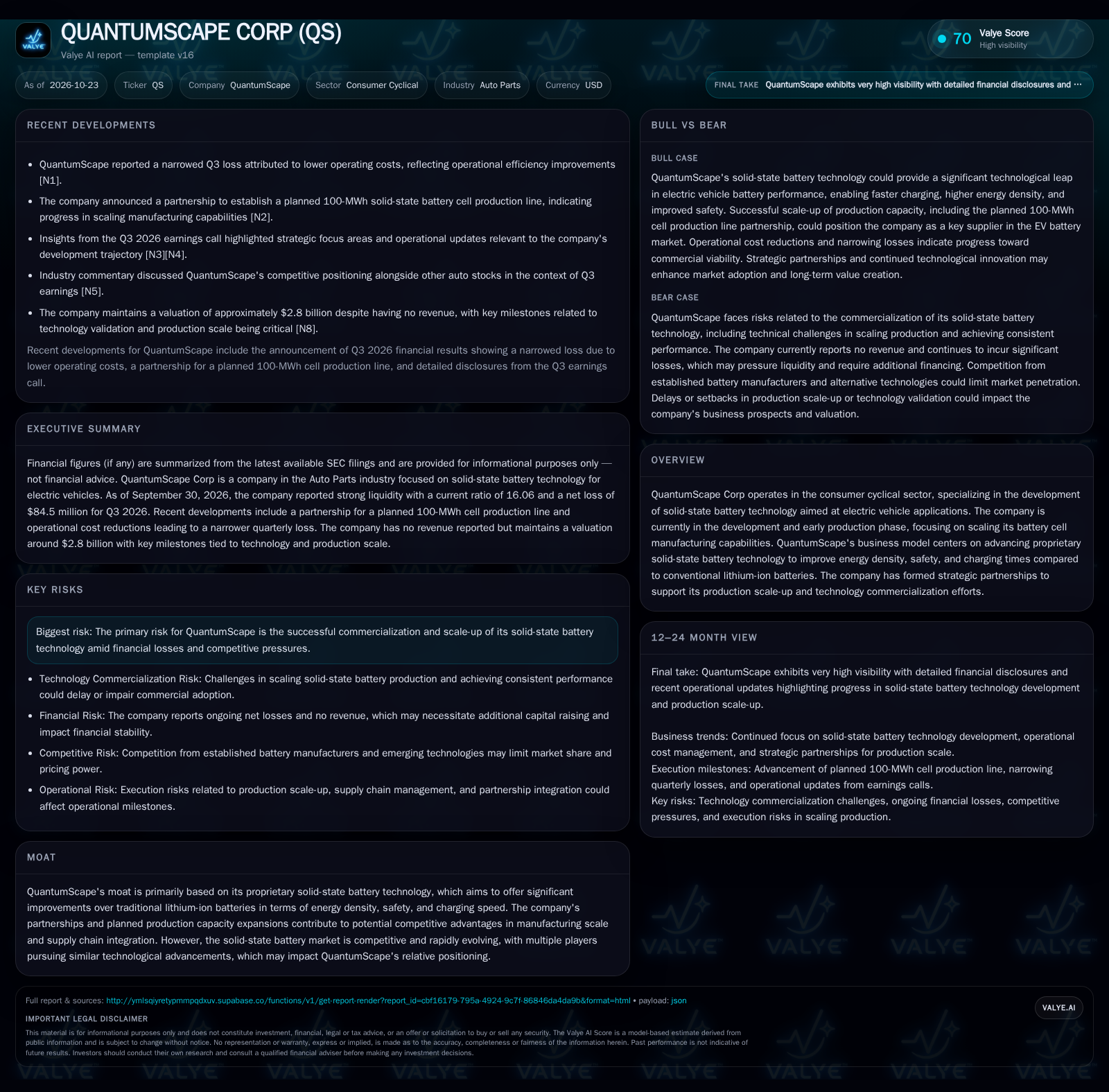
QuantumScape continues to report no revenue but maintains a $2.8 billion valuation as it advances proprietary solid-state battery technology for electric vehicles. Q3 2026 saw narrowed losses due to lower operating costs, and a new partnership aims to establish a 100-MWh cell production line, marking a key step toward commercial-scale production. [S2] [N1] [N2] [N8]
QuantumScape stands at a pivotal point in its journey to commercialize solid-state batteries for electric vehicles. Yet, with no revenue reported and a market valuation that anticipates breakthrough success, the stakes around technology validation, execution, and competitive response are exceptionally high. The coming quarters will test whether QuantumScape’s capital and partnerships can translate technical promise into commercial reality. [S2] [N1] [N2] [N8]
Recent Developments Highlight Operational Progress and Strategic Pivots
As of September 30, 2026, QuantumScape reported $832.7 million in current assets against $51.8 million in current liabilities, yielding a current ratio of 16.06 and a cash ratio of 15.81. The company reported cash and liquidity metrics for the period; these figures do not by themselves establish operating runway, investment capacity, financial flexibility, or financing capacity. [S2]
The company reported a net loss of $84.5 million for Q3 2026, but this loss narrowed compared to prior periods due to lower operating costs, indicating improved cost discipline as QuantumScape navigates its development phase. [S2] [N1]
QuantumScape announced a partnership for a planned 100-MWh solid-state cell production line, marking a concrete step toward scaling manufacturing capacity—a necessary move to meet potential OEM demand if technology validation succeeds. [N2]
Despite the absence of reported revenue, QuantumScape maintains a $2.8 billion valuation, underscoring investor belief in the transformative potential of its technology and the importance of near-term milestones related to production and technical validation. [N8]
How QuantumScape’s Business Model Could Unlock Value—Or Strain Resources
QuantumScape’s business model is predicated on developing and eventually manufacturing proprietary solid-state battery cells, promising higher energy density, faster charging, and improved safety relative to conventional lithium-ion batteries. If technical hurdles are cleared, the company could generate revenue primarily through direct sales to automotive OEMs or through licensing or joint ventures with established battery manufacturers.
Pricing power in the EV battery market depends on demonstrable performance gains and the ability to scale production efficiently. Early unit economics are likely to be challenged by high fixed costs—R&D, pilot production, and capital equipment—while variable costs (materials, labor) could trend down with scale. However, until full-scale commercial production is achieved, fixed costs dominate, and negative operating leverage persists.
Capital intensity is a defining feature: significant ongoing investment is required for pilot lines, eventual gigafactory-scale capacity, and continuous process optimization. The partnership for a 100-MWh line may help defray some of these costs or accelerate learning curves, but the company will likely face further funding needs if commercialization is delayed or scaling proves more expensive than anticipated.
With no revenue as of Q3 2026, all cash burn is funded from balance-sheet reserves and external capital. A critical economic inflection point will be the transition to meaningful shipments, which would test both gross margin potential and customer adoption at scale.
Competitive Landscape Intensifies as Battery Technology Evolves
QuantumScape’s core differentiator lies in its proprietary solid-state battery design, which, if commercialized, could offer substantial advantages in energy density, safety, and charging speed. However, the competitive landscape is crowded: established lithium-ion battery giants, other well-funded solid-state startups, and alternative chemistries (such as lithium iron phosphate or semi-solid designs) are all vying for OEM contracts and scale.
The company’s partnerships and progress toward a 100-MWh production line could provide early-mover advantages, particularly if manufacturing yields and performance targets are achieved ahead of rivals. However, the risk of rapid technology convergence is high—competitors may overcome their own technical barriers or leapfrog with alternative solutions, eroding any temporal lead.
Switching costs for OEMs are significant due to integration, validation, and supply chain dependencies, but only if QuantumScape’s product delivers reliably at scale. Until then, automakers are likely to hedge bets across multiple suppliers and technologies.
Sustainable competitive advantage could emerge from manufacturing know-how, intellectual property, and deep partnerships, but these factors remain unproven until mass production and real-world deployments commence.
Breakthroughs in Validation and Scale Catalyze Rapid Adoption
The most optimistic scenario for QuantumScape hinges on successful technical validation of its solid-state cells in real-world automotive applications, followed by a smooth scale-up of the planned 100-MWh production line. This would enable the company to secure meaningful supply agreements with major OEMs, potentially moving from pilot shipments to multi-year, high-volume contracts.
Such an outcome would likely be confirmed by public announcements of initial commercial shipments, OEM endorsements, and an inflection in recognized revenue. A further signal would be sustained improvements in manufacturing yields and cost per kWh, supporting gross margin expansion.
If QuantumScape can deliver on these milestones ahead of competitors, it could establish itself as a preferred supplier for next-generation EVs, justifying its current valuation and enabling future capital raises on favorable terms.
Evidence to confirm this scenario would include customer validation data, disclosed purchase orders, and a demonstrated ability to ramp production without significant quality or reliability issues.
Measured Progress Amid Persistent Uncertainties
The most plausible path forward is one of incremental technical progress and operational learning. QuantumScape may achieve key milestones such as pilot-scale production and initial validation with select OEMs, but widespread commercial adoption could remain several years away as manufacturing challenges and cost hurdles persist.
In this scenario, the company continues to narrow losses through operational discipline and selective partnerships, but remains pre-revenue or posts only modest initial sales. The market continues to value the technology option, but investor sentiment becomes increasingly sensitive to delays, cost overruns, or competitor announcements.
Confirmation of this scenario would come from continued progress updates, successful operation of the 100-MWh line, and incremental customer engagement, but with revenue recognition and margins remaining limited in the near term.
Evidence that would falsify this scenario would include either major technical setbacks or, conversely, a sudden surge in commercial orders and revenue that signals a faster-than-expected transition to scale.
Commercialization Challenges Lead to Delays and Funding Pressures
The adverse scenario materializes if QuantumScape encounters persistent or unanticipated technical obstacles in scaling its solid-state battery technology—such as low manufacturing yields, inconsistent cell performance, or reliability issues in automotive environments.
Such setbacks would likely delay the operation of the 100-MWh line, push out revenue timelines, and increase cash burn, potentially forcing the company to raise additional capital on less favorable terms or curtail R&D and expansion plans.
This scenario would be confirmed by announcements of milestone delays, cost overruns, or the need for interim financing rounds. Negative industry commentary or the accelerated progress of direct competitors could further pressure valuation and strategic options.
A further risk is that OEM partners lose confidence and shift resources to alternative suppliers or chemistries, limiting QuantumScape’s long-term market opportunity even if technical hurdles are eventually cleared.
Milestones and Metrics That Will Determine QuantumScape’s Trajectory
Progress and timeline for commissioning and ramping the planned 100-MWh cell production line, including any disclosed delays or yield issues. [N2]
Operational cash burn rate and updatedreported liquidity position, particularly in the context of ongoing losses and capital expenditure requirements. [S2]
Evidence of initial commercial shipments, revenue recognition, or signed supply agreements with automotive OEMs—if disclosed.
Updates on cell performance metrics (energy density, cycle life, safety) demonstrated in real-world or customer pilot programs.
Manufacturing yield improvements and cost per kWh trends, which would signal path to positive gross margins if disclosed.
Announcements of new or expanded partnerships, especially those involving joint development or co-investment in manufacturing infrastructure.
Competitive developments: peer announcements of solid-state battery breakthroughs or meaningful commercial wins could impact QuantumScape’s perceived lead.
Disclaimer: This is research-only, informational analysis and not investment advice. It may include AI-generated interpretation and general industry context. Always verify important details using primary sources.

Comments