
Hain Celestial’s Strategic Reset: Cash from Divestitures, Leadership Overhaul, and the Challenge of Rebuilding Core Profitability
After major divestitures and an executive shakeup, Hain Celestial holds new cash but faces a liquidity squeeze and persistent operating losses. The company’s future hinges on whether leadership can use its streamlined focus and fresh resources to restore profitability amid intense competition and shifting consumer preferences in the natural and organic foods sector.
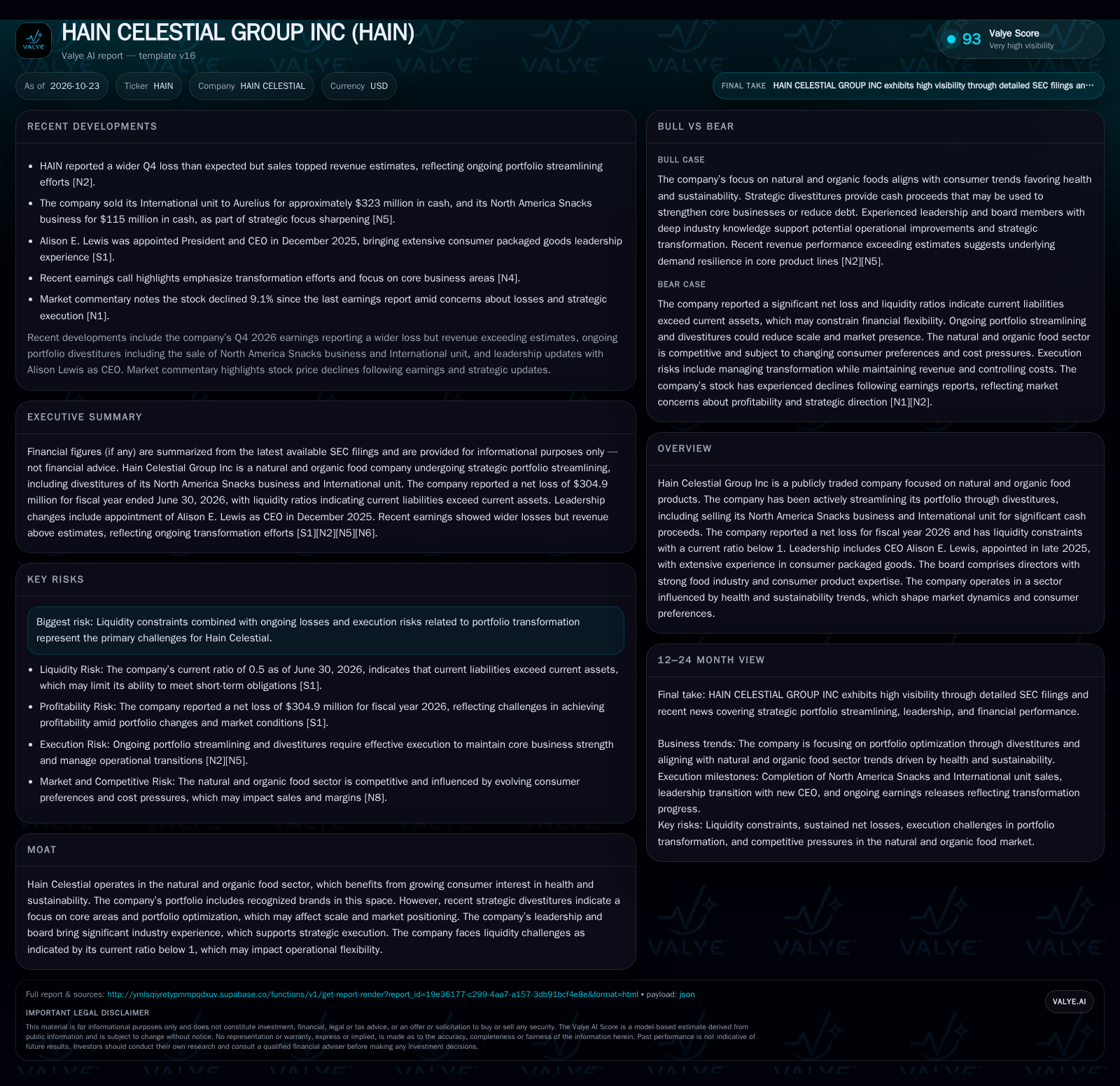
Hain Celestial recently sold its International and North America Snacks businesses, generating significant cash proceeds but narrowing its operations. Despite a cash infusion, the company ended FY26 with a current ratio of just 0.5 and a net loss of $304.9 million. New CEO Alison E. Lewis, with deep CPG experience, is tasked with stabilizing the core business and capitalizing on health-driven food trends, but execution risks and competitive pressures remain acute. Hain’s near-term trajectory will depend on its ability to convert divestiture proceeds into operational improvement and margin recovery in a structurally challenging market.
Hain Celestial Group is at a pivotal moment: after divesting its International and North America Snacks businesses for over $430 million in cash, the company is leaner but not yet healthier. Its balance sheet as of June 2026 shows liquidity under pressure, with current liabilities far outstripping current assets and a net loss of $304.9 million. With a new CEO at the helm and a sharpened focus on core natural and organic brands, Hain must now prove it can parlay its streamlined portfolio and fresh cash into a turnaround. Success will require decisive execution, careful capital allocation, and the ability to carve out sustainable margins in a crowded, fast-evolving sector.
Divestitures Bring Cash, But Liquidity Remains Tight and Losses Deepen
Hain Celestial’s most material recent actions are the divestitures of its International unit (sold to Aurelius for approximately $323 million in cash) and North America Snacks business ($115 million in cash), together raising over $430 million [N5]. While these deals bring in substantial funds, they also reduce the company’s operational scope and future revenue base. As of June 30, 2026, Hain reported cash and equivalents of $58.1 million, current assets of $416.3 million, and current liabilities of $830.8 million, for a current ratio of only 0.5 and a cash ratio of 0.07 [S1]. Critically, the company posted a net loss of $304.9 million in FY26, highlighting that divestitures have not yet translated into restored profitability or liquidity comfort. Alison E. Lewis’s appointment as CEO in December 2025 signals a leadership reset at a time when operational execution and capital allocation are paramount [S1].
How Hain’s Streamlined Portfolio Could (or Might Not) Generate Profits
Hain Celestial’s economics hinge on branded natural and organic food products, where volume growth, pricing power, and product mix drive gross margin. The company’s strategic shift—shedding less profitable or non-core units—may allow for tighter focus and cost discipline, but also reduces scale economies and revenue diversity. In theory, a leaner portfolio could improve margins if management can optimize supply chain, rationalize SKUs, and concentrate marketing spend on higher-return brands.
However, the natural and organic category is characterized by high input costs, frequent promotional activity, and retailer power that constrains pricing flexibility. Without scale, fixed costs (including overhead and brand investment) risk becoming a larger drag. The recent cash inflow from divestitures could be deployed to reduce debt, fund working capital, or invest in innovation and brand support. Yet with a current ratio well below 1, a significant portion may need to address immediate obligations rather than long-term growth. Operating leverage is now a double-edged sword: improved efficiency could lift margins, but any revenue shortfall or cost inflation could quickly deepen losses.
Brand Equity Versus Scale: Hain’s Place in a Crowded Natural Foods Market
Hain’s competitive position is built on a portfolio of recognized brands in the natural and organic segment, a space that continues to benefit from secular health and sustainability trends. However, the field is increasingly crowded: large incumbent food companies have expanded their own organic offerings, and niche disruptors target the same health-conscious consumers. The company’s recent divestitures may sharpen its focus but also reduce its overall shelf presence and negotiating leverage with retailers.
Switching costs for consumers are relatively low in food categories, putting a premium on brand loyalty, innovation, and shelf visibility. Hain’s board and new CEO bring deep industry experience, which could help navigate this landscape, but the loss of scale from divestitures means the company must punch above its weight on marketing, distribution, and product development. Pricing power is limited unless brands are truly differentiated, and cost inflation, especially in organic ingredients, remains a persistent headwind.
If Cash Is Deployed Effectively: A Path Back to Margin Expansion and Growth
Under this scenario, the company leverages its streamlined focus to improve operational efficiency, rationalize SKUs, and concentrate resources on growth categories aligned with consumer health trends. If the new leadership team can deliver cost discipline and margin recovery, Hain could return to profitability and eventually re-establish top-line growth, especially if the sector’s demand tailwinds persist.
Evidence that would confirm this trajectory includes a sequential improvement in gross and operating margins, a reported liquidity-ratio trends (indicating improved liquidity), and stabilization or growth in core brand revenues. Announcements of new product launches, successful marketing campaigns, or strategic partnerships in the natural and organic segment would also support the upside case.
Transformation Delivers Stability, But Growth and Margins Remain Subdued
The most plausible outcome is that Hain uses divestiture proceeds primarily to shore up its balance sheet and maintain operations, but sees only gradual improvement in profitability. The core brands may stabilize, but the loss of scale and persistent competitive pressure limit pricing power and margin upside. Cost savings from portfolio rationalization help offset some inflationary pressures, but the company continues to operate with thin margins and modest top-line growth.
Confirmation of this scenario would come from continued slight net losses or breakeven performance, a current ratio that remains below or just above 1, and lackluster revenue growth in the core business. If Hain manages to avoid further liquidity stress but cannot return to robust profitability, the company may become a slow-recovery story dependent on sector-wide demand trends.
Liquidity Crunch and Execution Missteps Could Force Further Retrenchment
The risk case is that divestiture proceeds are insufficient to cover ongoing losses and short-term obligations, leading to a liquidity crunch. If cost inflation, weak consumer demand, or operational missteps persist, Hain could be forced into additional asset sales, dilutive financings, or aggressive cost-cutting that erodes brand equity. In a worst-case scenario, inability to meet liabilities could trigger covenant breaches, supplier pressure, or even restructuring.
Evidence supporting the downside would include further deterioration in the current ratio, persistent or widening net losses, announcements of emergency financing or asset sales, and negative commentary from management about liquidity or operational challenges. Loss of retail shelf space or market share to better-capitalized rivals would further reinforce this scenario.
What Will Test Whether Hain Celestial’s Reset Can Deliver a True Turnaround
Sequential changes in the current ratio and cash balance, to assess whether the company is building or burning liquidity post-divestiture.
Gross and operating margin trends in the core business, as indicators of operational improvement or continued cost pressure.
Revenue growth or decline in retained brands, which would show whether portfolio focus is translating into market share gains or losses.
Updates on debt repayment or refinancing activity, particularly if balance-sheet stress persists.
Product launch cadence and innovation pipeline disclosures, to gauge whether Hain is investing in growth or merely stabilizing.
Commentary from management on cost discipline, SKU rationalization, and supply chain efficiency in upcoming earnings calls.
Any indications of further asset sales, restructuring, or external capital needs—especially if signaled by news or filings.
Competitive moves from large food companies or disruptive start-ups that could impact Hain’s market positioning, if disclosed.
Disclaimer: This is research-only, informational analysis and not investment advice. It may include AI-generated interpretation and general industry context. Always verify important details using primary sources.

Comments