
Atlantis Glory Inc.: The High-Stakes Gamble of a One-Shot Acquisition Shell
Atlantis Glory Inc. stands at a crossroads with no operations, no revenue, and almost no liquidity, entirely dependent on executing a single successful business combination. The company's fate hinges on its sole executive's ability to identify and consummate a viable acquisition before capital constraints force an end to its ambitions.
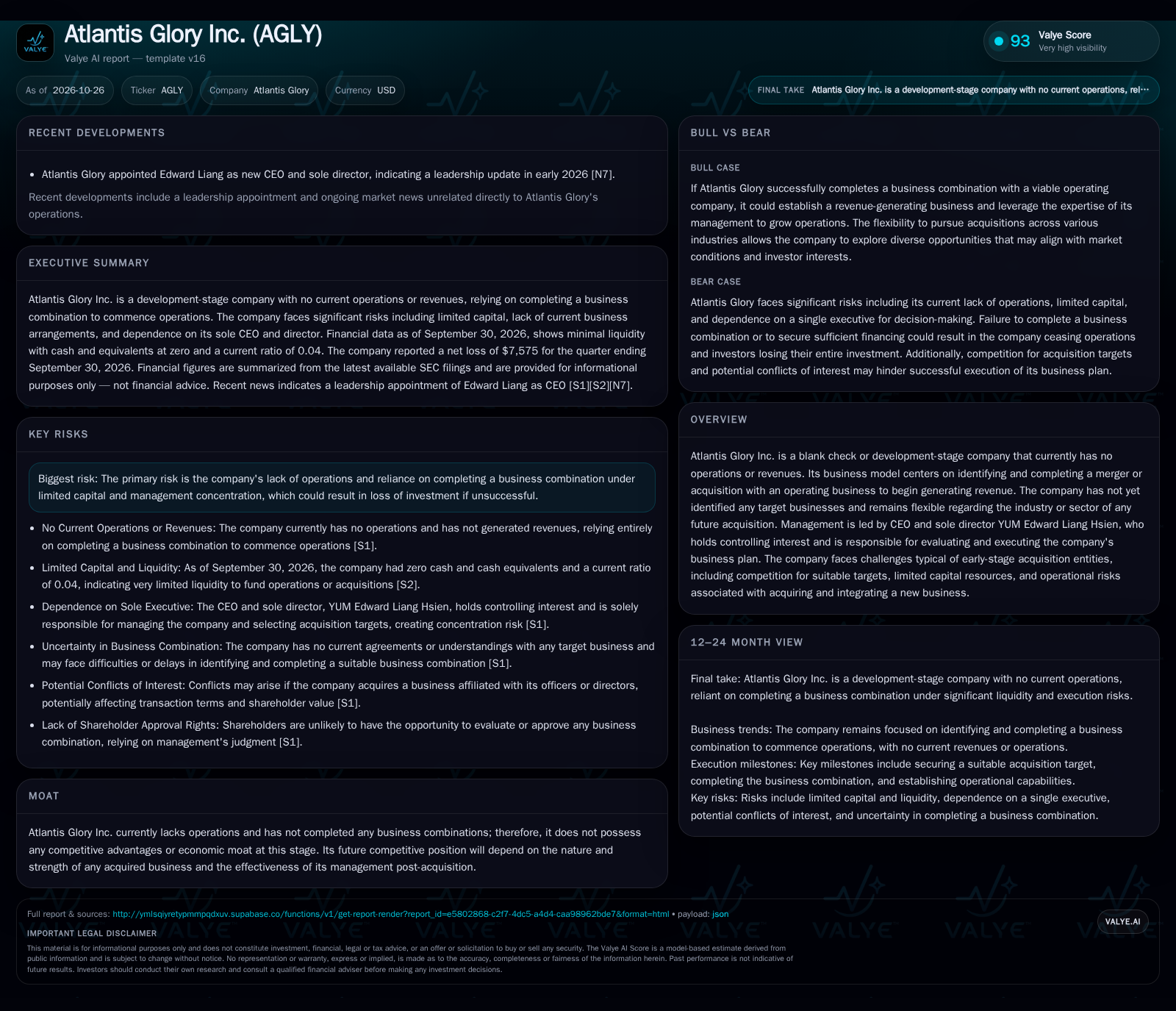
Atlantis Glory Inc. is a dormant shell company with no operations, zero cash, and $9,000 in current assets against $235,005 in liabilities as of September 30, 2026. The sole path forward is a business combination, but no targets or negotiations are underway. With limited capital, concentration of control, and no sector focus, the company faces existential risk if a deal is not secured soon. Investors are exposed to binary outcomes: either a transformative acquisition or possible dissolution. [S1] [S2]
Atlantis Glory Inc. embodies the purest form of a blank-check company: it has no operations, no revenue, negligible assets, and only a single executive at the helm. Its entire premise is to consummate a merger or acquisition—anywhere, in any industry—before its scant capital is exhausted. With no current negotiations or targets, and a near-zero cash position as of September 30, 2026, the company's fate is acutely binary. The stakes are high: if management fails to secure a deal, dissolution and total loss for shareholders are likely. Conversely, a well-executed acquisition could instantly transform Atlantis Glory’s prospects, but the risks and uncertainties are extreme. [S1] [S2]
Liquidity on the Brink: Why Immediate Action Is Critical for Atlantis Glory
As of September 30, 2026, Atlantis Glory Inc. reported zero cash and cash equivalents, $9,000 in current assets, and $235,005 in current liabilities, resulting in a perilous current ratio of 0.04 and a cash ratio of 0. The company has not generated revenue and posted a net loss of $7,575 for the quarter. There are no operations, no active business arrangements, and no identified acquisition targets. All strategic decisions rest with the sole CEO and director, YUM Edward Liang Hsien, who holds a controlling interest. This combination of minimal liquidity, concentration of control, and lack of a clear path forward means the company is running out of time to execute a business combination before its obligations overwhelm its resources. [S1] [S2]
The concentration of decision-making authority in a single executive amplifies governance risks, especially in a context where external oversight is limited or absent. This structure may accelerate decision-making but also heightens the potential for conflicts of interest or misaligned incentives, which can deter potential acquisition targets or investors seeking transparency and checks and balances. Moreover, the lack of sector focus creates ambiguity around strategic direction, which can complicate the identification of suitable targets and reduce the company's appeal to specialized investors or partners who value domain expertise and a clear investment thesis.
Shell Company Economics: One Shot, All or Nothing
Atlantis Glory’s business model is singular: complete a merger or acquisition with an operating business to become revenue-generating. Until such a deal is achieved, there are no operating cash flows, and all expenses (legal, due diligence, filings) are funded from an almost nonexistent cash base. Unlike operating companies, shell entities like Atlantis Glory generate no recurring revenue and have no inherent operating leverage—any upside is contingent on the economics of the acquired target.
Financially, the company faces fixed costs for compliance and administration, while all variable costs relate to the pursuit of a transaction. Given the zero cash balance, any acquisition would almost certainly require external funding (debt, equity raise, or target-side financing) or a merger with a business seeking a public listing. If a deal occurs, future economics will depend entirely on the acquired entity’s sector, growth profile, and capital structure. If the company fails to secure a transaction, residual capital will likely be consumed by ongoing expenses, leading to insolvency.
From a capital structure perspective, the necessity of external funding post-acquisition introduces additional layers of complexity and risk. The terms and availability of such financing are often contingent on the perceived quality and growth potential of the acquired business, as well as prevailing market conditions. If financing is expensive or dilutive, it may undermine the anticipated benefits of the transaction. Furthermore, the timing of capital raises relative to acquisition completion is critical; delays can erode negotiating leverage or result in unfavorable deal terms, thereby impacting the ultimate value creation potential of the combined entity.
No Moat, No Niche: The Realities of Competing for Scarce Acquisition Targets
Atlantis Glory has no operations, assets, or sector focus, and thus no competitive advantages or moat at present. Its only potential asset is its public listing, which may appeal to private companies seeking a fast track to the public markets. However, competition in the blank-check/shell company space is intense, with numerous entities—especially post-SPAC boom—chasing a shrinking pool of attractive targets.
The absence of sector restrictions provides theoretical flexibility but also dilutes focus and may reduce credibility with sophisticated targets who often prefer partners with domain expertise or a strong network. The company’s acute lack of capital is a significant handicap relative to peers that can offer more attractive deal terms or provide post-merger growth capital. The sole reliance on a single executive for target sourcing and execution further weakens its competitive position, as larger, better-resourced shells can deploy teams and advisors for deal origination.
The competitive disadvantage stemming from limited resources extends beyond capital constraints to include deal sourcing capabilities and post-merger integration expertise. Larger or more established shell companies often maintain dedicated teams or networks to identify proprietary deal flow and conduct thorough due diligence, which can lead to more favorable terms and higher-quality acquisitions. In contrast, Atlantis Glory’s reliance on a single executive limits its ability to engage multiple targets simultaneously or conduct comprehensive evaluations, increasing the risk of suboptimal deal selection or execution errors that could jeopardize future viability.
A Transformative Deal: How One Strategic Acquisition Could Reverse Fortunes
The most optimistic outcome for Atlantis Glory is the rapid identification and consummation of a merger with a viable, growth-ready operating business. This could be a private company seeking public listing, a distressed asset needing recapitalization, or an early-stage firm looking for capital and market access. If the acquired business has strong fundamentals and Atlantis Glory can secure additional funding (either as part of the transaction or through follow-on capital raises), the shell could be converted into an operating company with revenue, growth prospects, and equity value.
Confirmation of this scenario would require public disclosure of a signed letter of intent, merger agreement, or announcement of committed financing. Early signs might include increased cash balances (from bridge loans or PIPE investments), engagement of transaction advisors, or SEC filings detailing a proposed business combination. Falsification would be signaled by continued absence of such disclosures, further deterioration of liquidity, or management departures.
Stalled at the Starting Line: Prolonged Inactivity and Erosion of Remaining Value
The most likely scenario given current facts is that Atlantis Glory continues to search for an acquisition target without immediate success. Administrative and compliance costs consume the remaining $9,000 in assets, while liabilities and payables mount. Without new cash infusions or a near-term deal, the company’s ability to operate deteriorates, and the risk of involuntary dissolution or creditor action rises.
Evidence for this outcome would include persistently low or declining cash balances, absence of deal announcements or SEC filings indicating transaction progress, and mounting overdue liabilities. A reversal of this trend would require disclosure of a concrete transaction or successful capital raise.
Liquidity Exhaustion and Forced Liquidation: The Path to Total Loss
In the adverse scenario, Atlantis Glory is unable to identify or secure a business combination before its limited resources are exhausted. With zero cash and growing liabilities, the company faces the risk of creditor action, regulatory non-compliance, or administrative dissolution. In this event, remaining asset value is likely negligible, and shareholders could lose their entire investment.
This scenario would be confirmed by missed SEC filing deadlines, auditor going-concern warnings, resignation of the sole executive, or explicit disclosure of intent to cease operations. Any legal filings for bankruptcy or dissolution, or complete absence of communication from management, would also support this downside outcome.
Milestones That Will Determine Atlantis Glory’s Next Chapter
Announcement or SEC filing of a letter of intent, merger agreement, or acquisition target.
Disclosure of new financing arrangements, bridge loans, or capital raises to fund ongoing operations or a transaction.
Engagement of outside advisors, investment banks, or consultants to assist with M&A sourcing or execution—if disclosed.
Material changes in the company’s cash position or current assets in subsequent filings.
Updates regarding the CEO’s continued involvement, board composition, or any change in control.
Evidence of negotiations or exclusivity agreements with prospective targets—if disclosed.
SEC warnings, missed filing deadlines, or auditor comments regarding the company’s ability to continue as a going concern.
Any legal or regulatory filings suggesting impending dissolution, bankruptcy, or creditor action.
Disclaimer: This is research-only, informational analysis and not investment advice. It may include AI-generated interpretation and general industry context. Always verify important details using primary sources.

Comments