
Gorman-Rupp’s Record Results, Expansion Ambitions, and the Stakes of Cyclical Markets
Gorman-Rupp delivered record sales and earnings in Q3 2026, surpassing expectations while reducing debt and exploring new markets such as data centers. The company’s strong recent performance, acquisitive stance, and robust current ratio set the stage for growth, but cyclical demand, cost volatility, and substantial leverage remain central variables for investors.
Gorman-Rupp posted record Q3 sales and net income, exceeded earnings expectations, and reduced debt below key thresholds while pursuing acquisitions and data center expansion. These strengths are tempered by ongoing exposure to cyclical demand, cost volatility, and the operational risks of integrating new business lines and managing leverage. The core question is whether disciplined execution and strategic investments can sustain outperformance through economic cycles.
Gorman-Rupp Co’s third quarter of 2026 marks a pivotal moment for this industrial manufacturer. With record net sales and net income, the company not only beat market expectations but also improved its balance sheet and began pursuing growth beyond its legacy markets. Management’s focus on acquisitions and entry into data center-related opportunities signals a willingness to invest for the future, even as it navigates the challenges of cyclical end-markets, raw material cost swings, and significant leverage. The question for investors is whether this momentum can be sustained through inevitable economic cycles and competitive pressures.
Record Sales, Surpassing Estimates, and a Strategic Pivot
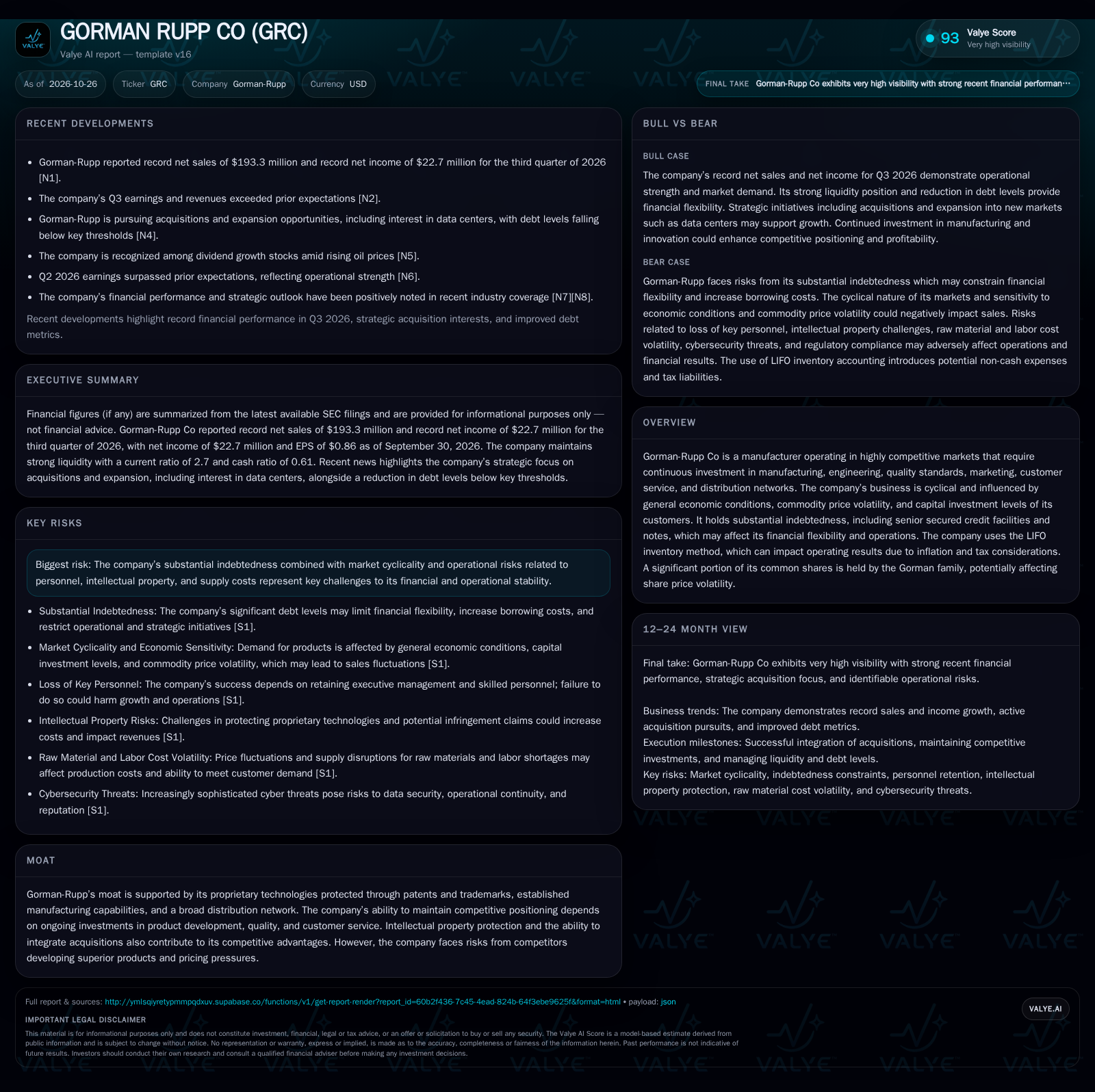
Gorman-Rupp reported record net sales of $193.3 million and net income of $22.7 million for Q3 2026, translating to EPS of $0.86 [N1] [S2]. These results exceeded prior expectations, demonstrating robust operational execution and possibly favorable market demand [N2]. As of September 30, 2026, the company held $59.3 million in cash and equivalents, with current assets of $261.5 million and current liabilities of $96.9 million, resulting in a current ratio of 2.7 and a cash ratio of 0.61 [S2]. Notably, Gorman-Rupp is actively pursuing acquisitions and exploring expansion into the data center sector, with debt levels falling below key thresholds during the period [N4]. These developments mark a period of both financial outperformance and strategic transformation, positioning the company for further growth but also introducing new operational complexities.
How Gorman-Rupp’s Business Model Converts Cyclical Demand into Profits
At its core, Gorman-Rupp generates revenue by manufacturing and distributing pumps and related fluid-handling equipment, with sales sensitive to the capital investment cycles of its industrial, municipal, and commercial customer base. Revenue is driven by both new equipment sales and aftermarket parts, with pricing power constrained by competition and customer procurement cycles. The company’s cost structure combines a significant fixed base—spanning manufacturing facilities, engineering teams, and distribution networks—with variable costs tied to raw materials, labor, and logistics. This setup creates operating leverage: higher volumes can drive outsized profit gains in upcycles, but cost volatility and underutilization risk margin pressure in downturns.
The use of LIFO inventory accounting means that periods of inflation can depress reported earnings due to higher cost-of-goods-sold, while also deferring tax liabilities [S1]. Substantial indebtedness results in ongoing interest expenses, and while recent debt reduction increases flexibility, leverage remains a meaningful drag on net profit and constrains capital allocation decisions [S1] [N4]. Expansion into data center-related opportunities could diversify the revenue base and provide new avenues for growth, but may require upfront capital, integration costs, and new skillsets. Acquisitions introduce both potential synergies and risks around execution, culture, and return on invested capital.
Competitive Landscape: Defensible Niche or Commodity Pressure?
Gorman-Rupp operates in highly competitive markets where barriers to entry are moderate: product performance, reliability, and lifecycle costs matter, but switching costs are often limited. The company’s moat is anchored in proprietary technology, established manufacturing capabilities, and a broad distribution network, but these advantages are not insurmountable [S1]. Larger diversified industrials, specialized pump manufacturers, and low-cost global entrants all vie for share, exerting pricing pressure and driving a steady pace of innovation.
Sustaining an edge depends on continuous investment in product development, quality, and customer service, as well as the ability to integrate acquisitions and expand into higher-growth or less cyclical verticals. The company’s interest in data centers reflects a strategic response to secular growth trends, but success will depend on whether its offerings can be meaningfully differentiated and whether it can navigate the procurement and operational requirements of this new customer segment. Intellectual property protection, while beneficial, is not an absolute moat, as rapid technological change and customer relationships remain critical. The concentrated ownership by the Gorman family may stabilize long-term vision, but can also affect liquidity and share price volatility [S1].
Acquisition Synergies and New Market Penetration Propel Outperformance
If Gorman-Rupp successfully executes its acquisition strategy—integrating new businesses that expand its product suite or customer reach—operating leverage could drive above-trend earnings growth. Entry into the data center sector, if paired with differentiated products or service capabilities, could provide a secular growth engine less exposed to traditional industrial cyclicality.
Confirmation of this scenario would come from sustained revenue and profit growth outpacing peers, margin expansion, and evidence that acquired businesses are being integrated efficiently with synergies realized. Demonstrable traction in new verticals, such as data centers, with marquee customer wins or recurring orders, would further validate the thesis. A declining ratio of interest expense to operating income would signal that leverage is becoming less of a constraint. Falsification would involve failed integrations, lack of revenue diversification, or a reacceleration of debt.
Cyclical Strength Meets Operational Discipline in a Competitive Market
The most plausible trajectory for Gorman-Rupp is a continuation of current momentum, with sales and profits tracking general industrial and infrastructure investment cycles. The company maintains its core competitive position by investing in product quality and customer service, while leveraging its balance sheet to pursue selective acquisitions that modestly expand its addressable market. Revenue and earnings remain cyclically sensitive, with periods of outperformance during upswings and margin compression when end-markets soften.
Evidence supporting this scenario would include stable or slightly rising gross and operating margins, continued positive operating cash flow, and incremental contributions from acquired businesses without major disruptions. Customer concentration risk and raw material cost volatility are managed but not eliminated. Falsification would manifest as persistent underperformance relative to industrial peers, significant operational missteps in integrating acquisitions, or a reversal in debt reduction progress.
Cyclical Downturn, Cost Inflation, and Integration Failures Erode Value
Gorman-Rupp’s exposure to cyclical end-markets, combined with substantial indebtedness, creates vulnerability if macroeconomic conditions deteriorate or industrial investment slows. A sharp drop in demand could lead to underutilized manufacturing capacity, margin compression, and difficulty servicing debt. Raw material and labor cost inflation could further erode profitability, especially given the constraints of LIFO accounting and competitive pricing dynamics.
If recent acquisitions fail to deliver synergies or distract management from core operations, integration costs and cultural friction may impair returns. Regulatory, cybersecurity, or intellectual property issues could introduce unexpected costs or liabilities. Confirmation of this scenario would include declining sales, shrinking margins, rising debt-to-EBITDA, negative free cash flow, or operational disruptions tied to new business lines. Falsification would require resilience in earnings and cash flow through a downturn and successful management of integration and cost risks.
Milestones and Metrics That Will Shape Gorman-Rupp’s Next Chapter
Quarterly sales and margin trends—especially relative to broader industrial peers—will clarify whether the company is sustaining or expanding its competitive position.
Progress on acquisition integration, with a useful metric being the contribution of acquired businesses to revenue growth and profitability, if disclosed.
Debt-to-EBITDA and interest expense as a percentage of operating income, to assess whether leverage is becoming less of a constraint or rebounding.
Evidence of traction in new verticals, such as data centers, including customer wins, project announcements, or recurring order flow.
Raw material and labor cost trends, and the company’s ability to pass through inflation or absorb volatility without margin erosion.
Retention of key personnel and management turnover, as failure here could disrupt strategic execution and operational stability.
Any indication of increased regulatory, cybersecurity, or intellectual property challenges, which could introduce new costs or risks.
Disclosure of customer concentration and order backlog, if available, to gauge revenue visibility and exposure to single-client or project risk.
Disclaimer: This is research-only, informational analysis and not investment advice. It may include AI-generated interpretation and general industry context. Always verify important details using primary sources.

Comments