
Greenbrier’s Manufacturing Downturn and Leasing Resilience: Navigating Rail Industry Cyclicality and Trade Policy Uncertainty
A sharp contraction in railcar manufacturing deliveries has pressured Greenbrier’s core revenue base, but steady growth and improved profitability in the leasing segment point to a shifting business mix. The company’s integrated model, capital allocation, and exposure to trade policy risks define the stakes for future earnings stability and capital deployment.
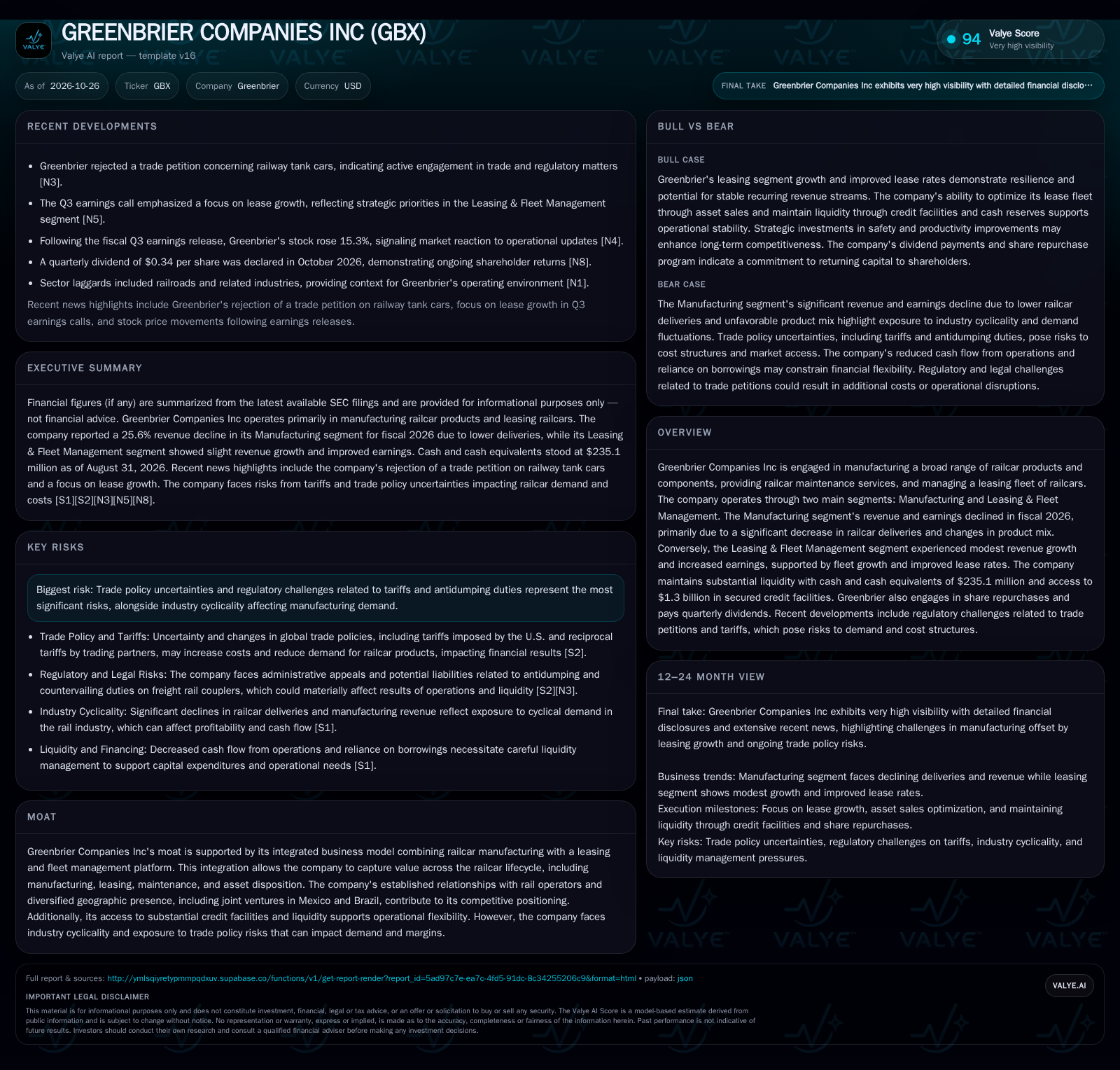
Greenbrier Companies faces a 25.6% drop in Manufacturing segment revenue due to a 31.9% decline in railcar deliveries, while its Leasing & Fleet Management segment delivers modest growth and stronger earnings. The company’s strategic focus is shifting toward leasing and asset optimization, but it remains exposed to cyclical demand swings and potential shocks from trade policy. Liquidity is supported by $235.1 million in cash and $1.3 billion in credit facilities, yet declining operating cash flow and rising capital expenditures highlight the importance of execution in a volatile rail market. [S1] [S2] [N3]
Greenbrier Companies Inc. is grappling with the acute cyclicality of the railcar manufacturing sector, as a steep year-over-year drop in deliveries has led to a sharp contraction in its Manufacturing segment’s revenue and earnings. However, the company’s Leasing & Fleet Management operations are showing signs of resilience, with improved lease rates and asset sales supporting segment profitability. As Greenbrier pivots more of its capital and strategic focus toward leasing and fleet optimization, the company’s ability to manage industry cycles, execute on asset rotation, and navigate trade policy headwinds will be key to stabilizing earnings and capital returns.
Manufacturing Weakness and Leasing Strength Define 2026 Financial Picture
Greenbrier’s fiscal 2026 results underscore a fundamental shift in its business dynamics. The Manufacturing segment, historically the company’s main revenue driver, experienced a 25.6% revenue decline to $2,266.5 million, primarily due to a 31.9% drop in railcar deliveries. This translated into a 68% plunge in segment earnings, highlighting the pronounced impact of industry cyclicality and potential overcapacity in the North American railcar market. In contrast, the Leasing & Fleet Management segment reported a modest 0.7% revenue increase to $194.6 million and a 22.3% jump in segment earnings, supported by higher lease rates, fleet growth, and increased asset sales. The company reported cash and liquidity metrics for the period; these figures do not by themselves establish operating runway, investment capacity, financial flexibility, or financing capacity. [S1]
How Greenbrier’s Integrated Model Monetizes Volatile Rail Markets
Greenbrier’s revenue model is built on two interlinked engines: the cyclical, capital-intensive Manufacturing segment and the relatively more stable, recurring Leasing & Fleet Management business. The Manufacturing segment generates cash through direct railcar sales, value-added conversions, and maintenance, but is highly exposed to freight demand, rail traffic, and capital spending cycles among rail operators and lessors. The sharp delivery drop in 2026 demonstrates the segment’s operating leverage, where fixed factory and labor costs magnify the profit impact of lower volumes.
The Leasing & Fleet Management segment, in contrast, offers a smoother earnings profile, benefiting from multi-year lease contracts, asset management fees, and gains on asset sales. Lease rates can be sensitive to supply-demand imbalances but tend to lag the manufacturing cycle, providing a partial earnings buffer. The segment’s improved profitability in 2026, despite manufacturing headwinds, reflects successful asset optimization—disposing of older or non-core assets at a gain while expanding the fleet to capture higher lease rates.
Capital intensity remains high: gross capital expenditures of $279.3 million in 2026 were primarily tied to lease fleet additions, while proceeds from asset sales ($192.8 million) partially offset these outlays. This asset rotation approach is designed to refresh the fleet and recycle capital but requires careful management of used railcar market conditions.
Integrated Platform and Global Reach: Offsetting Cyclical and Policy Headwinds?
Greenbrier’s competitive positioning hinges on its ability to deliver value across the railcar lifecycle—manufacturing, leasing, maintenance, and asset disposition—supported by long-standing relationships with North American railroads and lessors. This integration allows the company to flexibly shift between manufacturing and leasing depending on market conditions, capturing margin opportunities across the value chain.
The company’s global footprint, including joint ventures in Mexico and Brazil, diversifies revenue streams and partially insulates it from regional market swings. However, Greenbrier’s moat is not immune to industry overcapacity, commoditization of standard railcar types, and persistent pricing pressure from both domestic and international competitors. The company also faces substitute risk from modal shifts (e.g., trucking, intermodal) and technological changes that could impact long-term railcar demand.
Trade policy and tariff risks are increasingly salient: recent U.S. Customs determinations on antidumping duties for freight rail couplers could materially increase input costs or restrict market access.
Leasing Expansion and Asset Optimization Drive Durable Earnings Growth
A constructive scenario for Greenbrier envisions sustained growth in the Leasing & Fleet Management segment, underpinned by continued lease fleet expansion, improved lease rates, and active portfolio rotation. If railcar demand recovers, manufacturing volumes could rebound, further leveraging fixed cost infrastructure and driving margin recovery. Strategic asset sales at favorable prices could provide incremental earnings and cash to fund growth or return capital to shareholders.
Confirmation of this scenario would include a visible uptick in new railcar order activity, higher lease utilization and renewal rates, and a rising proportion of segment earnings from leasing relative to manufacturing. Evidence of successful cost management—such as further declines in SG&A and stable or improving operating margins in leasing—would also support the thesis. A more benign trade policy environment or favorable resolution of antidumping duty disputes could reduce input cost pressures, enhancing manufacturing profitability.
Mixed Recovery: Leasing Stability Offsets a Prolonged Manufacturing Slump
The most plausible near-term trajectory for Greenbrier is a continued bifurcation between its segments: leasing provides a degree of earnings stability, while manufacturing remains depressed amid weak railcar demand and policy uncertainty. Operating cash flow may remain volatile, especially if capital expenditures for lease fleet growth persist at high levels without a commensurate rebound in manufacturing cash generation.
In this scenario, Greenbrier’s liquidity and credit facilities cushion the impact of cyclical swings but do not eliminate the need for disciplined capital allocation. Modest order recovery in manufacturing, steady lease rates, and prudent asset rotation would support baseline earnings, but upside is capped without a sustained railcar cycle upturn. Signs supporting this view include flat to slightly rising lease revenue, muted manufacturing order books, and management commentary emphasizing risk management and cash conservation.
Trade Policy Shocks and Prolonged Rail Weakness Expose Financial Fragility
Adverse developments could see Greenbrier’s manufacturing volumes remain depressed for an extended period, while tariffs or antidumping duties materially inflate input costs or restrict access to key components. If the used railcar market weakens or lease rates decline, asset sales could become less profitable or even loss-making, squeezing cash flow and potentially straining credit covenants.
The downside chain would be confirmed by further sequential declines in manufacturing deliveries, shrinking order backlogs, negative trends in lease renewal rates, and an inability to offset capital expenditures with internally generated cash. Regulatory setbacks, such as adverse rulings on trade disputes, could accelerate cost headwinds and erode segment margins. In this scenario, Greenbrier could be forced to curtail share repurchases, defer fleet investments, or draw more heavily on credit facilities, increasing financial risk.
Signals That Will Define Greenbrier’s Strategic and Potential Financial Flexibility
Quarterly trends in new manufacturing orders, backlog, and delivery volumes—if disclosed—will provide the clearest read on the health of the core railcar cycle.
Lease fleet utilization rates, average lease term, and renewal/churn metrics would help test the durability of leasing segment earnings.
The pace, pricing, and margin on lease fleet asset sales should be monitored as a barometer of asset optimization and cash generation.
Operating cash flow trends relative to capital expenditures: persistent negative free cash flow would signal potential funding stress.
Resolution or escalation of trade policy disputes, especially U.S. antidumping and tariff developments affecting input costs and market access.
SG&A and other fixed cost management: further reductions would support margin resilience in a low-volume environment.
Drawdowns or amendments to secured credit facilities may indicate evolving liquidity needs or financial stress.
Disclaimer: This is research-only, informational analysis and not investment advice. It may include AI-generated interpretation and general industry context. Always verify important details using primary sources.

Comments