
Vicor’s AI Power Play: Can Factorized Power Architecture Sustain Leadership as Advanced Products Eclipse the Legacy Brick Portfolio?
Surging AI hardware demand and a strategic pivot toward proprietary Advanced Products have fueled Vicor’s recent financial outperformance. The company’s challenge now: maintaining innovation, scaling capacity, and defending its competitive edge as the power conversion market evolves.
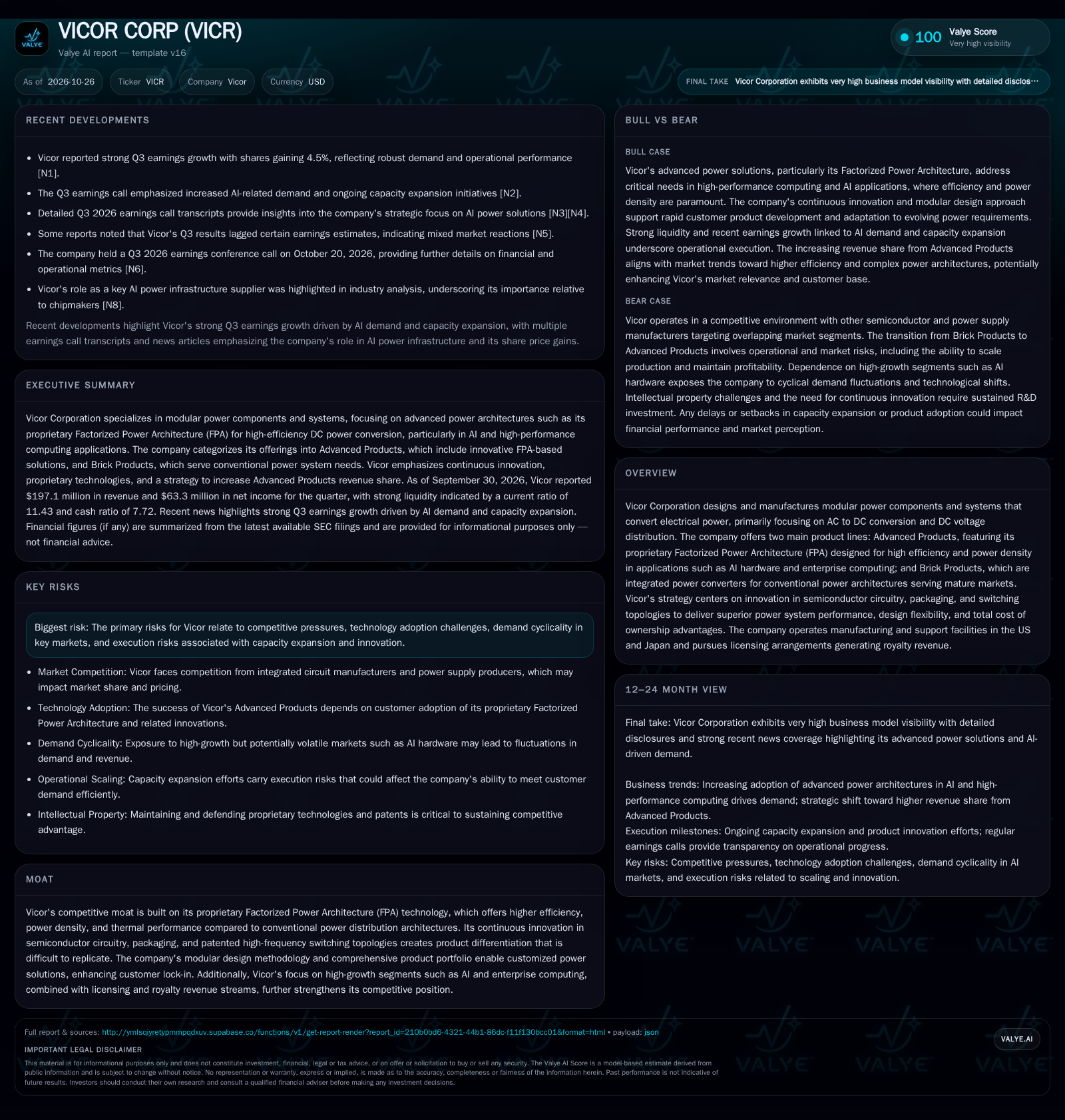
Vicor’s Q3 2026 results reflect robust demand for its proprietary Advanced Products, driven by AI and high-performance computing customers. Advanced Products now account for the majority of revenue, a shift that increases exposure to fast-growing but volatile markets. [S1] [S2] [N1] [N2]
Vicor Corporation’s Q3 2026 snapshot reveals a company riding the wave of AI hardware adoption, with its proprietary Advanced Products now contributing the majority of revenue. This strategic shift, anchored by the Factorized Power Architecture (FPA), has delivered strong financial results and positioned Vicor at the center of next-generation power delivery for high-performance computing. Yet, as legacy Brick Products fade in relative importance, Vicor faces heightened exposure to the booms and busts of AI-driven markets and the relentless pace of semiconductor innovation. The company’s ability to scale production, defend its technological edge, and manage competitive and execution risks will determine whether its leadership in modular power systems can endure.
AI-Driven Demand and Advanced Products Shift Reshape Vicor’s Revenue Mix
Vicor’s Q3 2026 financials highlight a business in transition: total revenues reached $197.1 million, with net income of $63.3 million and a reported cash position of $513.1 million. The most consequential development is the continued rise of Advanced Products—proprietary solutions built on Factorized Power Architecture (FPA)—which now account for 61% of total net revenues as of year-end 2025. This mix shift reflects both strong AI and high-performance computing demand and the company’s deliberate move away from legacy Brick Products serving mature, lower-growth markets. Recent earnings calls and news coverage confirm that AI infrastructure, particularly GPU and AI ASIC power delivery, has become Vicor’s primary growth engine, driving both operational momentum and share price gains. [S1] [S2] [N1] [N2]
How Advanced Products Could Reshape Vicor’s Margin Structure and Growth Trajectory
Vicor’s business model is highly sensitive to product mix, with Advanced Products offering greater pricing power and potentially superior gross margins compared to Brick Products. The FPA platform enables modular, efficient power delivery for power-hungry AI chips, allowing Vicor to command a premium in high-value applications where power density, thermal performance, and board space are critical constraints. As the share of Advanced Products rises, the company could benefit from operating leverage—fixed engineering and manufacturing costs spread over higher volumes and a richer mix.
However, the capital intensity of scaling advanced module production, including investments in proprietary semiconductor processes, packaging, and new manufacturing lines, may pressure near-term free cash flow. Absent explicit disclosure, it is plausible—but not proven—that Advanced Products also carry higher variable margins and lower average selling cost per watt compared to legacy offerings, especially as volume ramps with AI adoption.
Defending the Moat: Proprietary Architectures Versus Scaling Rivals and Substitutes
Vicor’s competitive edge rests on its patented Factorized Power Architecture and a history of innovation in high-frequency switching topologies and power packaging. Its vertically integrated approach, including Power-on-Package and under-motherboard power delivery for GPUs and AI ASICs, provides technical differentiation that is not easily replicated by conventional power supply manufacturers.
Yet, the company operates in a fiercely competitive landscape. Integrated circuit producers and power module vendors—ranging from diversified analog semiconductor companies to specialist power electronics firms—target overlapping customer segments, especially as the AI hardware market matures. The risk is that large, well-capitalized competitors may invest aggressively in proprietary architectures or integrated solutions, eroding Vicor’s pricing premium or accelerating technology substitution. Furthermore, chipmakers and hyperscale data center operators may pursue in-house power solutions or alternative architectures if Vicor’s modules become cost-prohibitive or fail to keep pace with new chip requirements.
The question is whether Vicor can maintain its innovation lead, defend its intellectual property, and adapt its product roadmap as both customer needs and competitive threats evolve.
Virtuous Cycle: AI Adoption Drives Volume, Margins, and Ecosystem Lock-In
In a favorable scenario, accelerating AI hardware deployment and rising power delivery complexity drive sustained demand for Vicor’s Advanced Products. As customers adopt FPA-based modules for next-generation GPUs and ASICs, Vicor’s revenue mix continues to shift upward, enabling higher average selling prices and reinforcing gross margin expansion. Successful capacity expansion allows the company to meet surging orders without bottlenecks, while ongoing innovation—such as further integration of power modules and customization for leading AI chip platforms—deepens customer lock-in and increases switching costs.
Evidence for this scenario would include continued sequential growth in Advanced Products revenue share, upward gross margin trends, new design wins with major AI hardware customers, and increasing royalty/license income from FPA adoption. Confirmation would also come from customer testimonials or public adoption announcements by leading hyperscalers or chipmakers, as well as expansion of manufacturing capacity coming online ahead of demand.
Sustaining Growth Amid Cyclicality and Execution Hurdles
The most plausible path forward is one of continued, but potentially uneven, revenue and earnings growth as AI-driven demand remains robust but subject to cyclical swings and competitive encroachment. Vicor’s Advanced Products maintain their technical edge in high-current, high-density applications, but incremental margin gains are offset by the costs of scaling capacity, defending intellectual property, and adapting to rapid shifts in customer requirements.
In this scenario, the company’s liquidity and operational discipline allow for ongoing investment without sacrificing profitability, but periods of weaker end-market demand or slower adoption may create temporary revenue plateaus. Confirmation would come from steady, though not accelerating, Advanced Products revenue share, stable gross margins, and regular updates on capacity expansion progress. Falsification would involve evidence of major customer defections, margin compression, or delays in bringing new manufacturing online.
Technological Disruption or Capacity Missteps Erode Vicor’s Lead
In an adverse outcome, the pace of innovation in AI power delivery outstrips Vicor’s ability to keep up, or major customers shift to alternative architectures—either in-house solutions or those offered by rivals. Delays or execution failures in scaling manufacturing could result in missed orders, lost design slots, or penalties, particularly if demand surges prove short-lived or uneven. If competitors close the gap on efficiency or integration, Vicor could face price-based competition, compressing margins and eroding its value proposition.
This scenario would be confirmed by declining Advanced Products revenue share, negative gross margin trends, public reports of customer losses, or significant delays in capacity ramp-up. Falsification would come from evidence of sustained technical leadership, new design wins, and resilient profitability despite competitive moves.
Milestones and Metrics to Gauge Vicor’s Advanced Products Momentum
Track the quarterly revenue share of Advanced Products versus Brick Products; further gains would indicate deepening penetration in AI and high-value segments.
Monitor gross margin trends, especially as capacity expansion investments ramp; margin resilience would support the thesis of superior economics for Advanced Products.
Watch for major customer design wins or public endorsements in the AI hardware and hyperscale data center markets.
Observe updates on manufacturing capacity expansion, including timelines for new lines or facilities coming online.
Follow R&D spending and patent filings as proxies for sustained innovation and moat reinforcement.
Monitor competitive announcements, particularly the launch of rival proprietary architectures or integrated power solutions targeting similar workloads.
If disclosed, track backlog or order visibility metrics, which would provide early insight into demand durability and execution risk.
Assess any reported royalty or licensing income growth, suggesting wider adoption of FPA or Vicor’s core IP beyond direct module sales.
Disclaimer: This is research-only, informational analysis and not investment advice. It may include AI-generated interpretation and general industry context. Always verify important details using primary sources.

Comments