
TPG RE Finance Trust: Navigating CRE Lending with Floating Rates, Leverage, and TPG Backing
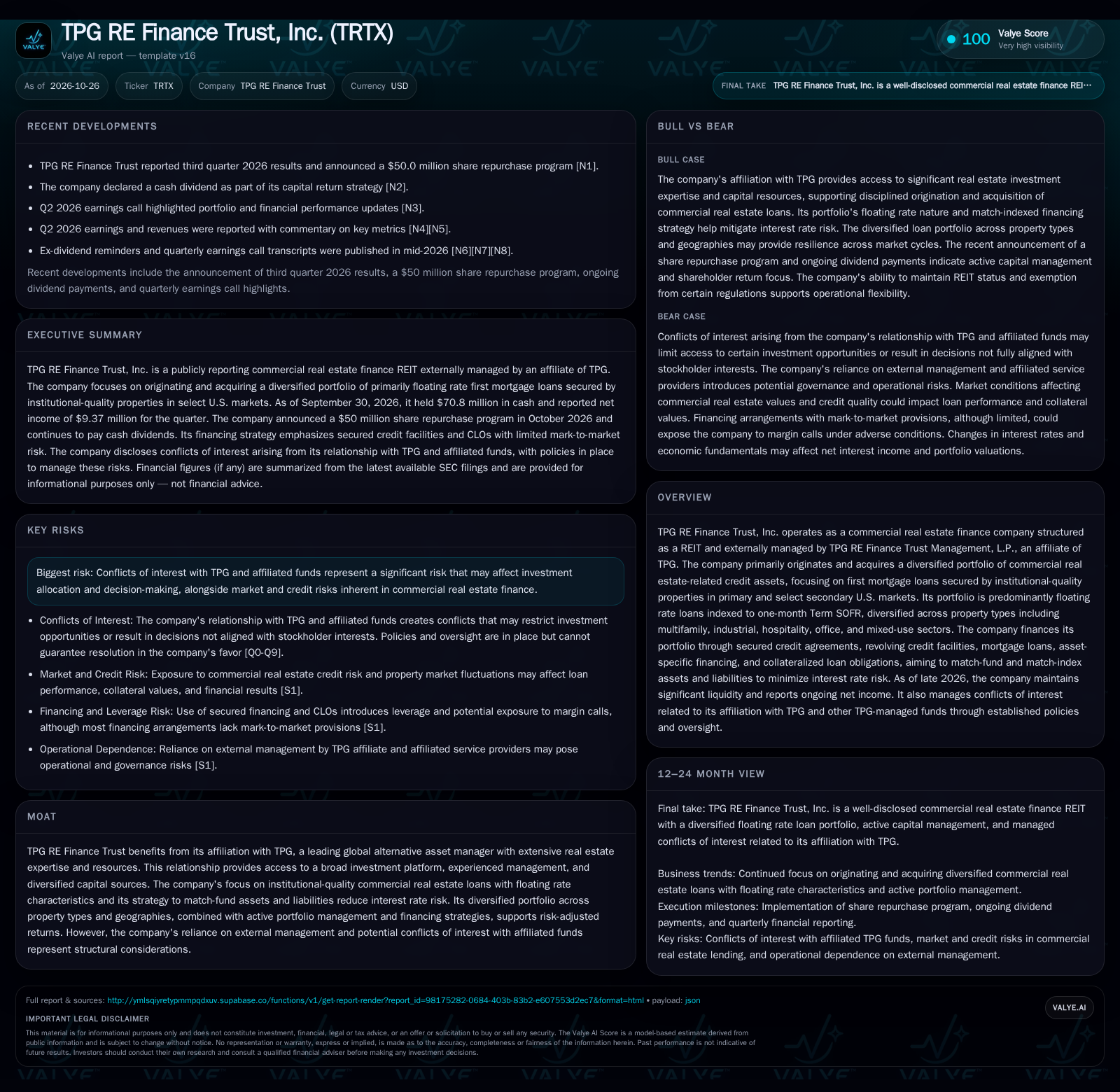
TPG RE Finance Trust, Inc. combines a diversified, floating-rate commercial real estate loan book with active capital management and the institutional heft of TPG. As the company deploys leverage and manages conflicts linked to its external manager, the thesis hinges on credit performance, liability structure, and the ability to generate risk-adjusted returns amid evolving market fundamentals.
The cited source reports dividend-related activity; that disclosure alone does not establish dividend-policy continuity, management confidence, or a material constraint on capital flexibility. Its external TPG management brings expertise and potential conflicts. [S1] [S2] [N1] [N2]
TPG RE Finance Trust, Inc. stands at the intersection of institutional real estate lending and public REIT capital markets. With a $4.1 billion investment portfolio dominated by floating-rate first mortgage loans, TRTX seeks to capture risk-adjusted yield while actively managing interest rate exposure and leverage. The company’s recent share buyback and ongoing dividends signal confidence in its capital position, but the true test lies in the performance of its credit book as commercial real estate markets evolve. The interplay between external TPG management, portfolio diversification, and liability structure shapes both the opportunity and the risk for shareholders.
Recent Portfolio Metrics and Capital Actions Shape the Strategic Backdrop
As of December 31, 2025, TPG RE Finance Trust reported a $4.1 billion unpaid principal balance across 50 loans, nearly all of which are floating rate and secured by institutional-quality properties. The company’s portfolio is diversified across major property types and geographies, with multifamily, industrial, hospitality, office, and mixed-use assets represented. [S1]
TRTX’s financing structure is notable: $3.28 billion in outstanding debt is primarily secured, and 82% of arrangements lack mark-to-market provisions—helping insulate the company from forced deleveraging when asset values fluctuate. [S1]
For Q3 2026, net income was $9.37 million, with $70.8 million in cash on hand. The cited source reports dividend-related activity; that disclosure alone does not establish dividend-policy continuity, management confidence, or a material constraint on capital flexibility. [S2] [N1] [N2]
These facts set the stage for the next phase of TRTX’s life cycle, as the company juggles yield generation, credit risk, leverage, and shareholder alignment in a shifting commercial real estate environment.
How TRTX’s Floating-Rate Lending Model Generates—and Risks—Returns
TRTX’s core business is the origination and acquisition of first mortgage loans, primarily at floating rates indexed to one-month Term SOFR. The weighted average all-in yield of 7.1% as of year-end 2025 reflects a combination of credit spread (3.2%) and prevailing base rates. [S1] This structure allows TRTX to benefit from rising short-term rates, provided credit quality holds and liability costs remain controlled.
The company’s revenues are driven by net interest income: the spread between loan yields and the cost of borrowed funds. Active match-funding and match-indexing of assets and liabilities are intended to neutralize rate risk, but the effectiveness depends on the precision of duration and index matching, as well as the stability of funding sources.
Operating leverage is present but limited by the external management model—most operating functions are handled by TPG affiliates, and fee structures may reduce scalability benefits for common shareholders. High leverage (with indebtedness at $3.28B against $4.1B in loan assets) magnifies returns but also amplifies downside if credit performance deteriorates.
Capital needs are dictated by the pace of loan originations, maturities, repayments, and the need to manage liquidity for dividends, buybacks, and potential REO asset resolutions. The ability to recycle capital efficiently is crucial for sustaining dividend and buyback activity.
TPG Affiliation, Portfolio Breadth, and Structural Risks in the CRE Lending Landscape
TRTX’s affiliation with TPG provides access to a deep origination pipeline, institutional relationships, and capital markets expertise that many standalone REITs lack. This can be a source of deal flow and risk management insight, particularly in periods of market stress. [S1]
The company’s portfolio diversification—by property type and geography—may help buffer against isolated sectoral downturns. However, commercial real estate lending is inherently cyclical, and large exposures to office or hospitality, for example, could become problematic if those asset classes face sustained pressure.
Competition is fierce among non-bank lenders, banks, private debt funds, and insurance companies, all seeking attractive risk-adjusted returns in commercial real estate. TRTX’s focus on institutional-quality, first-mortgage lending may provide some insulation, but pricing power is limited by the broader supply of capital chasing similar deals.
A unique challenge for TRTX is its external management and the conflicts of interest arising from overlapping TPG vehicles and shared service providers. These conflicts are disclosed and managed through policies, but they can affect investment allocation and operational decisions. [S1]
If Credit Quality Holds and Spreads Remain Wide, Shareholder Returns Could Outpace Expectations
The most favorable outcome for TRTX would be one in which commercial real estate credit performance remains stable or improves, allowing the company to earn its 7.1% weighted average all-in yield with minimal defaults or impairments. If base rates stay elevated but not so high as to spark systemic distress, TRTX’s floating-rate loan book could drive expanding net interest margins.
Continued access to low-cost, stable financing—especially with limited mark-to-market provisions—would enable the company to maintain or grow its loan book without facing forced deleveraging. If the share repurchase program is executed at a discount to book value, and dividends are sustained, total shareholder return could be meaningfully enhanced.
Evidence supporting this scenario would include declining or stable non-performing loan ratios, consistent or rising net interest income, successful execution of capital return programs, and resilience in the value of REO assets or rapid resolution of non-performing exposures.
Commercial Real Estate Headwinds Lead to Mixed Outcomes, but Portfolio Management Mitigates Major Shocks
The most plausible trajectory is one in which TRTX continues to generate moderate net interest income, but faces episodic credit losses as select property types or geographies come under stress. The diversified loan book softens the blow, but office and hospitality exposures could contribute to higher non-accruals or impairments.
Match-funded, floating-rate financing provides a partial hedge against interest rate volatility, but rising liability costs or isolated pockets of mark-to-market risk could pressure spreads. External management by TPG ensures ongoing access to deal flow and expertise, but also maintains the structural conflicts that can complicate capital allocation.
In this scenario, dividends are maintained but not materially increased, share repurchases are opportunistic rather than aggressive, and book value per share fluctuates with credit performance and asset valuations. Evidence would include a stable but not growing loan book, moderate provisioning for credit losses, and steady but unspectacular capital return activity.
A Spike in Credit Losses or Funding Stress Could Trigger Asset Sales and Dividend Cuts
Should commercial real estate markets deteriorate more sharply—whether due to rising vacancies, falling rents, or systemic macroeconomic shocks—TRTX could face a significant increase in loan delinquencies and impairments. This would reduce net interest income, erode book value, and potentially threaten compliance with REIT distribution requirements.
If liability costs spike or funding sources become less reliable, particularly for the 18% of financing with mark-to-market provisions, TRTX could be forced to deleverage by selling assets at unfavorable prices. This could further depress earnings and imperil dividend continuity.
Evidence for this scenario would include a sharp rise in non-performing assets, outsized provisions for credit losses, reductions in dividend announcements, and commentary on stressed liquidity or asset sales at discounts to book.
What Will Make or Break TRTX’s Ability to Deliver Attractive Risk-Adjusted Returns
Quarterly trends in non-performing loans and realized credit losses—particularly by property type and geography—will be critical to test the resilience of the loan book.
Net interest margin evolution, especially relative to changes in base rates and liability costs, will reveal whether the match-funding strategy is effectively protecting spreads.
Execution and pace of the $50 million share repurchase program—if disclosed—including average repurchase price relative to book value, will indicate management’s capital allocation discipline.
Updates on the resolution or disposition of REO assets, including realized gains or losses, will signal portfolio management effectiveness.
Any disclosed changes in the proportion of financing with mark-to-market provisions could alter the company’s vulnerability to market shocks.
Additional disclosures or events related to conflicts of interest—such as co-investment allocations or shared service provider arrangements—could affect governance perceptions and risk.
Disclaimer: This is research-only, informational analysis and not investment advice. It may include AI-generated interpretation and general industry context. Always verify important details using primary sources.

Comments