
Cincinnati Financial: Underwriting Discipline, Investment Leverage, and the Realities of Insurance Cyclicality
Cincinnati Financial’s third-quarter results highlight robust underwriting and investment-driven earnings, but the company’s future performance will hinge on managing market volatility, claims inflation, and competitive pricing pressure. Understanding the interplay between premium growth, investment income, and risk management will be critical for evaluating its durability in an increasingly dynamic insurance landscape.
Cincinnati Financial’s Q3 2026 earnings reveal strong profitability and a significant liquidity cushion [S2]. The company’s core economics rely on underwriting discipline and investment returns, but its exposure to claims volatility and market-driven portfolio swings remains material. The interplay between rate adequacy, claims trends, and investment yields will determine whether recent momentum proves durable amid sector-wide headwinds.
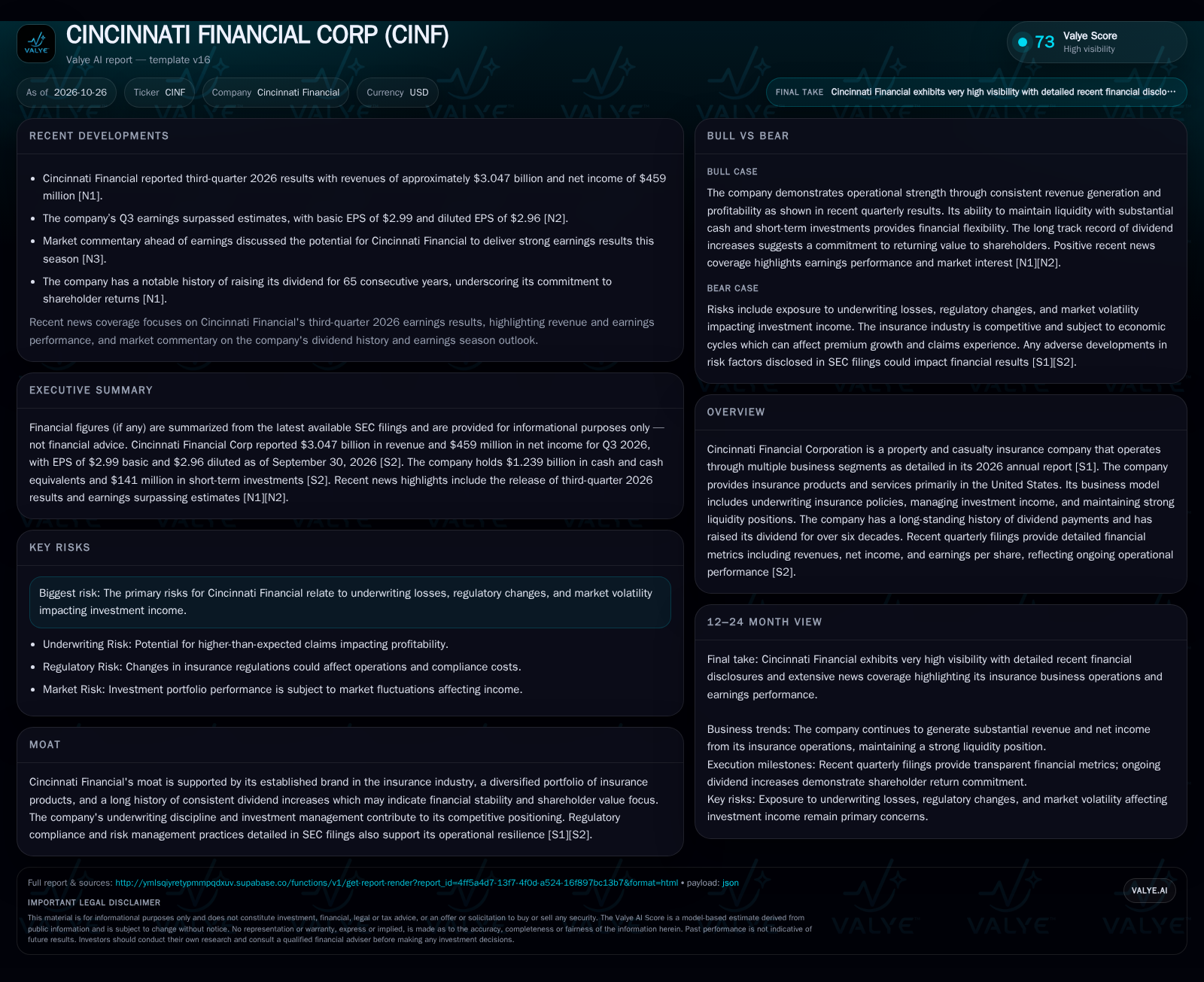
Cincinnati Financial Corporation’s latest quarterly results underscore its ability to deliver steady profits in a sector defined by risk and cyclical swings. Reporting $3.047 billion in revenue and $459 million in net income for Q3 2026 [S2], the company’s strong financial snapshot is the product of careful underwriting and active investment management. Yet, as with all insurers, the real test lies in navigating claims volatility, regulatory shifts, and the relentless pressure to balance rate adequacy against competitive and customer retention dynamics. The company’s future resilience will depend on its ability to sustain disciplined risk selection while adapting to changing market and macroeconomic conditions.
Recent Results Showcase Earnings Strength, But Risk Context Matters
Cincinnati Financial reported $3.047 billion in revenue and $459 million in net income for the third quarter of 2026, translating to basic EPS of $2.99 and diluted EPS of $2.96 [S2]. The company’s liquidity position as of September 30, 2026, included $1.239 billion in cash and cash equivalents, plus $141 million in short-term investments [S2]. These results confirm ongoing operational profitability and significant financial resources. However, as a property and casualty insurer, Cincinnati Financial’s near-term financials reflect only a snapshot in a business where claims experience and investment-market swings can rapidly alter the outlook. The company’s segment disclosures and risk factor reminders in recent filings emphasize that underwriting discipline and market risk management remain central to its sustained performance [S1] [S2].
How Underwriting and Investment Income Drive Profits—and Their Limits
Cincinnati Financial’s core business model revolves around two intertwined engines: underwriting profit and investment income. The company collects premiums from policyholders, using sophisticated risk models to set rates that, over time, should exceed the cost of claims and operating expenses. In favorable environments, strong underwriting—measured by a combined ratio below 100%—generates an underwriting profit. However, insurance is inherently volatile: catastrophe events, inflation in claims costs, and competitive pricing can quickly erode these margins.
A second, often equally important, driver is investment income on the company’s sizable float—the pool of premiums held before claims are paid out. With more than a billion dollars in cash and short-term investments [S2], and a larger investment portfolio not detailed here, Cincinnati Financial’s returns are sensitive to interest rates, credit spreads, and equity market performance. The company’s ability to generate earnings from both underwriting and investments provides a degree of diversification, but also exposes it to market cycles. Operating leverage emerges in periods of premium growth and benign claims, but can reverse sharply when loss ratios spike or capital markets turn adverse. Capital requirements are significant, driven by regulatory solvency standards and the need to maintain ratings, limiting the amount of distributable cash and increasing the importance of prudent asset-liability management.
Defensible Niche or Commodity Pressure? The Battle for Margin in P&C Insurance
Cincinnati Financial’s competitive positioning hinges on underwriting expertise, distribution relationships, and its ability to price risk accurately. In property and casualty insurance, where products are often perceived as commodities, differentiation comes from superior claims handling, agent partnerships, and product customization. Larger national carriers, regional specialists, and technology-driven newcomers all vie for share, often intensifying price competition—especially in soft markets or when new entrants pursue aggressive growth.
The company’s moat, as described in its filings, rests on underwriting discipline and investment management [S1] [S2]. Regulatory compliance and risk management add resilience, but do not eliminate exposure to adverse selection or industry-wide claim inflation. Technology adoption—such as predictive analytics for underwriting and digital distribution—could shift the playing field, potentially compressing margins for slower adopters. Ultimately, any sustained advantage will depend on Cincinnati Financial’s ability to maintain risk-adjusted pricing power, control loss ratios, and adapt to evolving customer and regulatory demands.
What Could Unlock Persistent Outperformance? Underwriting and Yield Tailwinds
A favorable scenario for Cincinnati Financial would see continued underwriting discipline—manifested in a combined ratio consistently below 100%—paired with stable or rising investment yields. This could occur if industry pricing remains rational, catastrophe losses are moderate, and claims inflation is contained.
Confirmation of this scenario would include persistent underwriting profitability, premium growth outpacing claims inflation, and rising net investment income. If the company reports improved loss ratios, stable expense ratios, and positive reserve development in future filings, it would suggest that risk selection and pricing remain effective. Additionally, evidence of successful technology adoption—such as improved digital distribution or data-driven underwriting—would bolster the case for durable margin expansion.
Sustained Profitability Amid Cyclical Swings: The Most Likely Trajectory
The most plausible outcome is that Cincinnati Financial maintains profitability, but with earnings fluctuating in response to industry cycles and macroeconomic shifts. Premium growth may moderate as competition intensifies or as regulatory changes constrain rate filings. Claims costs—especially for property lines exposed to severe weather or inflation—could trend higher, pressuring underwriting margins. Investment income may remain a stabilizing factor, but its contribution will depend on the interest rate environment and asset allocation decisions.
This scenario would be confirmed by relatively stable but occasionally volatile quarterly earnings, with the combined ratio hovering near 100% and investment income offsetting underwriting variability. Falsification would come from a persistent deterioration in loss ratios, evidence of adverse reserve development, or a sharp decline in investment returns not offset by premium growth.
How Adverse Claims or Market Shocks Could Erode Resilience
A negative turn could result if Cincinnati Financial experiences a spike in catastrophic claims, sustained claims inflation, or a severe downturn in investment markets. Underwriting losses could arise from inadequate pricing, adverse selection, or regulatory constraints on rate increases. If the company’s investment portfolio suffers from rising defaults, equity market declines, or compressed yields, the double impact could quickly erode profitability and capital.
This scenario would be confirmed by a rising combined ratio well above 100%, declining net income, and possible capital-raising or dividend cuts to preserve solvency. Additional warning signs would include negative reserve development, rating agency downgrades, or regulatory actions tied to solvency or consumer protection concerns.
Signals That Will Clarify Cincinnati Financial’s Durability and Competitive Edge
Trends in the combined ratio, especially the loss and expense components, to assess underwriting profitability and claims management effectiveness (if disclosed).
Net investment income growth and portfolio yield changes, as rising or falling rates will materially impact earnings (if disclosed in future filings).
Premium growth rates across business segments, to gauge competitive positioning and demand elasticity.
Reserve development—favorable or adverse—providing insight into claims estimation accuracy and risk selection (if disclosed).
Catastrophe loss disclosures or commentary on exposure to severe weather events, which can drive quarterly volatility.
Expense ratio trends, particularly in relation to technology investments and operational efficiency (if disclosed).
Regulatory updates or commentary on rate approval environments in major states or lines of business.
Any signals of rating agency action, as changes in credit ratings can affect capital costs and market perception.
Disclaimer: This is research-only, informational analysis and not investment advice. It may include AI-generated interpretation and general industry context. Always verify important details using primary sources.

Comments