
Public Storage’s Next Phase: Margin Pressure, Acquisition Leverage, and the Realities of Scale in Self-Storage
After posting third-quarter revenue growth but a dip in net income, Public Storage raises its outlook amid intensifying competition, cost pressures, and the ongoing challenge of translating scale into sustainable profit growth.
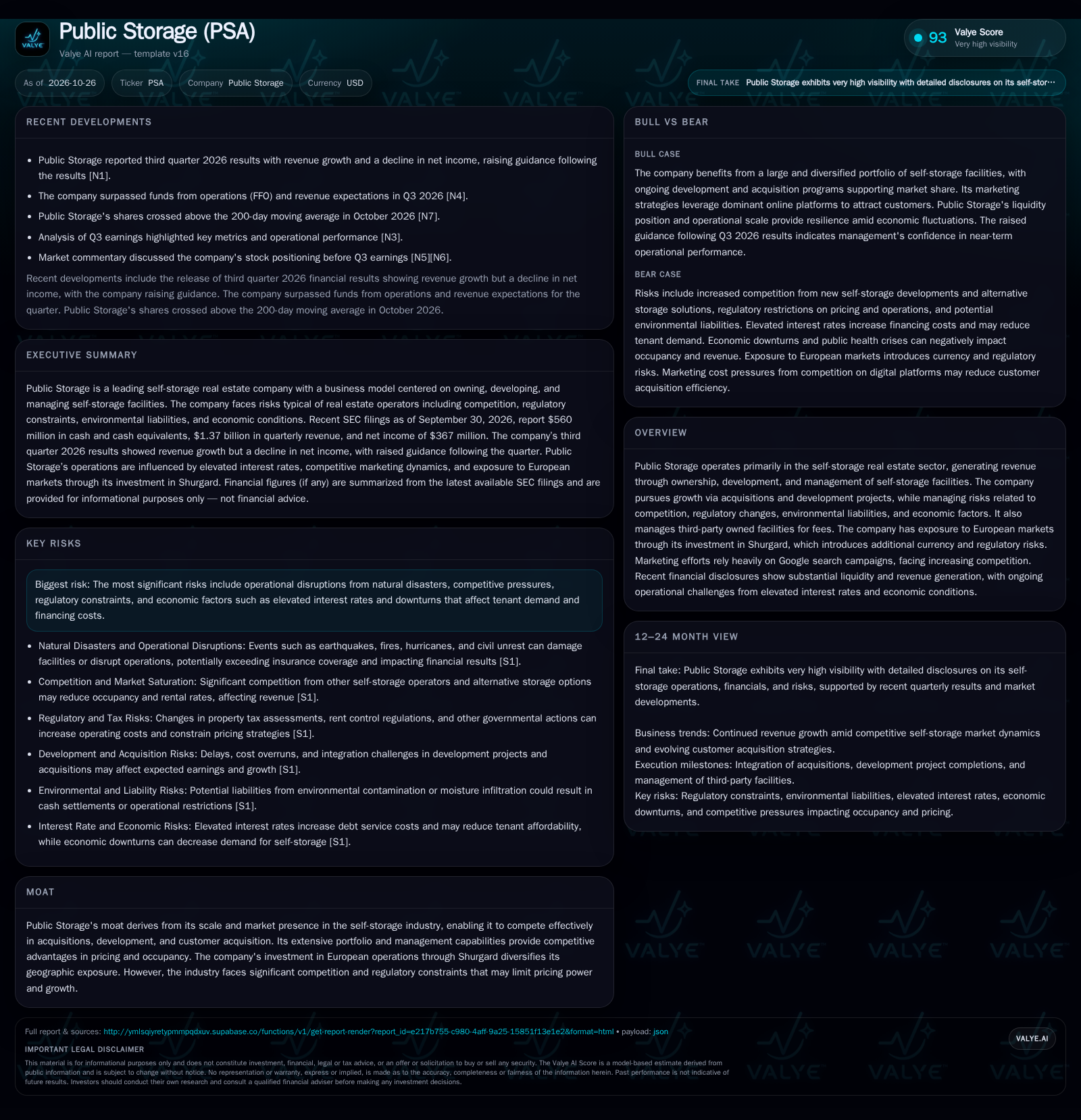
Public Storage delivered higher Q3 2026 revenue but saw net income fall, responding by raising guidance and surpassing FFO expectations. The company’s business model, centered on acquiring, developing, and managing self-storage assets, faces mounting competition and cost risks, with elevated interest rates affecting both funding and tenant affordability. Its scale and liquidity are strengths, but margin expansion depends on successful integration, pricing discipline, and defending occupancy in a crowded market. Key watchpoints include occupancy trends, acquisition returns, digital marketing costs, and regulatory developments.[S2] [N1] [N2] [N4]
Public Storage, the dominant force in self-storage real estate, is navigating a complex operating environment as it posts higher revenue but lower net income in the third quarter of 2026. The company’s raised guidance and outperformance on FFO and revenue metrics signal management’s optimism, but behind the numbers lies a delicate balancing act: defending margins and occupancy against intensifying competition, managing rising costs, and integrating new acquisitions—all while contending with elevated interest rates and regulatory headwinds. As the self-storage landscape evolves, Public Storage’s ability to turn scale into durable profitability will be tested by both cyclical pressures and the limits of the traditional storage model.[S2] [N1] [N2] [N4]
Recent Results Spotlight Margin Compression Amid Revenue Growth
In Q3 2026, Public Storage reported revenue of approximately $1.37 billion and net income of $367 million, with diluted EPS of $1.69. While revenue increased, net income declined, reflecting margin compression even as the company surpassed FFO and revenue expectations.[S2] [N1] [N2] [N4] The management team responded by raising forward guidance, indicating confidence in operational performance despite the mixed earnings picture. [S2]
How Public Storage Makes—and Risks—Its Money: The Self-Storage Economic Engine
Public Storage’s core economics derive from three intertwined activities: owning and operating self-storage facilities, developing new properties, and acquiring existing assets or operators. Revenue is primarily generated through rental income, with ancillary streams from late fees, insurance, and management of third-party facilities for a fee.[S1] Pricing is typically flexible and can be adjusted rapidly, but the ability to raise rents is constrained by competition and, in some jurisdictions, regulation.
Operating leverage is significant: fixed costs (property taxes, depreciation, and maintenance) are high, while incremental revenue from higher occupancy or pricing generally flows through at attractive margins. However, this leverage works both ways—declining occupancy or pricing pressure can rapidly erode profitability. Variable costs include labor, utilities, and marketing, with digital marketing spend (especially on Google search campaigns) rising as competition intensifies.[S1]
Capital needs are ongoing: acquisitions and development require substantial upfront investment, often financed with a mix of retained cash flow and debt. Elevated interest rates increase the cost of capital, tightening acquisition spreads and potentially making new developments less attractive unless rents can be raised in tandem. The company’s fee-based management of third-party facilities provides a lower-capital pathway to revenue, but these fees are typically less lucrative than owned-asset income and can impact pricing strategies during facility stabilization.[S1]
Scale as a Double-Edged Sword: Competition and the Limits of Advantage
Public Storage’s national scale and extensive portfolio provide advantages in brand recognition, marketing efficiency, and acquisition firepower. Its ability to manage third-party facilities and operate across multiple regions offers some diversification and resilience.[S1] However, the industry’s relatively low barriers to entry and the availability of capital for new developments have led to market saturation in many geographies. Traditional competitors include other large self-storage REITs, regional chains, and independent operators; new entrants also include private equity-backed platforms and alternative models such as valet-style storage services, which threaten to disrupt conventional customer acquisition and retention.[S1]
Digital marketing is both a strength and a vulnerability: while Public Storage can outspend smaller rivals on Google search campaigns, rising auction costs and shifting consumer search behavior could erode this edge over time. Customer switching costs are generally low—tenants can easily move to competing facilities or alternative solutions, especially when promotional pricing is widespread. Regulatory constraints, particularly around rent increases and local development approvals, further limit the company’s ability to fully exploit its scale.
When Scale Delivers: Margin Recovery and Acquisition Synergy
The most favorable scenario for Public Storage is one where its scale enables it to outcompete smaller operators on both acquisition and operating fronts, driving margin expansion. If occupancy remains high and the company successfully integrates acquired properties—realizing cost synergies and raising rents as markets stabilize—then incremental revenue could flow through at high margins, offsetting interest expense headwinds.
Further, if the company can harness data-driven pricing and marketing to improve customer acquisition efficiency—even as digital ad costs rise—its operating leverage could be preserved. A stabilization or decline in interest rates would relieve capital cost pressures, making development and acquisition spreads more attractive.
Evidence that would confirm this scenario includes sustained or rising same-store occupancy and rent growth, declining marketing costs per new customer, and improving margin trends in quarterly disclosures. Successful completion and leasing of new developments, as well as accretive acquisition returns above cost of capital, would also validate the upside thesis.
Sustaining Growth with Margin Headwinds: The Most Likely Trajectory
The most plausible path for Public Storage is continued revenue growth through a combination of incremental rent increases, modest occupancy gains, and selective acquisitions—offset by ongoing margin pressure from higher interest rates and rising operating costs.
In this scenario, digital marketing costs continue to rise, but are partially offset by scale and brand recognition. Occupancy rates may fluctuate but remain within a historically normal range, reflecting both industry seasonality and local market saturation. Regulatory and economic headwinds (such as local rent controls or a sluggish housing market) constrain pricing power, but do not trigger a severe downturn.
Evidence supporting this base case would include steady, but not accelerating, same-store revenue growth; relatively flat or gradually declining margins; and continued but more selective acquisition activity. Watch for commentary around competitive dynamics and digital marketing efficiency in quarterly calls and filings.
When the Cycle Turns: Occupancy Declines and Cost Escalation
The risk scenario centers on a combination of cyclical and structural pressures: a broad economic downturn reduces tenant demand, while elevated interest rates and operating costs compress margins further. In this environment, new supply (from overbuilding in recent years) exacerbates occupancy declines, forcing promotional pricing and further eroding profitability.
If digital marketing costs continue to rise and customer acquisition efficiency declines, Public Storage could see occupancy drop below breakeven levels for operating leverage, with limited ability to offset losses through rent increases due to regulatory or market constraints. Environmental or regulatory liabilities—such as costly remediation or tighter local development restrictions—could add further pressure.
Downside evidence would include sustained declines in same-store occupancy and rent per square foot, sharply rising marketing expense as a share of revenue, and commentary around increased competition or regulatory actions. A slowdown or write-down of development projects, or evidence of acquisition underperformance, would also support this scenario.
What Will Determine Public Storage’s Next Phase of Value Creation
Quarterly same-store occupancy rates and trends, if disclosed, will provide early warning of demand shifts and competitive pressure.
Average rent per occupied square foot and its growth trajectory would help test pricing power and the effectiveness of yield management.
Marketing expense as a percentage of revenue—especially digital acquisition cost trends—would clarify the sustainability of customer acquisition strategies.
Return on investment for recent acquisitions and developments, if disclosed, will illustrate the company’s ability to generate accretive growth above its cost of capital.
Updates on regulatory developments, such as new local rent controls or restrictions on facility expansion, could materially affect growth prospects.
Interest expense and debt service coverage ratios, if detailed, would highlight exposure to ongoing rate pressures and refinancing risk.
Trends in third-party facility management fees and related occupancy dynamics would clarify the economics of the fee-based segment versus owned facilities.
Disclosure of environmental or remediation costs, or the emergence of new liabilities, would help gauge risk to cash flow and capital allocation.
Disclaimer: This is research-only, informational analysis and not investment advice. It may include AI-generated interpretation and general industry context. Always verify important details using primary sources.

Comments