
Custom Truck One Source: Record Results, Guidance Momentum, and the Economics of Scale in Commercial Fleet Services
Custom Truck One Source posted record Q3 2026 revenue and raised full-year guidance, signaling short-term operational momentum.Yet, modest profitability and a reported cash ratio highlight the tension between growth, liquidity, and the capital-intensive realities of the truck services sector.
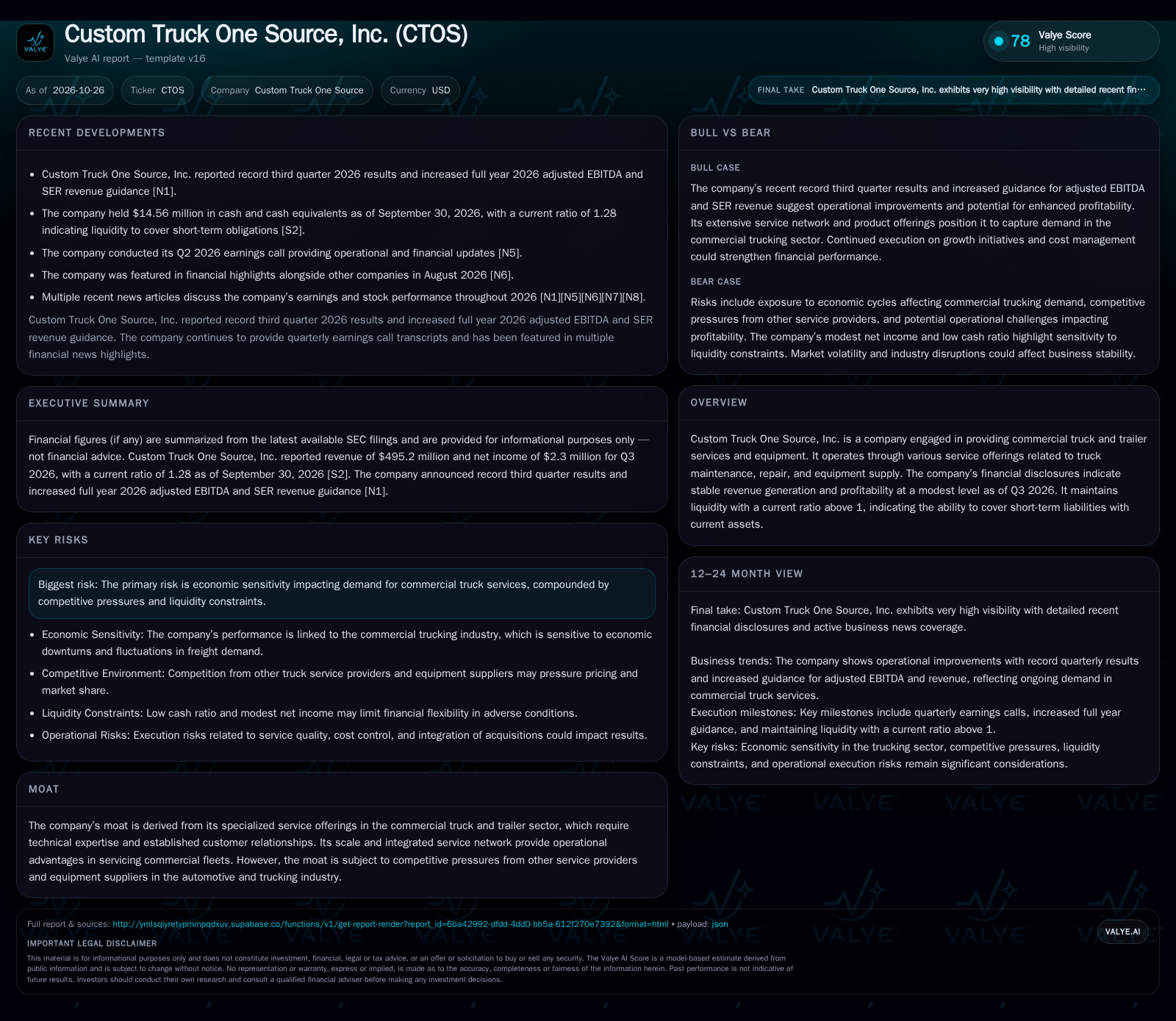
Custom Truck One Source reported record third quarter 2026 revenue of $495.2 million and raised its full-year adjusted EBITDA and SER revenue guidance. The business model’s reliance on scale, asset intensity, and cyclical demand presents both upside from operational leverage and downside risk from economic shocks. Execution on cost control, capital allocation, and competitive differentiation will determine whether recent momentum can translate into sustainable value creation. [S2] [N1]
Custom Truck One Source, Inc. is riding a wave of record quarterly revenue and upwardly revised guidance for 2026, reflecting robust demand in the commercial truck services and equipment market. However, beneath the surface of these headline numbers lies a business model defined by high capital intensity, modest net profitability, and thin liquidity. As the company seeks to convert operational momentum into lasting shareholder value, its ability to manage costs, deploy capital efficiently, and fend off competitive and macroeconomic pressures will be decisive. The question is whether Custom Truck One Source can turn scale into sustained economic advantage, or whether its growth will remain constrained by the inherent volatility and funding demands of the sector.
Record Revenue, Raised Guidance, and the Liquidity Balancing Act
Custom Truck One Source reported revenue of $495.2 million for the third quarter of 2026, accompanied by net income of $2.3 million and earnings per share of $0.01 [S2]. This marked a record quarter for the company and prompted management to increase its full-year 2026 adjusted EBITDA and SER revenue guidance [N1]. The company’s balance sheet at quarter-end showed $14.56 million in cash and cash equivalents, with a current ratio of 1.28 and a notably reported cash ratio of 0.01 [S2]. These figures highlight the ongoing tension between top-line growth and underlying liquidity constraints—a critical theme for a capital-intensive operator in a cyclical industry.
The interplay between revenue growth and liquidity management in Custom Truck One Source’s operations is emblematic of broader challenges in capital-intensive industries. The company reported cash and liquidity metrics for the period; these figures do not by themselves establish operating runway, investment capacity, financial flexibility, or financing capacity. This dynamic creates a delicate balancing act: aggressive growth strategies may strain liquidity, while conservative capital deployment could limit market responsiveness. Understanding how the company prioritizes cash flow generation, debt servicing, and investment in fleet modernization will be crucial in assessing its financial resilience and capacity to weather cyclical downturns or unexpected disruptions.
How Scale, Fixed Costs, and Asset Intensity Shape Profitability
Custom Truck One Source’s business model centers on providing commercial truck and trailer services, equipment, and maintenance—activities that typically require substantial investment in fleet, parts inventory, and service infrastructure. Revenue is driven by a mix of service, equipment rental or sales, and possibly ancillary parts or support offerings. The company’s reported modest net income margin, despite record revenue, suggests significant fixed costs and operating leverage: incremental revenue can yield strong margin improvement if utilization and pricing are optimized, but low utilization or pricing pressure can quickly erode profitability.
The need for ongoing capital expenditure to maintain and expand fleet and service capabilities is a structural feature, making free cash flow generation and capital allocation discipline central to long-term value creation.
The fixed-cost structure inherent in Custom Truck One Source’s model means that operational leverage can amplify both gains and losses. When asset utilization rates are high, fixed costs are spread over greater revenue, enhancing margins; conversely, underutilization can lead to disproportionate margin erosion. Additionally, the asset-heavy nature of the business necessitates continuous capital reinvestment to maintain competitive service levels and comply with evolving regulatory or environmental standards. The timing and scale of these investments are critical: overinvestment can depress free cash flow and increase leverage, while underinvestment risks service quality degradation and customer attrition. Strategic capital allocation decisions, therefore, must carefully weigh short-term profitability against long-term competitiveness.
Operational Breadth vs. Intense Competition in Truck Services
Custom Truck One Source’s moat is rooted in its technical expertise, scale, and integrated service network within the commercial trucking ecosystem. These attributes can provide switching frictions for large fleet customers who value reliability, breadth of service, and consolidated procurement. However, the sector is highly competitive, with numerous regional and national players—including independent service shops, OEM-affiliated providers, and equipment rental or leasing specialists—all vying for share. Pricing power is limited by customer cost sensitivity and the commoditization of some service lines.
Technology and digital platforms are also reshaping customer expectations around uptime, transparency, and predictive maintenance. If Custom Truck One Source can leverage data, telematics, or integrated digital offerings to lock in customers or drive efficiency, it could strengthen its competitive position. Conversely, failure to differentiate or keep pace with innovation may leave the company exposed to margin pressure and share erosion.
In an industry characterized by fragmented competition and price sensitivity, differentiation through integrated service offerings and scale can create meaningful barriers to entry. However, sustaining such advantages requires ongoing innovation and responsiveness to evolving customer needs. The increasing adoption of predictive maintenance technologies and data analytics by fleet operators raises the bar for service providers, who must integrate these capabilities to remain relevant. If Custom Truck One Source effectively harnesses digital tools to improve operational efficiency and customer experience, it could enhance switching costs and reduce price elasticity. Failure to do so, however, risks commoditization of services and intensified margin pressure as competitors leverage technology to undercut traditional providers.
Unlocking Operating Leverage Through Utilization and Service Expansion
The most favorable scenario for Custom Truck One Source involves sustained demand tailwinds in commercial trucking, allowing the company to improve asset utilization and push more volume through its fixed-cost base. Higher utilization of owned fleet and service infrastructure can drive margin expansion, particularly if supported by pricing discipline and growth in higher-margin service or specialty equipment offerings.
Upside would be confirmed by continued record revenue quarters, rising adjusted EBITDA margins, and evidence of working capital discipline—such as stable or improving cash flows despite growth. New or expanded customer relationships, especially with large fleets or strategic partners, would further validate the company’s ability to capture share and deepen its moat. A key falsifier would be stagnating revenue or persistent margin compression despite positive industry trends.
Managing Growth Amid Cyclical Headwinds and Capital Constraints
The most plausible trajectory is one where Custom Truck One Source maintains mid-single-digit revenue growth, with profitability fluctuating in line with economic cycles and fleet demand. The company continues to invest in its service network and equipment base, balancing growth opportunities with the need for careful working capital and liquidity management.
This scenario would be confirmed by moderate but consistent growth in revenue and adjusted EBITDA, stable current ratios, and incremental improvements in net income margin. Falsification would come from a material deterioration in liquidity (e.g., further decline in the cash ratio), missed guidance, or evidence of market share loss to more agile or better-capitalized competitors.
Liquidity Squeeze and Margin Pressure in a Downturn
Downside evidence would include a sharp drop in quarterly revenue, negative net income, and further deterioration in liquidity ratios. Early warning signs could be customer payment delays, inventory build-up, or increased reliance on short-term borrowing. Failure to adapt cost structure or secure additional funding in such an environment would threaten business continuity.
Testing the Thesis: What Will Determine Sustainable Value Creation for CTOS
Quarterly revenue and adjusted EBITDA trends: Sustained growth and margin improvement would support the upside case, while stagnation or reversal would challenge it.
Net income margin and free cash flow (if disclosed): Rising profitability and positive cash generation are necessary for long-term value, especially in a capital-intensive model.
Capital expenditure levels vs. depreciation: If disclosed, this would help assess whether growth is being funded efficiently or at the cost of balance sheet strain.
Customer concentration and contract duration (if disclosed): Shifts here could signal changing competitive dynamics or risk exposure.
Utilization rates and service mix: Higher utilization and a shift toward higher-margin offerings would confirm operating leverage.
Competitive responses or new technology entrants: Evidence of customer churn or pricing pressure from digital-first or OEM-affiliated competitors would be an early warning.
Management commentary on macro conditions and end-market demand: Tone and specificity in earnings calls or filings will provide valuable context on the outlook and risk appetite.
Disclaimer: This is research-only, informational analysis and not investment advice. It may include AI-generated interpretation and general industry context. Always verify important details using primary sources.

Comments