
Piedmont Realty Trust: Sunbelt Office Focus Faces Secular Headwinds and Lease Risk
With over 70% of lease revenue anchored in Sunbelt office markets, Piedmont Realty Trust must navigate evolving tenant demand, credit risk, and the realities of remote work. Ample credit line capacity provides near-term flexibility, but long-term value hinges on occupancy, tenant stability, and the trajectory of office utilization.
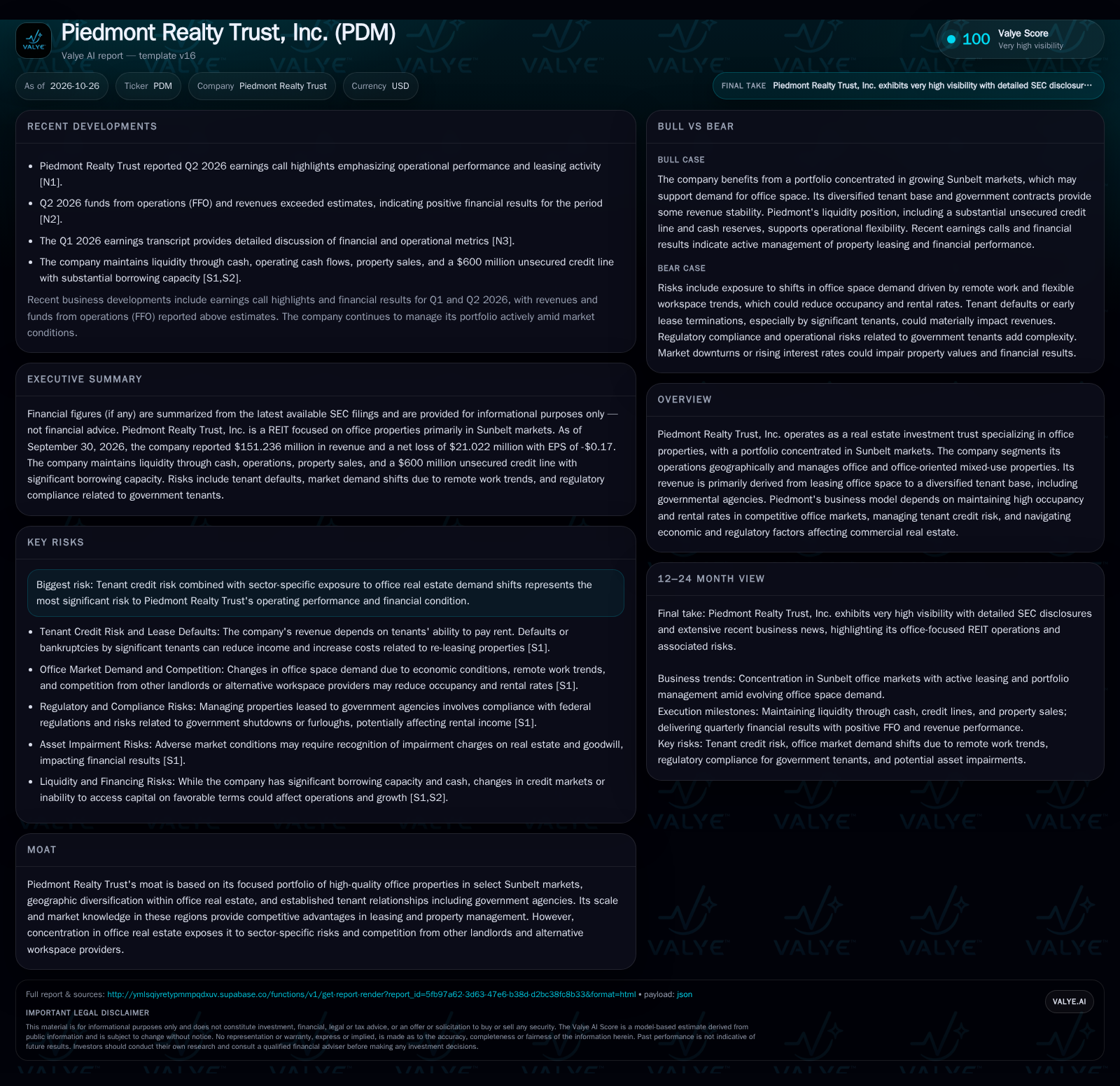
Piedmont Realty Trust is an office-focused REIT with a portfolio heavily concentrated in Sunbelt markets, generating most of its revenue from these regions. The company recently reported $151.2 million in quarterly revenue but posted a net loss, highlighting ongoing profitability challenges. The core question is whether Sunbelt market strength and tenant diversity can offset sector-wide office real estate headwinds. [S1] [S2]
Piedmont Realty Trust, Inc. stands as a pure-play office REIT with a strategic focus on the Sunbelt, a region that has outperformed many traditional office markets in recent years. Despite this geographic advantage, the company’s latest results—$151 million in quarterly revenue but a net loss—underscore the persistent profitability challenges facing office landlords. With nearly three-quarters of its rental income tied to Sunbelt properties, Piedmont’s future is tightly linked to the economic health, corporate migration patterns, and evolving work habits in these markets. Ample access to credit and some government tenant exposure provide operational flexibility and partial revenue stability, but the structural headwinds reshaping office demand remain the central concern for long-term investors. [S1] [S2]
Recent Performance and Sunbelt Concentration Shape the Risk-Reward Profile
Piedmont Realty Trust reported $151.236 million in revenue for the quarter ended September 30, 2026, but recorded a net loss of $21.022 million, translating to a basic and diluted EPS of -$0.17 per share. The company’s cash and cash equivalents at quarter-end stood at $3.903 million. Critically, over 70% of annualized lease revenue as of December 31, 2025, was generated from Sunbelt markets, highlighting a deliberate concentration in regions that have historically seen above-average population and employment growth. The company also maintains $553 million of available borrowing capacity on a $600 million unsecured credit line, with no required debt maturities until 2028, providing some breathing room in the face of sector volatility. This operating snapshot sets the stage: Piedmont has geographic leverage to potential Sunbelt outperformance, but ongoing losses and reported cash balance underscore the need for sustained occupancy and rent collections to cover costs and service debt. [S1] [S2]
How Piedmont Monetizes Office Space in a Changing Demand Landscape
Piedmont’s revenue model centers on leasing office and office-oriented mixed-use properties to a diversified tenant base, including government agencies. Its economics are shaped by occupancy rates, average rental rates, lease terms, and the cost structure of property operations and capital upkeep. Fixed costs are significant—property taxes, insurance, maintenance, and interest expense—so operating leverage is high: incremental revenue from higher occupancy or rent flows disproportionately to the bottom line, but the reverse is also true. Capital needs are ongoing, as lease turnover, tenant improvements, and property upgrades are required to maintain competitiveness and occupancy, especially as tenants demand more flexible layouts and amenities post-pandemic.
In the current environment, volume (occupancy) is under secular pressure from remote and hybrid work, while pricing (rental rates) is also at risk in markets with excess supply or reduced tenant demand. Piedmont’s exposure to government tenants may provide some revenue stability but can also introduce regulatory compliance costs and risk of payment disruption during government shutdowns. Liquidity sources include operating cash flow, asset sales, and draws on the credit line, but persistent net losses could eventually erode balance sheet flexibility if not reversed through improved leasing or asset rotation.
Assessing Competitive Strength in the Sunbelt Office Arena
Piedmont’s competitive positioning rests on its concentration in Sunbelt markets, where demographic trends have historically favored net in-migration, business formation, and employment growth. This focus may allow the company to outperform peers with legacy exposure to slower-growth or structurally challenged coastal office markets. Additionally, a diversified tenant base—including federal and other governmental agencies—can buffer against cyclical volatility, provided tenant credit remains robust.
However, the office real estate sector is facing structural headwinds: remote work, flexible workspace providers, and shifting tenant preferences are compressing demand for traditional long-term leases. Competing landlords, both public and private, are increasingly aggressive on concessions, tenant improvements, and lease flexibility. Alternative workspace solutions—co-working, flex leases, and even conversions to residential or mixed-use—represent further substitutes. The question is whether Piedmont’s Sunbelt focus and tenant relationships can offset these counterforces, or whether sector-wide pressure will ultimately overwhelm local advantages.
If Sunbelt Office Demand Rebounds and Tenant Stability Holds
A favorable outcome for Piedmont would involve a stabilization or rebound in Sunbelt office demand, driven by continued corporate migration, economic growth, and a moderation of remote work adoption in its core markets. If Piedmont can maintain high occupancy and lease rates while limiting concessions, incremental revenue would flow through to earnings due to high operating leverage. Tenant credit stability—especially among anchor and government tenants—would further insulate the company from income shocks.
Confirmation of this scenario would require evidence of sustained or rising occupancy rates, renewal spreads at or above market, and minimal tenant defaults or terminations. Leasing velocity, positive rent roll-ups, and limited asset impairments would also support the thesis. Conversely, a rise in vacancy, negative lease spreads, or material tenant credit events would falsify the upside case.
Navigating a Prolonged Period of Muted Office Demand
The most plausible outcome is a slow, uneven recovery for the office sector, with Sunbelt markets faring better than national averages but still grappling with the aftermath of remote work adoption and evolving tenant needs. Piedmont may be able to maintain occupancy near current levels but will likely face continued pressure on rental rates, higher tenant improvement costs, and longer lease-up periods. Net operating income may stagnate or decline modestly, offset in part by potential asset sales or selective refinancing given the absence of near-term debt maturities.
This scenario would be confirmed by flat or slightly declining occupancy, moderate levels of lease rollover activity, and continued but controlled credit line usage. Evidence of stable government and large corporate tenant retention would support the base case, while a sudden spike in vacancies or asset impairments would point to downside risk.
Tenant Defaults and Prolonged Vacancy Drive Further Losses
In an adverse scenario, remote work and flexible space trends accelerate, leading to a wave of lease terminations, non-renewals, and tenant defaults—particularly among non-government tenants. Government shutdowns or budget cuts could further disrupt rental income from federal tenants. Prolonged vacancies would force Piedmont to increase concessions and tenant improvement spending, while asset values could face impairment risk if market rent assumptions reset lower. Persistent net losses would eat into liquidity, eventually forcing asset sales at unfavorable terms or drawing heavily on the credit line.
Evidence for this scenario would include a sharp decline in occupancy, a spike in tenant defaults or lease terminations, significant asset impairments, and accelerated credit line drawdowns. Deterioration in Sunbelt office fundamentals, particularly if mirrored nationally, would further validate a negative thesis.
What Could Move the Needle for Piedmont Realty Trust’s Office Thesis
Quarterly occupancy and leasing velocity in core Sunbelt markets—trends here would directly test the company’s ability to maintain revenue and operating leverage.
Lease renewal spreads and tenant concession levels (if disclosed)—these metrics would illuminate pricing power or continued competitive pressure.
Tenant credit events, such as defaults or early terminations, especially among top 10 tenants or government agencies.
Asset impairment charges recognized on the real estate portfolio, as these would signal lower market value and future revenue potential.
Utilization of the $600 million credit line—rising borrowings could indicate cash flow stress or proactive capital deployment.
Government shutdowns or regulatory changes affecting federal tenant leases and compliance costs.
Capital recycling activity (property sales or acquisitions) and the terms achieved—these would provide insight into management’s ability to redeploy capital or shore up the balance sheet.
Trends in remote work adoption and office demand at the market level, as measured by third-party data or management commentary.
Disclaimer: This is research-only, informational analysis and not investment advice. It may include AI-generated interpretation and general industry context. Always verify important details using primary sources.

Comments